Preview
Hüseyin Akbulut, MSc (2026). Exercise and the Brain: the Physiology of Perceived Effort. Sporeus. Retrieved, November 19, 2026. https://sporeus.com/en/science/exercise-brain-perceived-effort-physiology/
Bangor University, 2009. Samuele Marcora and colleagues ask two groups of participants to perform the same physical test: cycling at 80% of peak power until exhaustion. The only difference is what they do beforehand. One group spends 90 minutes on a demanding cognitive task (the AX-CPT attention test); the other watches emotionally neutral documentaries. Heart rate, oxygen uptake and blood lactate respond in the same way in both conditions. Yet after the mentally fatiguing task, participants quit about 15% sooner: 640 seconds versus 754. The physiology had not changed; the brain had (Marcora et al., 2009). The experiment challenged one of the most basic assumptions of endurance science: that muscles tire and then stop.
Table of Contents
Why Does the Brain Interfere with Performance?
Traditional exercise physiology looks for fatigue in the muscle fibres: falling pH, glycogen depletion, impaired calcium release. Tim Noakes’s central governor model, developed from the late 1990s and early 2000s, turned this around: the brain continuously monitors signals from the muscles, the cardiovascular system and temperature sensors, and proactively reduces motor output before a catastrophic failure can occur. In this view, fatigue is not a symptom of peripheral collapse but a protective signal. Weighing fuel reserves, core temperature and mechanical stress, the brain produces a conservative estimate that we experience as exhaustion (Noakes, 2012).
Marcora took a different route with his psychobiological model: exercise ends when perceived effort (RPE) reaches the maximum level the person is willing to tolerate, or when they believe they can no longer continue. You stop not because your muscles fail, but because the effort exceeds what your motivation will bear. That gives two levers: raise motivation (lift the ceiling of tolerable effort) or lower perceived effort (reach the ceiling later). Both can extend performance without changing peripheral physiology.
Adenosine, Dopamine and the Cost of Effort
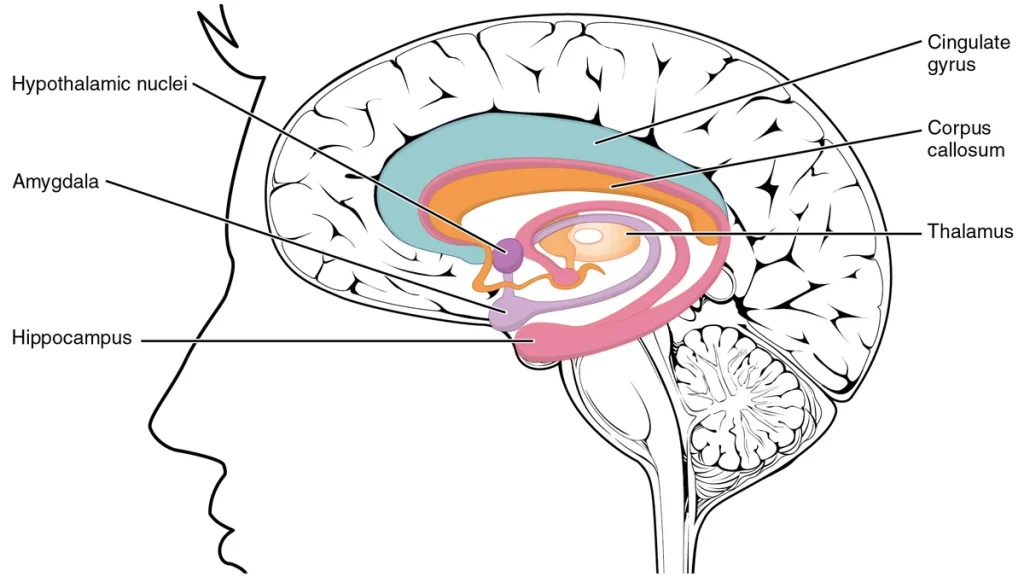
The neurochemistry behind perceived effort is becoming clearer. Adenosine is a metabolic by-product that accumulates in the brain during prolonged physical and mental work. Acting on A1 and A2A receptors, including in the basal ganglia, it dampens dopaminergic signalling and is thought to raise the perceived cost of generating motor commands. This is one plausible contributor to the “heavy legs” feeling late in a long run, alongside peripheral factors.
Caffeine acts largely through this mechanism: it is a competitive antagonist of adenosine receptors. It does not provide fuel; its main effect is to make effort feel cheaper. Taken at 3 to 6 mg/kg about 30 to 60 minutes before exercise, it improves endurance performance by a few percent on average across many studies, a larger effect than most legal nutritional interventions. Dopamine, in turn, fuels motivation: dopaminergic neurons in the ventral tegmental area and nucleus accumbens regulate the willingness to invest effort. Brain serotonin and dopamine have both been implicated in central fatigue, and states such as overtraining and sleep loss are associated with a feeling of heavy, unwilling legs without structural muscle damage (Meeusen et al., 2006).
Self-Talk: 18% Longer with Unchanged Physiology
In a randomised controlled trial, Blanchfield and colleagues (2014) taught participants to use motivational self-talk (“feeling good”, “push through this”) over two weeks. Time to exhaustion in a cycling test at 80% of peak power rose by about 18% (from 637 to 750 seconds), while the control group did not improve; RPE was lower partway through the test, while heart rate was unchanged. The broader meta-analysis by Hatzigeorgiadis and colleagues (2011) found a moderate but consistent effect of self-talk on sport performance (effect size of about 0.48).
Effective self-talk cues are short, personal and planned in advance: “strong legs”, “relax”, “I can do this”, rehearsed in training and timed for the hardest moments. Unrehearsed self-talk is less effective; to be accessible under fatigue, it has to be practised under fatigue. Exercise felt easier not because the body had changed, but because the brain reinterpreted the effort signal.
Deception Studies: Is There a Hidden Reserve?
In a study by Stone and colleagues (2012), trained cyclists completed a 4,000 m time trial while racing against what they believed was a replay of their own best performance. In fact, it had been set 2% faster. The cyclists matched it and produced a higher power output than in their “maximal” baseline effort. When a later study raised the deception to 5%, the riders could no longer keep up. Together these experiments suggest that maximal efforts usually leave a small reserve, regulated by the brain rather than imposed by the muscles.
The finishing sprint points the same way: after hours of slowly declining pace, runners at every level often speed up over the final stretch, which would be hard to explain if the muscles were truly exhausted. Salam and colleagues (2018) reported that mental fatigue did not alter critical power, the sustainable aerobic ceiling, but reduced W′, the finite work capacity above it. A later replication did not reproduce the W′ effect, so this finding should be treated as provisional.
Flow and Brain Endurance Training
Csikszentmihalyi’s flow state, an optimal experience in which challenge and skill are perfectly balanced, has been linked by some researchers to transient hypofrontality: reduced activity in prefrontal regions involved in effortful control. Runners describe “flying” at physiologically demanding paces; whether this reflects a real change in efficiency or mainly a change in perceived effort is still an open question.
Brain endurance training (BET) grew out of Marcora’s model. Demanding cognitive tasks such as the Stroop test or working-memory tasks are added to, or performed alongside, physical training, so that athletes repeatedly work under mental fatigue. Early controlled studies, including some in team-sport and endurance athletes, have reported larger improvements in endurance or repeated-effort performance than physical training alone; the evidence is promising but still limited.
For coaches: treat mental load as part of training load. Demanding cognitive work, travel and poor sleep before a key session can raise perceived effort and reduce output even when physiological markers look normal. Rehearse self-talk cues in hard sessions, use caffeine deliberately rather than habitually, and remember that an athlete’s “maximum” in testing is partly a decision.
Conclusion
Marcora’s 2009 experiment showed one thing clearly: the same muscles, heart and lungs can deliver different performances. The difference lay in the brain. Self-talk can extend endurance without drugs, supplements or equipment. Caffeine loosens the brain’s effort brake without making the muscles stronger. Brain endurance training may offer a further avenue for athletes whose physical training has plateaued. Part of the limit of endurance lies not in the muscles but in the brain, and the brain can be trained.
References
- Marcora, S.M., Staiano, W., & Manning, V. (2009). Mental fatigue impairs physical performance in humans. Journal of Applied Physiology, 106(3), 857-864. https://doi.org/10.1152/japplphysiol.91324.2008
- Noakes, T.D. (2012). Fatigue is a brain-derived emotion that regulates the exercise behavior to ensure the protection of whole body homeostasis. Frontiers in Physiology, 3, 82. https://doi.org/10.3389/fphys.2012.00082
- Meeusen, R., Watson, P., Hasegawa, H., Roelands, B., & Piacentini, M.F. (2006). Central fatigue: the serotonin hypothesis and beyond. Sports Medicine, 36(10), 881-909. https://doi.org/10.2165/00007256-200636100-00006
- Blanchfield, A.W., Hardy, J., De Morree, H.M., Staiano, W., & Marcora, S.M. (2014). Talking yourself out of exhaustion: the effects of self-talk on endurance performance. Medicine & Science in Sports & Exercise, 46(5), 998-1007.
- Hatzigeorgiadis, A., Zourbanos, N., Galanis, E., & Theodorakis, Y. (2011). Self-talk and sport performance: a meta-analysis. Perspectives on Psychological Science, 6(4), 348-356. https://doi.org/10.1177/1745691611413136
- Stone, M.R., Thomas, K., Wilkinson, M., Jones, A.M., St Clair Gibson, A., & Thompson, K.G. (2012). Effects of deception on exercise performance: implications for determinants of fatigue in humans. Medicine & Science in Sports & Exercise, 44(3), 534-541.
- Salam, H., Marcora, S.M., & Hopker, J.G. (2018). The effect of mental fatigue on critical power during cycling exercise. European Journal of Applied Physiology, 118(1), 85-92. https://doi.org/10.1007/s00421-017-3747-1
Related: Mental Fatigue and Physical Performance · The Central Governor: Is Fatigue a Decision?

Hüseyin Akbulut is the founder of Sporeus and author of THRESHOLD (EŞİK), a 540-page Turkish-language book on endurance science.
- 540pp THRESHOLD Book
- MSc Sport Sciences
- Marmara University
Why Does the Brain Interfere with Performance?
Traditional exercise physiology looks for fatigue in the muscle fibres: falling pH, glycogen depletion, impaired calcium release. Tim Noakes's central governor model, developed from the late 1990s and early 2000s, turned this around: the brain continuously monitors signals from the muscles, the cardiovascular system and…
Adenosine, Dopamine and the Cost of Effort
The neurochemistry behind perceived effort is becoming clearer. Adenosine is a metabolic by-product that accumulates in the brain during prolonged physical and mental work. Acting on A1 and A2A receptors, including in the basal ganglia, it dampens dopaminergic signalling and is thought to raise the…
Self-Talk: 18% Longer with Unchanged Physiology
In a randomised controlled trial, Blanchfield and colleagues (2014) taught participants to use motivational self-talk ("feeling good", "push through this") over two weeks. Time to exhaustion in a cycling test at 80% of peak power rose by about 18% (from 637 to 750 seconds), while…
Deception Studies: Is There a Hidden Reserve?
In a study by Stone and colleagues (2012), trained cyclists completed a 4,000 m time trial while racing against what they believed was a replay of their own best performance. In fact, it had been set 2% faster. The cyclists matched it and produced a…
Flow and Brain Endurance Training
Csikszentmihalyi's flow state, an optimal experience in which challenge and skill are perfectly balanced, has been linked by some researchers to transient hypofrontality: reduced activity in prefrontal regions involved in effortful control. Runners describe "flying" at physiologically demanding paces; whether this reflects a real change…