Preview
Hüseyin Akbulut, MSc (2026). Stretching in Football: What the Science Actually Says. Sporeus. Retrieved, October 27, 2026. https://sporeus.com/en/training/stretching-football-static-dynamic-science/
Introduction
Few topics in football coaching are more misunderstood than stretching. Players stretch before matches because they always have. Coaches include stretching because it seems sensible. But the science on stretching has shifted dramatically in the past two decades and some of what most players do before training is not only unhelpful but actively counterproductive. Understanding the real evidence behind different stretching methods changes pre-match preparation in ways that matter for both performance and injury prevention.
Table of Contents
The Science
Stretching falls into three primary categories with very different physiological effects:
Static stretching involves holding a muscle at its end range of motion for 20–60 seconds. It increases range of motion temporarily by reducing muscle stiffness (musculotendinous compliance). However, this reduction in stiffness also reduces the elastic energy storage capacity of muscle-tendon units, impairing the stretch-shortening cycle (SSC) that underpins sprint speed, jump height, and change of direction. Pre-activity static stretching reduces power output by 4–8% for up to 30 minutes post-stretch.
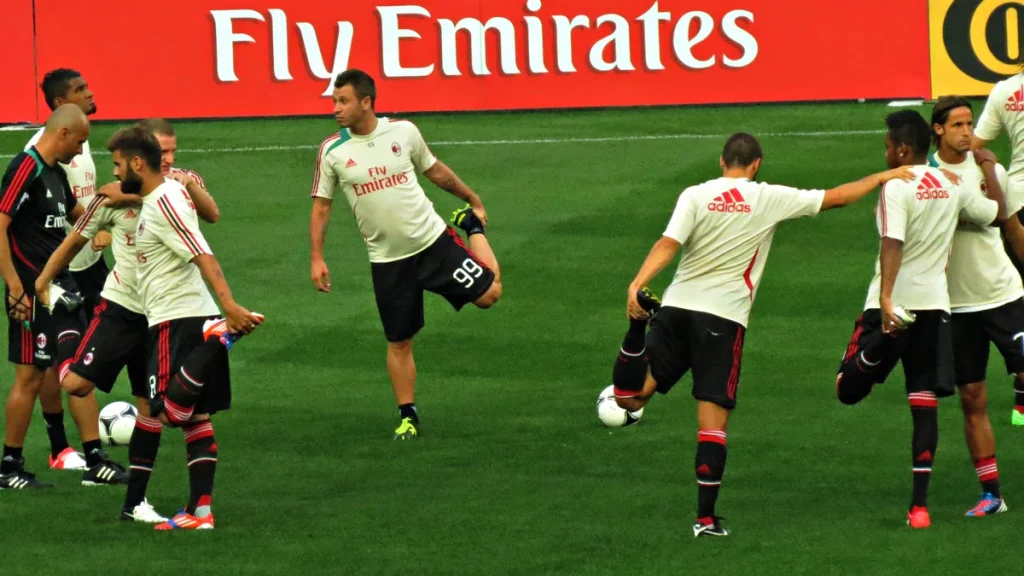
Dynamic stretching involves controlled movements through the full range of motion, leg swings, hip circles, high knees, walking lunges. It raises muscle temperature, activates the neuromuscular system, and maintains stiffness while improving range of motion. It does not impair power output and serves as an effective warm-up component. Dynamic stretching is the appropriate pre-match flexibility tool.
Proprioceptive Neuromuscular Facilitation (PNF) stretching involves cycles of isometric contraction followed by passive stretch. It produces the largest acute gains in range of motion of any stretching method and is best used post-training or in dedicated flexibility sessions. It requires a partner and takes more time than static or dynamic methods.
Flexibility vs mobility is an important distinction. Flexibility refers to passive range of motion in a single joint. Mobility refers to active, controlled movement through a range while maintaining force production. Football demands mobility, not maximal passive flexibility. A player who can perform a box split but cannot control a single-leg landing is flexible but not mobile.
What Research Says
Behm and Chaouachi (2011) published a major systematic review in the European Journal of Applied Physiology synthesising 125 studies on pre-activity stretching. Their conclusion: static stretching durations below 30 seconds cause minimal performance impairment; durations above 60 seconds reliably impair power and sprint output. The recommendation emerging from this review: if static stretching is used pre-match at all, keep individual holds below 30 seconds.
Chaouachi et al. (2010) specifically tested pre-match stretching protocols in trained young footballers and confirmed that a dynamic stretching protocol (leg swings, hip rotations, walking lunges over 12 minutes) produced superior sprint and jump performance compared to a traditional static stretching warm-up. The dynamic group averaged 3.8% faster in 10-metre sprints.
Witvrouw et al. (2004) investigated whether stretching reduced muscle injury rates in professional Belgian footballers over a full season. Contrary to expectation, hamstring flexibility was not a significant predictor of hamstring injury, muscle strength imbalances and previous injury history were stronger predictors. The idea that stretching “prevents” muscle tears has limited direct evidence.
Did You Know? In a 2019 survey of 109 professional clubs in Europe’s top five leagues, over 60% still used static stretching as part of their pre-match warm-up routine, despite two decades of research showing dynamic warm-up is superior for performance. The gap between science and practice in football is real, even at the highest levels.
Applied to Football
Translating the evidence into practical warm-up and recovery protocols:
- Replace static with dynamic pre-match. Leg swings, hip circles, walking knee hugs, reverse lunges with rotation, and progressive sprint buildups prepare the neuromuscular system without impairing power output.
- Save static stretching for post-training. Holding stretches for 30–60 seconds after a session, when muscle temperature is high and recovery has begun, is effective for developing long-term flexibility without performance cost.
- PNF for mobility development. Players with specific range-of-motion limitations (hip flexors, hamstrings, ankle dorsiflexion) benefit from PNF sessions 2–3 times per week as part of recovery protocols, not pre-match preparation.
- Strength and control, not passive flexibility. Target hip strength (glutes, abductors) and single-leg balance rather than hamstring flexibility alone for injury resilience. The muscle needs to control the range, not just achieve it.
- Short static holds are not catastrophic. A 15–20 second hold as part of a longer dynamic warm-up is unlikely to significantly impair performance. The concern is with prolonged, dedicated static stretching sessions (10+ minutes) immediately before play.
In Short
- Static stretching before play reduces power output by 4–8%, counterproductive before sprint and explosive actions
- Dynamic stretching raises temperature and activates the neuromuscular system without impairing performance
- Save long static stretching for post-training recovery sessions
- Flexibility (passive range) matters less than mobility (active, controlled range) for football performance
- Muscle strength imbalances, not poor flexibility, are the stronger predictors of hamstring injury
References
- Behm, D. G., & Chaouachi, A. (2011). A review of the acute effects of static and dynamic stretching on performance. European Journal of Applied Physiology, 111(11), 2633–2651.
- Chaouachi, A., Castagna, C., Chtara, M., Brughelli, M., Turki, O., Galy, O., … & Behm, D. G. (2010). Effect of warm-ups involving static or dynamic stretching on agility, sprinting, and jumping performance in trained individuals. Journal of Strength and Conditioning Research, 24(8), 2001–2011.
- Witvrouw, E., Mahieu, N., Danneels, L., & McNair, P. (2004). Stretching and injury prevention: an obscure relationship. Sports Medicine, 34(7), 443–449.
Next in Series: Heart Rate Variability: The Morning Number That Tells You Everything
Discuss this in the forum: Do runners and cyclists need a daily mobility routine? · Static stretching before a session?

Hüseyin Akbulut is the founder of Sporeus and author of THRESHOLD (EŞİK), a 540-page Turkish-language book on endurance science.
- 540pp THRESHOLD Book
- MSc Sport Sciences
- Marmara University
Introduction
Few topics in football coaching are more misunderstood than stretching. Players stretch before matches because they always have. Coaches include stretching because it seems sensible. But the science on stretching has shifted dramatically in the past two decades and some of what most players do…
The Science
Stretching falls into three primary categories with very different physiological effects:
What Research Says
Behm and Chaouachi (2011) published a major systematic review in the European Journal of Applied Physiology synthesising 125 studies on pre-activity stretching. Their conclusion: static stretching durations below 30 seconds cause minimal performance impairment; durations above 60 seconds reliably impair power and sprint output. The…
Applied to Football
Translating the evidence into practical warm-up and recovery protocols: