Preview
Hüseyin Akbulut, MSc (2026). The Most Common Football Injuries — And the Science of Why They Happen. Sporeus. Retrieved, September 25, 2026. https://sporeus.com/en/injury/common-football-injuries-science-causes/
Introduction
Professional football clubs lose an average of 30–50 player days per player per season to injury. In a squad of 25, this means the equivalent of approximately 5 players being absent at any given time. Injury is not random — it follows predictable patterns driven by biomechanics, physiology, and workload management. Understanding which injuries dominate in football, why they occur, and what the evidence says about prevention transforms the way intelligent coaches and players approach the game.
Table of Contents
The Science
Large-scale epidemiological studies — most notably the UEFA Elite Club Injury Study, running continuously since 2001 — allow injury patterns to be mapped across elite European football with high statistical confidence. The key injury categories:
Hamstring strains are the most common injury in football, accounting for 17–23% of all time-loss injuries in elite clubs. They occur predominantly during high-speed running (the late-swing phase, when the hamstring decelerates the extending leg) and during explosive sprint accelerations. Risk factors: previous hamstring injury, strength asymmetry between limbs, fatigue in the final 15 minutes of matches, insufficient eccentric strength.
Ankle sprains are the most common acute (contact and non-contact) injury. The lateral ankle complex — particularly the anterior talofibular ligament (ATFL) — is most commonly affected when the foot lands in supination (inverted). They are frequent on uneven or artificial surfaces, during tackling, and during aerial landings.
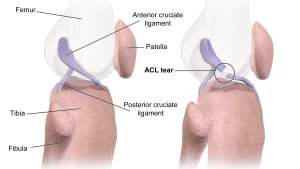
ACL injuries are less frequent but the most severe in terms of time lost — average return to play is 8–12 months. The ACL is most commonly torn via non-contact mechanisms: planting and cutting, landing from a jump, or sudden deceleration. Female players have 2–6 times higher ACL injury rates than male players due to differences in anatomical alignment, hormonal influences, and neuromuscular control patterns.
Groin/adductor strains account for 10–15% of muscle injuries, most common in positions requiring repeated cutting and lateral acceleration (wide players, full-backs). Hip adductor weakness relative to abductor strength is a key modifiable risk factor.
Overuse injuries — patellar tendinopathy, Achilles tendinopathy, shin splints — accumulate through high training loads without adequate recovery. They are particularly common in pre-season and during fixture congestion.
What Research Says
Ekstrand et al. (2011) published the definitive UEFA Club Injury Study data in British Journal of Sports Medicine, analysing 24 clubs over 8 seasons (2001–2009) and documenting 4,983 injuries across 67,173 player hours of exposure. Hamstring injuries alone cost clubs an average of 15 days per injury. Recurrence rate was 16% — high enough to identify inadequate rehabilitation as a systemic failure across European football.
Meeuwisse et al. (2007) proposed the widely-used dynamic, recursive model of injury causation, arguing that injury risk is not static — it changes based on cumulative exposure, recovery status, and the interaction between predisposing factors and inciting events. This model shifted sports medicine from a risk-factor checklist to a continuous, adaptive risk management framework.
Hewett et al. (1999) published landmark data on ACL injury prevention through neuromuscular training in female athletes, showing that a 6-week jump landing programme reduced ACL injury rates by 67%. This was the foundation for the FIFA 11+ and numerous subsequent protocols demonstrating that non-contact ACL injuries are partially preventable.
Did You Know? The most expensive single line in a professional football club’s medical budget is not surgical procedures or physiotherapy — it is wage costs during injury absence. A player earning €50,000 per week who misses 16 weeks with an ACL tear costs the club €800,000 in wages alone, before medical fees, lost squad contribution, or transfer replacement costs.
Applied to Football
Evidence-based injury prevention integrates into normal training without disrupting football sessions:
- Nordics for hamstrings. The Nordic hamstring curl exercise — isometric and eccentric loading of the hamstring — reduces hamstring injury rates by 51% in players who perform it consistently (Petersen et al., 2011). Ten reps, twice per week, in the warm-down. It is the most evidence-supported single exercise in football injury prevention.
- Balance training for ankles. Single-leg balance work and proprioceptive board training reduce ankle sprain recurrence by 35–50%. Simple, equipment-free, implementable in any facility.
- Adductor strengthening for groin. The Copenhagen adductor exercise, performed 3 sets per week, reduces groin strain incidence by up to 41% in systematic review data.
- Load management prevents overuse. Monitoring weekly HSR distance and limiting spikes above 1.5× the 4-week average is the most effective strategy against tendinopathy and bone stress injuries.
- Previous injury is the strongest predictor. A player returning from hamstring, ankle, or ACL injury requires individualized load management and progressive return protocols — not a one-size timeline.
- Hamstring strains are the most common injury in football; ACL tears the most severe
- Fatigue, previous injury, and strength imbalances are the dominant modifiable risk factors
- Nordic curls reduce hamstring injuries by 51%; FIFA 11+ reduces ACL risk by up to 50%
- Non-contact injuries are largely preventable through targeted neuromuscular training
- Workload management — particularly ACWR control — is the primary tool against overuse injuries
- Ekstrand, J., Hägglund, M., & Waldén, M. (2011). Injury incidence and injury patterns in professional football. British Journal of Sports Medicine, 45(7), 553–558.
- Hewett, T. E., Lindenfeld, T. N., Riccobene, J. V., & Noyes, F. R. (1999). The effect of neuromuscular training on the incidence of knee injury in female athletes. American Journal of Sports Medicine, 27(6), 699–706.
- Petersen, J., Thorborg, K., Nielsen, M. B., Budtz-Jørgensen, E., & Hölmich, P. (2011). Preventive effect of eccentric training on acute hamstring injuries in men’s soccer. American Journal of Sports Medicine, 39(11), 2296–2303.
Key Takeaways
References
—
Next in Series: Article 19 — Youth Football Development — What Science Says About the Right Age to Train Hard
Introduction
Professional football clubs lose an average of 30–50 player days per player per season to injury. In a squad of 25, this means the equivalent of approximately 5 players being absent at any given time. Injury is not random — it follows predictable patterns driven…
The Science
Large-scale epidemiological studies — most notably the UEFA Elite Club Injury Study, running continuously since 2001 — allow injury patterns to be mapped across elite European football with high statistical confidence. The key injury categories:
What Research Says
Ekstrand et al. (2011) published the definitive UEFA Club Injury Study data in British Journal of Sports Medicine, analysing 24 clubs over 8 seasons (2001–2009) and documenting 4,983 injuries across 67,173 player hours of exposure. Hamstring injuries alone cost clubs an average of 15 days…
Applied to Football
Evidence-based injury prevention integrates into normal training without disrupting football sessions: