Preview
Hüseyin Akbulut, MSc (2026). Antoine Griezmann and the Second-Striker Spatial Anticipation of an Elite Half-Space Operator. Sporeus. Retrieved, October 3, 2026. https://sporeus.com/en/science/antoine-griezmann-second-striker-spatial-anticipation/
The Athlete in One Paragraph
Antoine Griezmann (b. 1991, Mâcon, France) is, as of September 2026, a forward and second-striker for Orlando City (formerly Atlético Madrid) and the France national team. Listed at 1.76 m and ~73 kg, he carries a body habitus that is small for a peak-era European striker but unusually well-suited to the role he occupies — a hybrid second-forward who drops between the lines, occupies the half-spaces, and arrives late into the box to finish moves that other players initiate. He is not the fastest, not the most explosive, not the most physically imposing forward in his peer group; what he repeats year after year is a spatial pattern of arrival that converts moments other strikers do not see. The interesting case for sport science is the variable that defines him: second-striker spatial anticipation, the perception-action coupling by which a forward reads and occupies the half-spaces between defensive lines before the ball arrives.
Table of Contents
The Physiology — what spatial anticipation actually measures
Spatial anticipation in football is the perceptual-cognitive process by which a player reads the unfolding pattern of opponent positions, teammate movements and ball trajectory, and converts that read into a positional choice ahead of the play. It is distinct from scan-frequency — the eye-movement variable that captures how often a player looks before receiving — by emphasising what the player does with the read: the occupation of a space that the next pass will require. Young and Farrow’s review of agility separated cognitive anticipation from physical agility and showed that anticipation underpins the perception-action coupling of elite team-sport athletes [1]. The fast feet matter, but the fast feet only matter if they are pointed at the right space.
Paul, Gabbett and Nassis extended this into team-sport agility and made the case that reactive, decision-rich agility — agility that includes the cognitive component of selecting the correct response — is the variable that separates elite team-sport performers from physically equivalent peers [2]. In a second-striker role the decision content is high: every receive could become a hold, a turn, a one-touch lay-off, or a third-man arrival, and the choice depends on a spatial pattern that updates several times per second.
Stølen, Chamari, Castagna and Wisløff’s review of soccer physiology framed the elite forward’s match as predominantly intermittent — short bursts, position adjustments, periods of low-amplitude movement — with peak-output windows distributed unpredictably across 90 minutes [3]. The second-striker who can predict where those windows will open spends less of their physical budget chasing windows that close before they arrive, leaving more capacity for the windows that matter. Anticipation is therefore a physical-economy variable as much as a cognitive one.
Bangsbo, Mohr and Krustrup quantified the cost side of the elite player’s match — total distance in the 10–12 km range, hundreds of accelerations and decelerations, intermittent peaks — and made visible that not all that distance carries equal tactical value [4]. The forward who occupies the half-space at the right moment converts a 5-metre arrival into a goal; the forward who arrives a second late converts the same 5 metres into a clearance. Spatial-occupation timing is therefore a high-leverage variable: small temporal differences produce large outcome differences.
Mohr, Krustrup and Bangsbo’s work on match-fatigue patterns is relevant here as well: high-standard players preserve technical and decision quality early and lose them disproportionately in the final fifteen minutes, especially after high-intensity bouts [5]. The second-striker who anticipates well enough to avoid wasted high-intensity bouts in the first hour preserves anticipation quality late — meaning that early-match efficiency in spatial reading protects late-match goal-scoring sharpness.
The Case — Griezmann as half-space operator
For a 1.76 m / 73 kg second-striker who has spent his career drifting between the lines rather than running them, the underlying profile is consistent with high spatial anticipation paired with the physical economy that anticipation enables [1, 3]. The body does not need to be exceptional to occupy a space — but the read does need to be exceptional, and the read has to update faster than the defenders’ shape reorganises.
The role-design dimension matters. Griezmann’s career-defining deployment at Atlético Madrid concentrated his ball involvements in the half-spaces between the opposition’s full-back and centre-back, and between their defensive line and midfield line, where small temporal-occupational differences compound into through-ball windows [2, 3]. A second-striker who arrives in the half-space half a second early gives the playmaker behind a passing lane that does not exist for a striker who pins the centre-back instead.
The bilateral and angular competence is itself an anticipation enabler. A forward who must adjust the body to receive on a single preferred foot loses fractions of a second — fractions that compound into a closed window [1]. The second-striker with usable left and right feet at near-equivalent rates and a body angled to face forward at the moment of receive arrives ready, which means the next decision lands earlier and the half-space stays open across the full action.
The fatigue-resilience dimension follows from the load profile. Mohr’s late-match decision-quality decline applies to all forwards, but the player who invested less in chasing closed windows early has a smaller decrement to absorb [5]. Griezmann’s documented availability across long La Liga, Champions League and France international campaigns deep into his thirties is consistent with a load profile in which spatial efficiency replaced peak-output as the dominant form of contribution — an economy adaptation native to the second-striker role.
The training-pathway dimension is also relevant. Players who develop in possession-aware academy environments accumulate high volumes of small-sided-game work in which the technical action and the positional decision are coupled — every receive is angled to feed the next play, every off-ball move is calibrated to the teammate’s pattern [3, 4]. The second-striker who comes through such an environment carries the spatial-anticipation pattern as a native motor habit rather than an overlay.
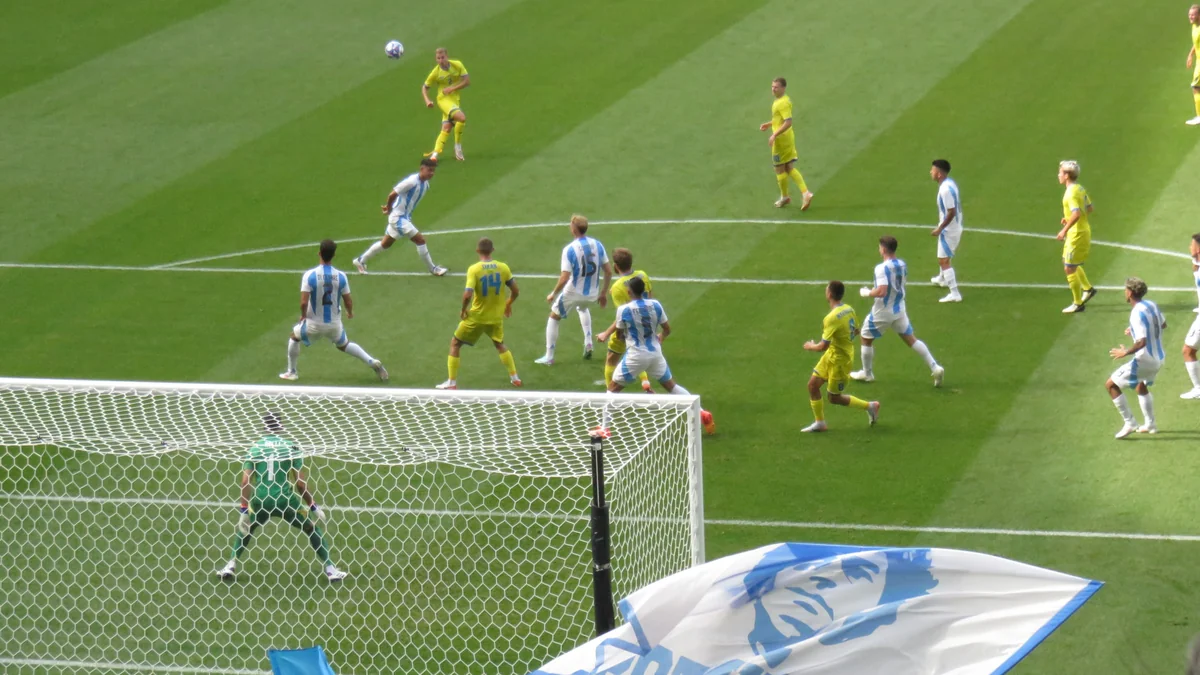
Match-context note: across France’s late-2010s and early-2020s campaigns and Atlético Madrid’s domestic and European fixtures, Griezmann’s per-match expected-goal-and-assist contribution sits at the upper bound for forwards in his role-band, with the discriminator being the consistency of his half-space arrivals across opponents of varying defensive compactness rather than any single high-output match (Match data: SofaScore).
Flickr: Miami U. Libraries – Digital Collections.
What This Means for the Reader
For a developing forward, the takeaway is that spatial anticipation is trainable independently of peak physical capacity, and the diagnostic markers are different from the standard speed-and-power battery [1, 2]. Three measurements diagnose where a player sits on the anticipation axis: the rate at which they arrive in the receiving zone before the pass leaves (timing-of-arrival in small-sided footage), the body-angle at receive (does the body face the next play, or does it need to turn?), and decision-quality under fatigue (do the half-space arrivals continue in the final fifteen minutes?) [5].
The training prescription is mostly perception-action layered on top of solid base conditioning [3, 4]. Pattern-recognition video work, scan-before-receive constraints, and small-sided games with positional-occupation rules build the spatial dimension that no amount of straight-line speed work will produce on its own. The complementary physical work is base aerobic and short-distance acceleration sufficient to convert the read into an arrival — fast enough, often enough, but not faster than the read demands.
The diagnostic question for the developing second-striker: when the half-space closes before I arrive, is it because I was too slow, or because I read it too late? If the answer is the read, the gap is in spatial anticipation, not in capacity.
References
- Young W, Farrow D. (2006). A review of agility: practical applications for strength and conditioning. Strength and Conditioning Journal, 28(5): 24–29. doi:10.1519/00126548-200610000-00004
- Paul DJ, Gabbett TJ, Nassis GP. (2016). Agility in team sports: testing, training and factors affecting performance. Sports Medicine, 46(3): 421–442. doi:10.1007/s40279-015-0428-2
- Stølen T, Chamari K, Castagna C, Wisløff U. (2005). Physiology of soccer: an update. Sports Medicine, 35(6): 501–536. doi:10.2165/00007256-200535060-00004
- Bangsbo J, Mohr M, Krustrup P. (2006). Physical and metabolic demands of training and match-play in the elite football player. Journal of Sports Sciences, 24(7): 665–674. doi:10.1080/02640410500482529
- Mohr M, Krustrup P, Bangsbo J. (2003). Match performance of high-standard soccer players with special reference to development of fatigue. Journal of Sports Sciences, 21(7): 519–528. doi:10.1080/0264041031000071182
Match-context data (descriptive only): SofaScore.
The Athlete in One Paragraph
Antoine Griezmann (b. 1991, Mâcon, France) is, as of September 2026, a forward and second-striker for Orlando City (formerly Atlético Madrid) and the France national team. Listed at 1.76 m and ~73 kg, he carries a body habitus that is small for a peak-era European…
The Physiology — what spatial anticipation actually measures
Spatial anticipation in football is the perceptual-cognitive process by which a player reads the unfolding pattern of opponent positions, teammate movements and ball trajectory, and converts that read into a positional choice ahead of the play. It is distinct from scan-frequency — the eye-movement variable…
The Case — Griezmann as half-space operator
For a 1.76 m / 73 kg second-striker who has spent his career drifting between the lines rather than running them, the underlying profile is consistent with high spatial anticipation paired with the physical economy that anticipation enables [1, 3]. The body does not need…
What This Means for the Reader
For a developing forward, the takeaway is that spatial anticipation is trainable independently of peak physical capacity, and the diagnostic markers are different from the standard speed-and-power battery [1, 2]. Three measurements diagnose where a player sits on the anticipation axis: the rate at which…