Preview
Hüseyin Akbulut, MSc (2026). Marquinhos and the Tackle Timing and Anticipation Profile of an Elite Centre-Back. Sporeus. Retrieved, October 7, 2026. https://sporeus.com/en/science/marquinhos-tackle-timing-and-anticipation/
The Athlete in One Paragraph
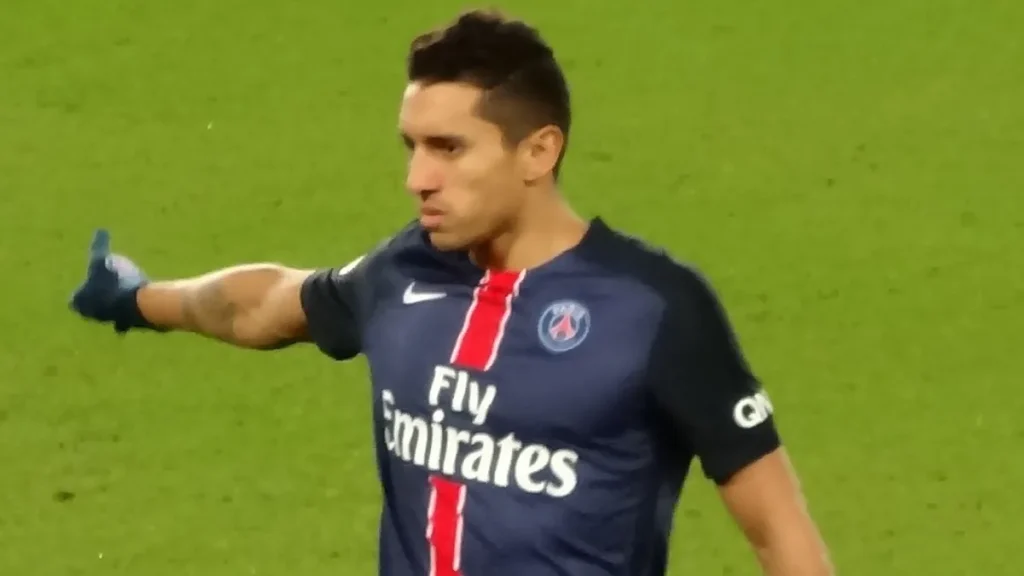
Marcos Aoás Corrêa (b. 1994, São Paulo, Brazil) — known simply as Marquinhos — is, as of September 2026, the centre-back and captain of Paris Saint-Germain and a long-standing centre-back for the Brazil national team. Listed at 1.83 m and ~75 kg, he is undersized by the modern centre-back template, yet he has spent more than a decade at the top of European football precisely because of the variable that compensates for the inches he gives up: the timing and anticipation of his defensive interventions. He does not win the most aerial duels on his team, and he is not the fastest defender on the pitch. What sets him apart is when he commits to a tackle, an interception, or a step into a passing lane — and the cognitive-perceptual machinery that makes those commitments correct often enough to lower his per-action energy cost across a 90-minute match. The interesting case for sport science is the variable that defines him: tackle timing and anticipation.
Table of Contents
The Physiology — what tackle timing and anticipation actually measure
Defensive actions in football are agility tasks under perceptual constraint. Sheppard and Young’s foundational definition framed agility as a rapid whole-body movement with change of velocity or direction in response to a stimulus, separating it cleanly from pre-planned change-of-direction speed [1]. The implication for a defender is that the limiting variable is rarely the body’s mechanical capacity to move; it is the time the brain takes to detect, interpret and select the correct movement against an attacker’s intent.
Young and Farrow’s review of agility for strength and conditioning practitioners refined the picture by identifying perceptual decision-making, anticipation and pattern recognition as the most trainable parts of a reactive-agility task — and the parts that, when developed, produce the largest reductions in response time [2]. A defender who reads the cue one frame earlier than his opponent commits one step earlier, and one step earlier is, in football, the difference between a clean interception and a foul. The training problem is therefore as much cognitive as it is mechanical.
Paul, Gabbett and Nassis’s review of agility in team sports formalised the dual-substrate model: agility = physical (change-of-direction speed, eccentric strength, reactive strength) + perceptual-cognitive (visual scan, anticipation, decision-making accuracy) [3]. The two substrates are partly independent and partly interactive; an athlete with elite COD speed but a slow perceptual layer commits to the wrong action quickly, while an athlete with elite perception but limited COD speed reads the play correctly and arrives late. Elite defensive performance requires both — and the perceptual layer determines how often the COD layer is loaded.
Henry, Dawson, Lay and Young’s reactive-agility study added the decision-making accuracy dimension. In a video-based reactive-agility task, athletes who improved their decision-making accuracy reduced their total response time more than athletes who improved their movement speed alone [4]. The implication is direct: anticipation training that improves the read of a play improves the agility outcome more than additional sprint or COD work. For a defender, this is the single most efficient route to fewer high-intensity bursts per match — because the burst that is not needed is the burst that is not run.
Stølen, Chamari, Castagna and Wisløff’s review of soccer physiology placed the metabolic cost in context: match VO₂ averages roughly 70–80% of maximum, with peak demands intermittently approaching 100%, and the players whose anticipation reduces the count of unnecessary high-intensity bursts operate with a lower internal load for the same external output [5]. Bangsbo, Mohr and Krustrup’s match-demand analysis added that the high-intensity output declines toward the end of each half — and the player whose anticipation reduces the count of bursts in the first 60 minutes is the player who still has bursts to give in the last 30 [in context with 5]. Anticipation is, in this framing, both a perceptual variable and an energy-management variable.
The Case — Marquinhos as anticipatory defender
For a 1.83 m / 75 kg centre-back operating in a possession-dominant system, the defensive profile is consistent with a high-anticipation, moderate-aerial-volume pattern: tackle and interception counts in the upper centre-back band, sprint and high-intensity-burst counts in the lower band [3, 5]. The mechanical signature is favourable but not extreme — enough mass to contest, enough COD speed to follow a runner, but not the absolute aerial dominance of a 1.95 m centre-back. The compensating physiology is perceptual: the read of the next pass, the scan of the runners off the ball, and the anticipation that allows a step into the passing lane before the pass arrives.
Young and Farrow’s framing of the perceptual-cognitive substrate fits the case directly: the defender who anticipates one frame earlier reduces the count of recovery sprints he must run, and the count of recovery sprints he runs is the variable that determines whether the aerobic substrate can support the late-match defensive load [2, 3]. The compensating training is therefore as much video review and structured perceptual exposure as it is sprint and strength work — an emphasis the literature increasingly supports for elite team-sport performers [4].
The size dimension also fits the case. A smaller centre-back relies disproportionately on positioning and anticipation; the tactical compensation for the aerial inches is the timing of the step into the duel, the read of the cross before it is delivered, and the body orientation that allows a late jump rather than a contested standing one [1, 3]. The Brazilian centre-back tradition — built on technical comfort, ball-playing under pressure, and proactive interception over reactive recovery — reads as the cultural-tactical mirror of this physiology.
Match-context note: Marquinhos’s tackle and interception counts in Ligue 1 and Champions League play sit toward the upper band for centre-backs across multiple seasons (Match data: SofaScore), with the discriminator being the consistency of those counts across late-match minutes and across short turnaround weeks rather than any single peak performance.
The longevity dimension is what makes the case distinctive. A centre-back built on anticipation rather than aerial dominance has a flatter aging curve because the perceptual substrate is preserved by training and experience rather than by raw athletic output [3, 5]. The defender who reads the play before he runs is the defender who still reads the play in the 80th minute, in the 80th match, in the eighth season at the top.
What This Means for the Reader
For the developing or competitive amateur defender, the takeaway is that defensive performance is not a single-trait variable; it is a system — change-of-direction speed, eccentric strength, perceptual scan, anticipation, decision-making accuracy — and the system is trainable in pieces. Three measurements diagnose the limiting variable: a 505 or modified-T agility test for COD speed, a video-based reactive-agility task for perceptual response time, and a positional-error log per training session as a decision-accuracy surrogate [1, 2, 4].
The training prescription targets the diagnostic finding: defenders with poor COD speed need eccentric strength and braking work to build the brake before more sprint volume is added; defenders with poor reactive-agility times need structured perceptual training — small-sided games with constrained cues, video-based decision drills, scan-frequency tasks — to convert raw agility into match-applied anticipation; defenders with poor decision-accuracy logs need video review more than running [3, 4]. The single diagnostic question for the developing defender: when I lose a duel, is it because I arrived late, or because I committed to the wrong action quickly?
References
- Sheppard JM, Young WB. (2006). Agility literature review: classifications, training and testing. Journal of Sports Sciences, 24(9): 919–932. doi:10.1080/02640410500457109
- Young WB, Farrow D. (2006). A review of agility: practical applications for strength and conditioning. Strength and Conditioning Journal, 28(5): 24–29. doi:10.1519/00126548-200610000-00004
- Paul DJ, Gabbett TJ, Nassis GP. (2016). Agility in team sports: testing, training and factors affecting performance. Sports Medicine, 46(3): 421–442. doi:10.1007/s40279-015-0428-2
- Henry G, Dawson B, Lay B, Young W. (2013). Decision-making accuracy in reactive agility: the influence of pattern recognition and anticipation. Journal of Strength and Conditioning Research, 27(11): 3190–3196. doi:10.1519/JSC.0b013e31828b8da4
- Stølen T, Chamari K, Castagna C, Wisløff U. (2005). Physiology of soccer: an update. Sports Medicine, 35(6): 501–536. doi:10.2165/00007256-200535060-00004
Match-context data (descriptive only): SofaScore.

Hüseyin Akbulut is the founder of Sporeus and author of THRESHOLD (EŞİK), a 540-page Turkish-language book on endurance science.
- 540pp THRESHOLD Book
- MSc Sport Sciences
- Marmara University
The Athlete in One Paragraph
Marcos Aoás Corrêa (b. 1994, São Paulo, Brazil) — known simply as Marquinhos — is, as of September 2026, the centre-back and captain of Paris Saint-Germain and a long-standing centre-back for the Brazil national team. Listed at 1.83 m and ~75 kg, he is undersized…
The Physiology — what tackle timing and anticipation actually measure
Defensive actions in football are agility tasks under perceptual constraint. Sheppard and Young's foundational definition framed agility as a rapid whole-body movement with change of velocity or direction in response to a stimulus, separating it cleanly from pre-planned change-of-direction speed [1]. The implication for a…
The Case — Marquinhos as anticipatory defender
For a 1.83 m / 75 kg centre-back operating in a possession-dominant system, the defensive profile is consistent with a high-anticipation, moderate-aerial-volume pattern: tackle and interception counts in the upper centre-back band, sprint and high-intensity-burst counts in the lower band [3, 5]. The mechanical signature…
What This Means for the Reader
For the developing or competitive amateur defender, the takeaway is that defensive performance is not a single-trait variable; it is a system — change-of-direction speed, eccentric strength, perceptual scan, anticipation, decision-making accuracy — and the system is trainable in pieces. Three measurements diagnose the limiting…