Preview
Emre Köse (2026). Aryna Sabalenka and the Power-Baseliner WTA Shot Velocity of an Elite Tennis Player. Sporeus. Retrieved, October 11, 2026. https://sporeus.com/en/science/aryna-sabalenka-power-baseliner-wta-shot-velocity/
The Athlete in One Paragraph
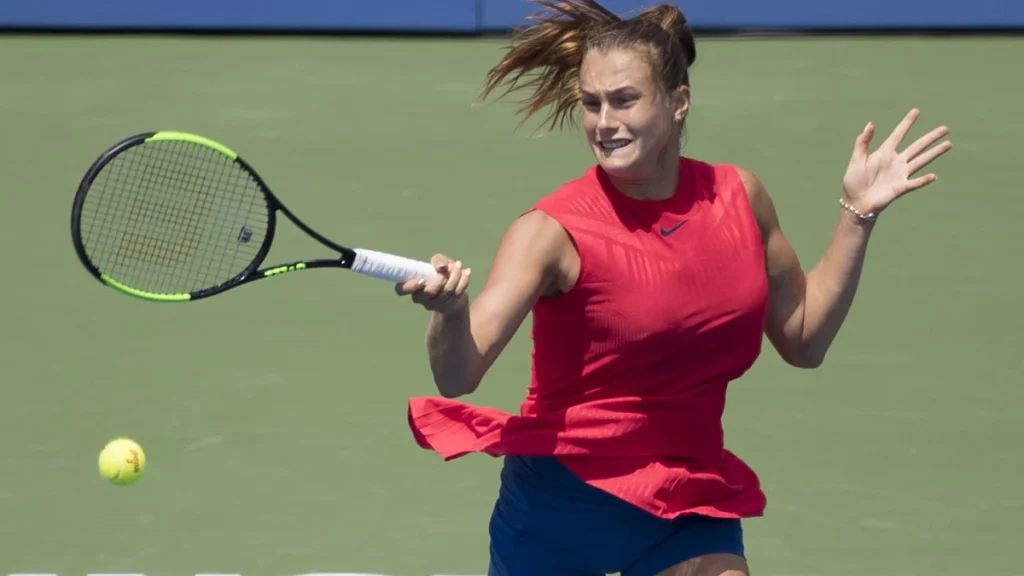
Aryna Siarhiejeŭna Sabalenka (b. 1998-05-05, Minsk, Belarus) is a multi-Grand-Slam-champion WTA professional and a defining modern reference point for the power-baseliner archetype on the women’s tour. Listed at 1.82 m and ~80 kg — tall, broad-shouldered, lower-body and trunk-loaded relative to the WTA divisional norm — she carries an anthropometry that has been engineered into one of the highest serve and groundstroke velocity profiles on the tour. The interesting case for sport science is not any single ace or any single forehand winner but the underlying neuromuscular question: what does a tall-frame, power-baseliner WTA shot-velocity profile actually rest on, and how does the maximal-strength substrate, the rapid force production layer, and the kinetic-chain transfer translate the structural advantage of frame and limb-length into measurable racket-head and ball velocities at the service line and from the back of the court? The answer lives in the literature on maximal strength, neuromuscular power, and reactive-strength expression — not in court-coverage or rally-pattern angles, which describe a different game.
Table of Contents

The Physiology — what power-baseliner WTA shot velocity actually is
Wisløff and colleagues’ foundational study on the relationship between maximal squat strength and explosive lower-body output established the upstream variable for ballistic sport: the squat-strength substrate scales with sprint and vertical-jump capacity, and the same neuromuscular substrate underwrites the lower-body drive that initiates a tennis serve and the open-stance forehand [1]. For a tall power-baseliner, the lower-body force base is the ground from which the kinetic chain accelerates upward through trunk rotation and into the arm and racket; without the base, the chain is rate-limited at the legs.
Cormie, McGuigan and Newton’s review of maximal neuromuscular power formalises the second layer [2]. Maximal force expressed slowly is necessary but not sufficient for ballistic output; the rate of force development — how quickly that force can be expressed against time — is what governs racket-head speed at impact. The training prescription is well established: heavy strength work raises the force ceiling, and ballistic and weighted-jump work raises the rate of force development; together they raise the area under the force-time curve that ballistic sport requires.
Stølen, Chamari, Castagna and Wisløff’s intermittent-sport synthesis adds the work-and-recovery context [3]. Tennis is repeated short bursts against an aerobic refill, and the power output of the eighth serve has to look like the power output of the second; the upstream maximal-strength substrate matters less if the aerobic refill cannot defend it across the match. The integrated profile — strength base, rate-of-force-development layer, aerobic refill — is what produces the shot-velocity stability the WTA top tier requires across two-and-three-set matches.
Bangsbo, Mohr and Krustrup’s account of intermittent metabolic demand sits underneath that [4]. The high-intensity ballistic actions are repeated against an aerobic background, and the sub-maximal recovery between actions is itself the rate-limiting step for the next action; the player whose refill is faster keeps her ballistic profile intact for longer. For a power-baseliner whose tactical signature is to end points early but who still has to defend ballistic output when points extend, this rate-limit is where shot-velocity decay first shows up.
Sheppard and Young’s framework on agility — the closed-skill change-of-direction layer underneath open-skill reactive agility — adds the lateral-loading context that the power-baseliner pays to express her shot-velocity profile [5]. The serve and the groundstroke do not happen in isolation; they happen after a deceleration, a recovery step, or a stance reset, and the eccentric-loading capacity that survives that sequence is part of what keeps the velocity profile intact in the late game. The takeaway is that power-baseliner shot velocity is a kinetic-chain problem layered on a maximal-strength substrate and protected by an aerobic refill — not a single-variable expression of frame.
The Case — Sabalenka as power-baseliner velocity exemplar
For a 1.82 m / ~80 kg WTA player whose tactical signature is first-strike tennis ended by ballistic forehand and serve output, the underlying profile is consistent with a maximal-strength substrate, a rate-of-force-development layer, and a kinetic-chain efficiency that hold up across grand-slam-distance match work [1, 2]. The visible elements of her game — the high-percentage first-serve velocity at the upper end of the WTA distribution, the open-stance forehand that ends rallies before they reach attritional length, the willingness to take the ball early on the rise from the back of the court — map onto exactly the variables the literature identifies as the kinetic-chain expression of a tall, power-loaded frame.
The frame-and-power loading is the structural variable. A WTA player at 1.82 m carries a longer effective lever from shoulder to racket-head, and a longer lever produces a higher tip velocity for a given angular velocity at the shoulder; the kinetic-chain that drives that angular velocity has to be capable of expressing maximal force quickly enough to make the lever an asset rather than a liability [1, 2]. The lower-body and trunk loading associated with the WTA-top first-serve velocity profile is what makes the long lever an asset.
The under-discussed dimension is the rate-of-force-development layer. Cormie’s framework distinguishes maximal strength from ballistic power and shows that the training stimulus is different — heavy lifts develop the force ceiling, weighted-jump and medicine-ball work develop the rate at which force can be expressed [2]. A power-baseliner who develops only the maximal-strength layer produces a heavy ball but loses the late-rally rate-of-force-development the long match demands; a power-baseliner who develops only the ballistic layer hits hard for one set and not three.
The intermittent-recovery layer is the third differentiator. Stølen and Bangsbo together describe the aerobic refill that defends ballistic output across repeated work-bouts; on a fast surface where rallies stay short the refill is forgiving, and on a slower surface where rallies extend the refill is the rate-limiting step for shot-velocity stability [3, 4]. The power-baseliner whose first serve looks the same in the third set as in the first has paid for that stability with the aerobic substrate underneath the ballistic profile.
(Match data: WTA / ITF) Across her grand-slam record, Sabalenka’s first-serve velocity, forehand groundstroke speed, and unreturned-serve percentage have sat at or near the upper end of the WTA distribution; the discriminator at the top of the tour is not peak velocity in any one shot but the stability of that velocity across the match.
What This Means for the Reader
For the developing tennis player working toward a power-baseliner profile, the lesson is that shot velocity is not a single training variable; it is a kinetic-chain expression of a maximal-strength base, a rate-of-force-development layer, and an aerobic refill that defends both [1, 2, 3, 4]. The athlete who trains only the swing produces an early-rally weapon that decays; the athlete who trains the chain produces a weapon that survives the match.
Practical assessment for amateurs: track three indicators across a training block — a maximal-strength reference (a properly supervised back-squat or trap-bar deadlift one-rep max progression), a ballistic reference (a vertical-jump or medicine-ball-throw test with peak velocity as the variable of interest), and a repeated-effort reference (multiple service-game-simulation sets with the late-set serve velocity measured). Drift in any one is the early signal that one layer is leading or lagging the others [5].
The diagnostic question for the developing power-baseliner: is my third-set serve velocity within a small percentage of my first-set serve velocity, and if not, is the leak coming from the legs, from the rate of force development, or from the refill?
References
- Wisløff U, Castagna C, Helgerud J, Jones R, Hoff J. (2004). Strong correlation of maximal squat strength with sprint performance and vertical jump height in elite soccer players. British Journal of Sports Medicine, 38(3): 285–288. doi:10.1136/bjsm.2002.002071
- Cormie P, McGuigan MR, Newton RU. (2011). Developing maximal neuromuscular power: Part 1 — biological basis of maximal power production. Sports Medicine, 41(1): 17–38. doi:10.2165/11537690-000000000-00000
- Stølen T, Chamari K, Castagna C, Wisløff U. (2005). Physiology of soccer: an update. Sports Medicine, 35(6): 501–536. doi:10.2165/00007256-200535060-00004
- Bangsbo J, Mohr M, Krustrup P. (2006). Physical and metabolic demands of training and match-play in the elite football player. Journal of Sports Sciences, 24(7): 665–674. doi:10.1080/02640410500482529
- Sheppard JM, Young WB. (2006). Agility literature review: Classifications, training and testing. Journal of Sports Sciences, 24(9): 919–932. doi:10.1080/02640410500457109
Match-context data (descriptive only): WTA / ITF.

Tennis coach at Istanbul Beykoz Tennis Club for over 12 years. Graduate of the Coaching Education programme at Marmara University Faculty of Sport Sciences.
- 12+ Years on Court
- Graduate of Marmara University Faculty of Sport Sciences
The Athlete in One Paragraph
Aryna Siarhiejeŭna Sabalenka (b. 1998-05-05, Minsk, Belarus) is a multi-Grand-Slam-champion WTA professional and a defining modern reference point for the power-baseliner archetype on the women's tour. Listed at 1.82 m and ~80 kg — tall, broad-shouldered, lower-body and trunk-loaded relative to the WTA divisional norm…
The Physiology — what power-baseliner WTA shot velocity actually is
Wisløff and colleagues' foundational study on the relationship between maximal squat strength and explosive lower-body output established the upstream variable for ballistic sport: the squat-strength substrate scales with sprint and vertical-jump capacity, and the same neuromuscular substrate underwrites the lower-body drive that initiates a tennis…
The Case — Sabalenka as power-baseliner velocity exemplar
For a 1.82 m / ~80 kg WTA player whose tactical signature is first-strike tennis ended by ballistic forehand and serve output, the underlying profile is consistent with a maximal-strength substrate, a rate-of-force-development layer, and a kinetic-chain efficiency that hold up across grand-slam-distance match work…
What This Means for the Reader
For the developing tennis player working toward a power-baseliner profile, the lesson is that shot velocity is not a single training variable; it is a kinetic-chain expression of a maximal-strength base, a rate-of-force-development layer, and an aerobic refill that defends both [1, 2, 3, 4].…