Preview
Emre Köse (2026). The Kinetic Chain: How Force Travels From Ground to Ball. Sporeus. Retrieved, September 24, 2026. https://sporeus.com/en/tennis/kinetic-chain-force-ground-to-ball/
Ask a club player where their forehand power comes from and most will tell you “the arm.” Ask the same question to a national-level coach and you’ll get a different answer: the ground.
Table of Contents
- What "Kinetic Chain" Actually Means
- The Six Links
- The Stretch-Shortening Cycle: Why Loading Matters
- Where the Chain Breaks: The Three Most Common Faults
- The Serve: A Pure Kinetic-Chain Demonstration
- What the Chain Looks Like on a Modern Forehand
- Two Drills That Build the Chain
- One Thing to Do on Court Tomorrow
The kinetic chain is the single biomechanical concept that explains the gap between those two answers — and the gap between a 100 km/h forehand and a 140 km/h one. It is the framework every modern tennis stroke is built on, and the framework that most amateur players are violating on every shot they hit.
This is the article I wish someone had given me when I started coaching. Not because it’s clever — it isn’t. But because once you see force through the lens of the kinetic chain, you cannot un-see it. Stroke faults stop being mysteries and start being diagnoses: weak link in segment three, leaking energy at the trunk, late activation of the shoulder. The vocabulary changes, and so do the corrections.
What “Kinetic Chain” Actually Means
The kinetic chain is the sequential activation of body segments to generate, transfer, and deliver force. In a tennis stroke, force originates at the ground (ground reaction force, GRF), travels through the legs, hips, trunk, shoulder, arm, and forearm, and is finally delivered to the ball through the racquet.
Each segment is both an accelerator and a transmitter. It speeds up the segment above it, then transfers that energy on. If any link breaks down — weak legs, blocked hips, late trunk rotation, slow shoulder — the whole chain underdelivers. The research is clear: by the time you reach the racquet, you are riding accumulated energy from every prior segment. About 50–55% of racquet head speed on a serve comes from segments below the shoulder (Elliott et al., 1995; Kovacs & Ellenbecker, 2011). On a modern forehand it is similar — closer to 50% from the legs and trunk before the arm even moves.
This is why I say “the ground” when asked. The arm finishes the chain. It does not start it.
The Six Links
A useful working model breaks the kinetic chain into six segments. From bottom to top:
- Ground contact and leg drive. GRF is produced as the lower leg pushes against the court. Both vertical and horizontal force components matter. Serves are vertical-dominant; ground strokes are more horizontal-rotational.
- Hip rotation. The pelvis rotates around the spine, accelerated by hip flexors, glutes, and obliques. Hip-to-shoulder separation is the engine here.
- Trunk rotation. The shoulders catch up to the hips, but with a delay. That delay is the stretch that loads the elastic structures of the abdomen, lats, and chest.
- Shoulder rotation. The arm is whipped around by the trunk’s momentum. Internal rotation of the shoulder is the fastest joint motion in sport — peak angular velocities exceed 2,500°/s on a professional serve (Fleisig et al., 2003).
- Elbow extension. On the serve, this is critical; on ground strokes, less so.
- Wrist and forearm. Pronation, supination, and wrist motion — fine-tune the contact, but the speed is already there.
The order matters. The chain is sequential, not simultaneous. Each segment reaches peak velocity, decelerates, and hands off to the next. Slow-motion video of any pro stroke will show the same pattern: hips peak first, then shoulders, then arm, then racquet. The wave moves from bottom to top.
The Stretch-Shortening Cycle: Why Loading Matters
A well-timed kinetic chain doesn’t just sequence segments — it pre-loads them. This is the stretch-shortening cycle (SSC).
The principle: a muscle that is rapidly stretched immediately before contracting produces more force than one that contracts cold. The classic example outside tennis is the countermovement jump: dip down before you leap, you jump higher. Inside tennis: load the legs and trunk before the swing, and the swing comes out faster.
On a forehand, the loading phase is the unit turn — the player rotates the trunk, coil the hips, drop the back leg slightly. On a serve, it is the toss phase: legs bend, back arches, shoulders separate from hips. In both, elastic energy is stored in tendons and fascia. When the chain unwinds, that stored energy is added to active muscle contraction. The result is a faster, more efficient stroke that costs less metabolic energy than pure concentric force production would.
The research shows this isn’t a small effect: SSC contribution can account for 20–30% of force production in ballistic athletic movements (Komi, 2003). In practical terms: a player who skips the loading phase — who arrives at contact “static” with no countermovement — is leaving roughly a quarter of their potential power on the table.
This is why I am stricter about preparation than about the swing itself. The swing is mostly downstream of the load. Fix the load and the swing usually fixes itself.
Where the Chain Breaks: The Three Most Common Faults
In twelve years of coaching, I have seen the same three breakdowns over and over. They are the diagnoses I reach for first when a player’s power output is below their physical potential.
Fault 1: Arm-dominant swing. The player starts the stroke with the arm, not the body. The kinetic chain runs in reverse: arm fires, then shoulder, then trunk lagging behind. Speed maxes out at whatever the arm alone can produce — usually 70–90 km/h on a forehand. The fix is rarely “use more arm.” It is “delay the arm.”
Fault 2: Hip-shoulder unity. Hips and shoulders rotate together as one block. No separation angle. No stretch loaded into the obliques and lats. The trunk segment becomes a passive transmitter instead of an active accelerator. Pro forehands show 40–50° of hip-shoulder separation at peak load; club players often show under 15°.
Fault 3: Blocked rotation. The hips stop rotating early, often because the front foot is closed or the back leg never drives. Energy that should have transferred up the chain gets absorbed back into the ground. The player feels like they swung hard, but the ball comes off slow.
The first cue I give for all three: start the stroke with the feet, not the hands. It sounds vague until you watch the player and realize they are doing the opposite.
The Serve: A Pure Kinetic-Chain Demonstration
The serve is the cleanest illustration of the chain because the body has time to do everything sequentially. Unlike a defensive forehand on the run, the serve is a closed skill executed from a set position. Every link is on display.
A high-quality professional serve unfolds like this:
- 0.0s — toss release, knees bending, shoulder turn begins.
- 0.2s — peak knee flexion, trunk fully turned, racquet drops behind back.
- 0.3s — leg drive explodes upward, hips begin to rotate toward the net.
- 0.4s — trunk catches up, then overtakes hips; shoulder rotation accelerates the arm.
- 0.45s — elbow extends rapidly; forearm begins pronation.
- 0.5s — contact, with racquet head speed peaking and immediately decelerating.
The whole sequence is half a second. Energy moves from the ground up. The arm is the last segment to peak and the first to decelerate after contact. The hand is the lash of the whip — fast because everything behind it is faster, sequenced correctly, and timed to deliver maximum velocity at contact.
This is why serve speed correlates more strongly with vertical jump and rotational power than with arm strength (Kraemer et al., 2003). The fastest servers are not the strongest arms. They are the best chains.
What the Chain Looks Like on a Modern Forehand
The modern forehand is more horizontal than the serve but the chain logic is identical.
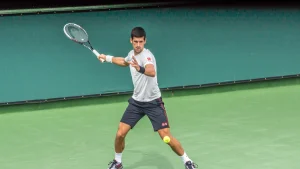
The player splits, recognizes the ball, and turns the unit (shoulders and hips together) to load. The back leg loads — typically the right leg for a right-hander hitting an open-stance forehand. As the ball approaches, the player initiates the chain from the ground. Right leg drives, hips begin to open, shoulders follow but with delay. The arm is still trailing — the racquet is below or behind the body line. Only when the trunk is well into its rotation does the arm whip through.
The classic cue “swing low to high” describes the racquet path but misses the engine. The engine is rotational, not vertical. The racquet goes low to high because the trunk is rotating around a tilted axis, not because the arm is making a deliberate scoop.
Wrist lag — that visible bend in the wrist as the racquet trails the arm — is a result of the chain being properly sequenced, not a thing to consciously create. If you tell a club player “lag your wrist,” they will tense the wrist and try to manufacture the position. The result is a stiff, slow stroke. The right cue is upstream: “feel the trunk catch up to your hips, then let the racquet come last.”
Two Drills That Build the Chain
I use these constantly with players who are leaking power. They are not glamorous. They work.
Drill 1: Medicine ball rotational throw, side-on. Stand sideways to a wall, two to three meters away. Hold a 2–4 kg medicine ball at trunk height. Drive off the back leg, rotate the hips, then the trunk, and release the ball forward. Watch the chain: feet, hips, trunk, arm, hands. Three sets of six per side, two to three times per week. The transfer to ground-stroke power is measurable within six weeks.
Drill 2: Shadow forehand with no racquet, eyes on belt buckle. The player stands at the baseline and shadow-strokes a forehand. Their job is to watch their own belt buckle the whole time. The belt buckle is a proxy for hip rotation. If the buckle moves through a full 90°+ range from load to follow-through, the hips are doing their job. If the buckle stays nearly still, hip rotation is missing — and the chain is broken at link two.
Both drills isolate the segments below the arm. That is deliberate. The arm is rarely the problem. The legs and trunk almost always are.
One Thing to Do on Court Tomorrow
Pick any stroke — forehand, backhand, or serve. Hit ten balls focusing only on the back-leg drive. Forget the arm. Forget the racquet. Feel the back leg push the ground, and let everything above it react to that push. Most players, doing this for the first time, will produce 5–10% more pace on those ten balls. That extra pace was already there. They just weren’t accessing it.
The kinetic chain is not a technique. It is a sequencing principle. Master it on one stroke and the next strokes get easier. Violate it on every stroke and you are coaching the symptoms instead of the cause.
About the author: Emre Köse is a tennis coach at Beykoz Tenis Kulübü in Istanbul, with 12+ years on court. He holds a BSc in Coaching Education from Marmara University, Faculty of Sport Sciences.
Related in this series: Where serve speed actually comes from · Wrist lag and pronation on the forehand · Trunk rotation and separation angle
Selected reading:
- Elliott, B., Marsh, T., & Blanksby, B. (1995). A three-dimensional cinematographic analysis of the tennis serve. International Journal of Sport Biomechanics.
- Fleisig, G., Nicholls, R., Elliott, B., & Escamilla, R. (2003). Kinematics used by world class tennis players to produce high-velocity serves. Sports Biomechanics.
- Kovacs, M., & Ellenbecker, T. (2011). An 8-stage model for evaluating the tennis serve. Sports Health.
- Komi, P. V. (2003). Strength and Power in Sport. Blackwell Science.
- Kraemer, W. J., Triplett, N. T., Fry, A. C., et al. (2003). An in-depth sports medicine profile of women college tennis players. Journal of Sport Rehabilitation.
What "Kinetic Chain" Actually Means
The kinetic chain is the sequential activation of body segments to generate, transfer, and deliver force. In a tennis stroke, force originates at the ground (ground reaction force, GRF), travels through the legs, hips, trunk, shoulder, arm, and forearm, and is finally delivered to the…
The Six Links
A useful working model breaks the kinetic chain into six segments. From bottom to top:
The Stretch-Shortening Cycle: Why Loading Matters
A well-timed kinetic chain doesn't just sequence segments — it pre-loads them. This is the stretch-shortening cycle (SSC).
Where the Chain Breaks: The Three Most Common Faults
In twelve years of coaching, I have seen the same three breakdowns over and over. They are the diagnoses I reach for first when a player's power output is below their physical potential.
The Serve: A Pure Kinetic-Chain Demonstration
The serve is the cleanest illustration of the chain because the body has time to do everything sequentially. Unlike a defensive forehand on the run, the serve is a closed skill executed from a set position. Every link is on display.