Preview
Hüseyin Akbulut, MSc (2026). Iga Świątek and the WTA Clay-Court Rally Pattern Physiology of an Elite Tennis Player. Sporeus. Retrieved, September 30, 2026. https://sporeus.com/en/science/iga-swiatek-wta-clay-court-rally-pattern-physiology/
The Athlete in One Paragraph
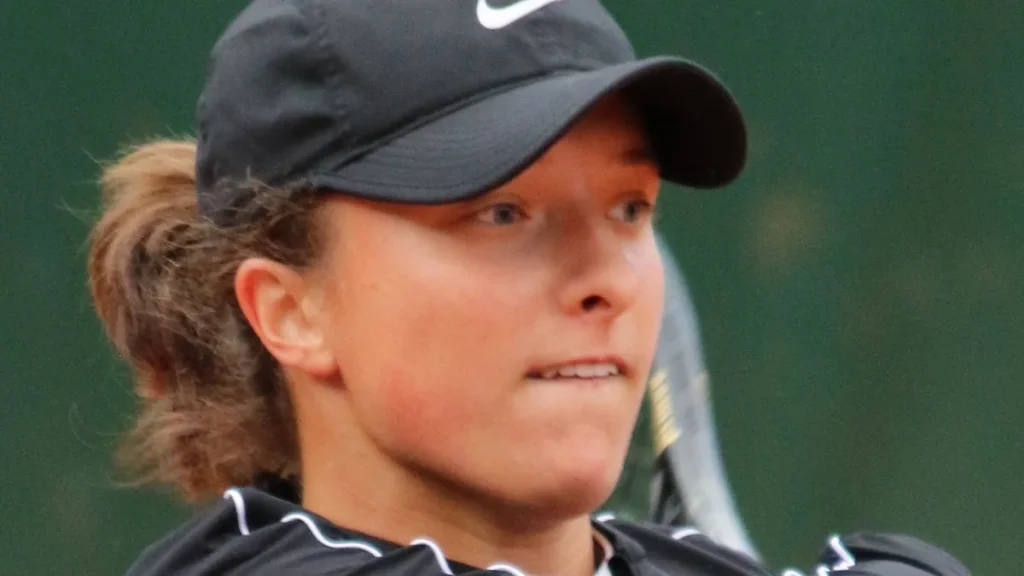
Iga Natalia Świątek (b. 2001-05-31, Warsaw, Poland) is a professional tennis player on the WTA tour and a long-standing member of the Poland Billie Jean King Cup squad. Listed at 1.76 m and ~60 kg, she has built her grand-slam record on clay, with multiple Roland-Garros titles produced by an offensive-baseliner game that thrives on the long, heavy-spin, high-bouncing rallies that the surface invites. The interesting case for sport science is not any single forehand or any single drop-shot but the rally-pattern physiology underneath the clay-court signature: rallies that routinely exceed eight or ten shots, played on a slow surface that lengthens points and amplifies the aerobic and repeated-effort cost of each game. The variable underneath that story is WTA clay-court rally-pattern physiology — how aerobic substrate, repeated-effort capacity, lateral-coverage economy, and inter-point recovery interact to keep an offensive baseliner’s intensity intact across long clay rallies and three-set matches.
Table of Contents
The Physiology — what clay-court rally-pattern physiology actually involves
Bangsbo, Mohr and Krustrup’s account of the physical and metabolic demands of intermittent high-intensity sport supplies the framework here: long rallies followed by short between-point recoveries produce a metabolic profile in which the aerobic engine refills the anaerobic debt during the sub-maximal phases between rallies, and the depth of that refill governs the intensity available in the next rally [1]. On clay the rallies are longer and the work-to-rest ratio shifts toward more work per game, so the demand on the aerobic refill grows.
Buchheit and Laursen’s high-intensity-interval-training framework, written for the prescription of work, applies directly to the rally-pattern problem [2]. The repeated-effort cost is governed by the same variables the HIIT literature identifies — work intensity, work duration, recovery duration, recovery modality — and the clay-court rally pattern is, mechanically, an open-ended high-intensity interval session. The athletes who survive long-rally sets are those whose aerobic ceiling and recovery half-life let them produce the next rally from a less-degraded baseline.
Joyner and Coyle’s framework on champion endurance physiology emphasises that at the elite tail the limiting factors are not raw aerobic ceilings but the rate-limiting steps in recovery: substrate replenishment, fluid balance, neuromuscular re-priming [3]. On clay these rate-limiting steps run continuously across long rallies, so the marginal differences in aerobic ceiling and recovery efficiency that look small on paper compound into visible late-set differentiation.
Stølen, Chamari, Castagna and Wisløff’s update on the physiology of intermittent high-intensity sport places the same picture inside the soccer literature, with repeated short sprints, decelerations and lateral cuts under fatigue [4]. The mechanical demand on clay-court coverage — the lateral cuts, the heavy decelerations to absorb high-bouncing balls, the recoveries to the centre line — sits inside this framework with the addition of a heavier per-rally work envelope.
Helgerud, Engen, Wisløff and Hoff’s classic on aerobic endurance training reminds us that a higher aerobic engine is not just about running further — it is about recovering faster between high-intensity efforts, because aerobic capacity governs phosphocreatine resynthesis and lactate clearance during the sub-maximal periods that punctuate the high-intensity ones [5]. For a clay-court baseliner the aerobic substrate is not background fitness — it is the rate-limiting step that keeps the eighth ball of a long rally as sharp as the second.
The takeaway is that clay-court rally physiology is a repeated-effort problem before it is a power problem. The technique, spin and shot selection that produce the long rallies are the surface; the aerobic substrate and recovery half-life are the substrate that keeps those rallies productive.
The Case — Świątek as clay-court rally exemplar
For a 1.76 m / 60 kg WTA player whose grand-slam record is built disproportionately on clay, the underlying profile is consistent with a repeated-effort capacity and aerobic substrate that hold up across the longer-rally surface better than across faster surfaces [1, 2, 5]. The visible elements of her clay game — the heavy topspin that lengthens rallies by design, the willingness to stay back and absorb extended exchanges, the lateral coverage that retrieves balls others would concede — map onto exactly the variables the literature identifies as protective in long-rally contexts.
The aerobic-substrate layer is the under-discussed one. A WTA player who maintains intensity into the eighth, tenth or twelfth shot of a clay rally has paid for that capacity with the kind of aerobic ceiling that Joyner and Coyle describe at the champion-endurance tail, and the recovery half-life that Helgerud and colleagues showed responds to interval training [3, 5]. The visible fitness is the surface; the aerobic substrate is the rate-limiting step underneath it.
The repeated-effort layer is what drives the third-set differentiation. The cumulative cost of long-rally tennis across two prior sets degrades the recovery half-life of every subsequent point; the player whose half-life was shorter at the start of the match arrives at the third set with more reserve [2, 4]. On clay this compounds disproportionately because the per-game work envelope is larger.
The lateral-coverage layer interacts with the rally length. Each additional ball in a clay rally is another lateral cut, another deceleration, another return to the centre line — and the cumulative mechanical cost of an eight-shot rally is more than four times the cost of a two-shot rally because the late-rally cuts come on a more fatigued system [4]. Coverage economy and aerobic substrate together govern how that cost compounds.
(Match data: WTA) Świątek’s clay-court rally-length distribution and her three-set winning percentage on clay sit at or above WTA top-five norms, with the discriminator being late-rally and late-set shot quality rather than peak first-shot pace.
What This Means for the Reader
For a developing or amateur player working on rally-physiology economy, the lesson is that clay rewards the aerobic substrate and the recovery half-life more than it rewards the first-strike weapon [1, 2, 3, 4, 5]. The shorter rallies on faster surfaces forgive a smaller aerobic engine; the long rallies on clay do not.
Practical assessment: track three indicators across the season — a sub-maximal aerobic reference (five-minute steady-state heart-rate at a fixed pace), a repeated-effort benchmark (a six-times-thirty-metre sprint with short recoveries, with the decline across efforts as the variable of interest), and a lateral-coverage reference (a modified 505 with bilateral comparison). Drift in any of the three is the early signal that the rally-pattern physiology is moving the wrong way.
The diagnostic question for the clay-court player or aspiring offensive baseliner: am I recovering between the points of a long rally the way I did at the start of the match, or am I quietly compounding a fatigue tax that the third set will collect on?
References
- Bangsbo J, Mohr M, Krustrup P. (2006). Physical and metabolic demands of training and match-play in the elite football player. Journal of Sports Sciences, 24(7): 665–674. doi:10.1080/02640410500482529
- Buchheit M, Laursen PB. (2013). High-intensity interval training, solutions to the programming puzzle. Sports Medicine, 43(5): 313–338. doi:10.1007/s40279-013-0029-x
- Joyner MJ, Coyle EF. (2008). Endurance exercise performance: the physiology of champions. Journal of Physiology, 586(1): 35–44. doi:10.1113/jphysiol.2007.143834
- Stølen T, Chamari K, Castagna C, Wisløff U. (2005). Physiology of soccer: an update. Sports Medicine, 35(6): 501–536. doi:10.2165/00007256-200535060-00004
- Helgerud J, Engen LC, Wisløff U, Hoff J. (2001). Aerobic endurance training improves soccer performance. Medicine and Science in Sports and Exercise, 33(11): 1925–1931. doi:10.1097/00005768-200111000-00019
Match-context data (descriptive only): WTA.
The Athlete in One Paragraph
Iga Natalia Świątek (b. 2001-05-31, Warsaw, Poland) is a professional tennis player on the WTA tour and a long-standing member of the Poland Billie Jean King Cup squad. Listed at 1.76 m and ~60 kg, she has built her grand-slam record on clay, with multiple…
The Physiology — what clay-court rally-pattern physiology actually involves
Bangsbo, Mohr and Krustrup's account of the physical and metabolic demands of intermittent high-intensity sport supplies the framework here: long rallies followed by short between-point recoveries produce a metabolic profile in which the aerobic engine refills the anaerobic debt during the sub-maximal phases between rallies,…
The Case — Świątek as clay-court rally exemplar
For a 1.76 m / 60 kg WTA player whose grand-slam record is built disproportionately on clay, the underlying profile is consistent with a repeated-effort capacity and aerobic substrate that hold up across the longer-rally surface better than across faster surfaces [1, 2, 5]. The…
What This Means for the Reader
For a developing or amateur player working on rally-physiology economy, the lesson is that clay rewards the aerobic substrate and the recovery half-life more than it rewards the first-strike weapon [1, 2, 3, 4, 5]. The shorter rallies on faster surfaces forgive a smaller aerobic…