Preview
Hüseyin Akbulut, MSc (2026). Femke Bol and the Young Female 400 m Hurdler Development of an Elite Hurdler. Sporeus. Retrieved, September 30, 2026. https://sporeus.com/en/science/femke-bol-young-female-400m-hurdler-development/
The Athlete in One Paragraph
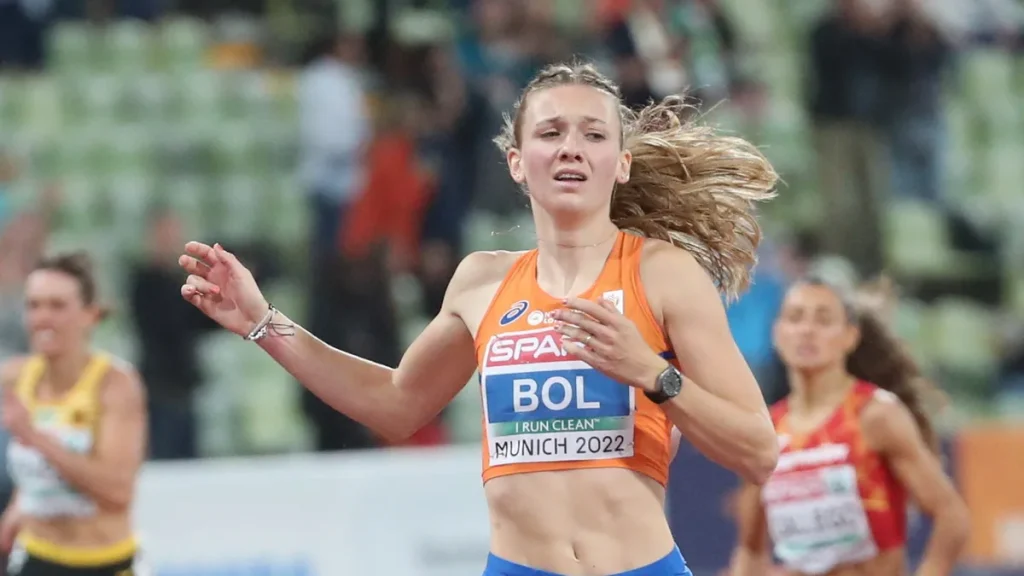
Femke Bol (b. 2000-02-23, Amersfoort, Netherlands) is one of the defining women’s 400 m hurdlers of her generation, a multiple world champion across the 400 m hurdles, the 400 m flat, and the 4×400 m relay, and a regular European-record-holder across both the indoor and outdoor disciplines. Listed at 1.84 m and approximately 64 kg, she carries an unusually long-limbed profile for a one-lap hurdler — closer to a 400 m flat specialist’s height than to the traditional female hurdling archetype — into a career arc that has unfolded across her early twenties at a pace that is itself a sport-science case study. The interesting variable is not whether she will hold this level forever; it is the developmental trajectory itself: how a top 400 m hurdler in early adulthood balances training transfer between the hurdles event and the flat 400 m, and how the female-physiology-specific framing of that trajectory differs from the male equivalent. The variable underneath is the young female 400 m hurdler’s developmental window, and Bol — by competing at near-record level across multiple disciplines simultaneously while still in her early twenties — exposes that window in unusually clean fashion.
Table of Contents

The Physiology — what young female 400 m hurdler development actually means
A 400 m hurdler in her early twenties is an athlete whose underlying aerobic ceiling, lactate threshold and running economy are still trainable, simultaneously, in a way that older athletes’ systems generally are not. Joyner and Coyle’s three-factor endurance model — VO₂max, lactate threshold, running economy — provides the cleanest decomposition of what the one-lap aerobic side of the equation looks like, and the back-half clearance demand of a 400 m hurdler depends on all three [1]. In the early-twenties window, all three remain plastic: VO₂max responds to high-intensity interval work, threshold velocity responds to sustained tempo work, and economy continues to refine itself across years of consistent volume.
Buchheit and Laursen’s HIIT framework formalises the programming of the high-end side: 40–60 s all-out work targets the glycolytic ceiling and lactate-tolerance window directly, and the aerobic-clearance side that supports it can be raised by structurally different sessions in the same training block [2]. Faude, Kindermann and Meyer’s review of lactate threshold concepts makes clear that the chosen testing method matters less than the underlying biology, and that threshold velocity in trained athletes can rise meaningfully across a multi-year training arc without the corresponding ceiling rise that would imply a true VO₂max change [3].
For a female athlete in particular, the developmental trajectory is shaped by additional considerations the literature on the physiology of soccer in elite players has touched on indirectly: body composition, fibre-type distribution, and the seasonal block-and-recovery structure that allows neuromuscular and aerobic adaptations to consolidate without colliding with one another [4]. Helgerud, Engen, Wisløff and Hoff’s foundational study on aerobic-interval training showed that a structured 8-week aerobic-interval block raises lactate threshold and sustainable submaximal velocity in trained athletes, which is the single most relevant adaptation for the back-half rhythm of a 400 m hurdler [5]. The takeaway: a female 400 m hurdler in her early twenties is plastic on every meaningful axis, and the training-design question is which axis to load first, second and third across a multi-year block.
The Case — Bol as developmental-trajectory lens
Bol’s profile is unusually clean for the variable in question. Her trajectory across the 400 m hurdles, the 400 m flat and the 4×400 m relay shows the operational signature of an athlete whose underlying aerobic ceiling and threshold velocity are both trainable enough to support multiple disciplines without a corresponding loss of specificity in any of them. The flat 400 m is, mechanistically, the same energy-system demand as the hurdles minus the per-barrier cost; an athlete who races both at near-elite level is, by implication, banking the aerobic clearance and threshold-velocity gains in a way that benefits the back-half rhythm of the hurdles event without compromising the flat-400 specific top-end [1, 5].
Her anthropometry is consistent with the developmental profile. At 1.84 m and ~64 kg, the absolute stride distance available at given hip extension is generous; the relative oxygen cost — the variable that actually appears in the late-race economy equation — remains competitive [1]. The long-limbed profile imposes its own demands on the per-hurdle clearance mechanics — a longer lead-leg trajectory means a longer time-in-the-air per barrier, which compounds across ten obstacles unless the athlete trains the takeoff-landing cycle as a discrete neuromuscular skill alongside the metabolic work [4].
The training-transfer side is the deeper part of the case. Threshold velocity raised through tempo work in the flat-400 specific block transfers directly to the hurdles back-half [3]; HIIT work in the 30–60 s window transfers across both disciplines [2]; the per-barrier neuromuscular skill, however, transfers in only one direction — hurdles work supports the flat-400 acceleration profile less than the reverse, because the flat 400 lacks the discrete re-acceleration demand. The block-design implication is that threshold and clearance can be developed cross-disciplinary, but barrier-mechanic specificity must be preserved as a discrete training stream [5].
(Performance data: World Athletics)
What This Means for the Reader
For the developing female 400 m or 400 m hurdles athlete in her late teens or early twenties, the diagnostic question is not which event to specialise in — it is which axis of development is most under-loaded right now. Threshold velocity, glycolytic-tolerance window, and per-barrier neuromuscular skill develop on different timescales; an athlete who chases all three in equal measure within a single training block typically progresses on none of them, while an athlete who sequences the three across a multi-year arc consolidates each one in turn [1, 2]. Helgerud and colleagues’ aerobic-interval framework remains the canonical block for raising threshold velocity in a finite, measurable window of weeks [5].
The second implication is recovery and periodisation. A female athlete in her early twenties is plastic but not infinitely so; sleep, nutrition, and seasonal block-and-recovery structure determine whether the trainable adaptations consolidate or collide with one another [3, 4]. The diagnostic question for the athlete: across the next 12 months, which one of threshold velocity, glycolytic-tolerance window, or per-barrier mechanics is the most under-loaded — and what does my training calendar say about whether I am sequencing them, or chasing all three at once?
References
- Joyner MJ, Coyle EF. (2008). Endurance exercise performance: the physiology of champions. The Journal of Physiology, 586(1): 35–44. doi:10.1113/jphysiol.2007.143834
- Buchheit M, Laursen PB. (2013). High-intensity interval training, solutions to the programming puzzle. Sports Medicine, 43(5): 313–338. doi:10.1007/s40279-013-0029-x
- Faude O, Kindermann W, Meyer T. (2009). Lactate threshold concepts: how valid are they? Sports Medicine, 39(6): 469–490. doi:10.2165/00007256-200939060-00003
- Stølen T, Chamari K, Castagna C, Wisløff U. (2005). Physiology of soccer: an update. Sports Medicine, 35(6): 501–536. doi:10.2165/00007256-200535060-00004
- Helgerud J, Engen LC, Wisløff U, Hoff J. (2001). Aerobic endurance training improves soccer performance. Medicine & Science in Sports & Exercise, 33(11): 1925–1931. doi:10.1097/00005768-200111000-00019
Performance data (descriptive only): World Athletics.
The Athlete in One Paragraph
Femke Bol (b. 2000-02-23, Amersfoort, Netherlands) is one of the defining women's 400 m hurdlers of her generation, a multiple world champion across the 400 m hurdles, the 400 m flat, and the 4×400 m relay, and a regular European-record-holder across both the indoor and…
The Physiology — what young female 400 m hurdler development actually means
A 400 m hurdler in her early twenties is an athlete whose underlying aerobic ceiling, lactate threshold and running economy are still trainable, simultaneously, in a way that older athletes' systems generally are not. Joyner and Coyle's three-factor endurance model — VO₂max, lactate threshold, running…
The Case — Bol as developmental-trajectory lens
Bol's profile is unusually clean for the variable in question. Her trajectory across the 400 m hurdles, the 400 m flat and the 4×400 m relay shows the operational signature of an athlete whose underlying aerobic ceiling and threshold velocity are both trainable enough to…
What This Means for the Reader
For the developing female 400 m or 400 m hurdles athlete in her late teens or early twenties, the diagnostic question is not which event to specialise in — it is which axis of development is most under-loaded right now. Threshold velocity, glycolytic-tolerance window, and…