
Preview
Hüseyin Akbulut, MSc (2026). Sydney McLaughlin-Levrone and the 400 m Hurdles Stride Pattern and Economy of an Elite Hurdler. Sporeus. Retrieved, October 26, 2026. https://sporeus.com/en/science/sydney-mclaughlin-levrone-400m-hurdles-stride-pattern-economy/
The Athlete in One Paragraph
Sydney McLaughlin-Levrone (b. 1999-08-07, New Brunswick, New Jersey, United States) is the defining women’s 400 m hurdler of her generation, a multiple world-record holder with a current best of 50.37 set at the Paris 2024 Olympic final and the Tokyo 2020 and Paris 2024 Olympic champion in the event. Listed at 1.75 m and approximately 60 kg, she carries a relatively long-limbed but narrow profile into a discipline that, more than any other lap on the track, demands a deliberate compromise between sprint mechanics and endurance economy. The case for sport science here is not the time itself; it is the stride-count between hurdles, which is the operational expression of an underlying decision about how to spend a finite glycolytic budget across ten barriers and a flat run-in. The variable is inter-hurdle stride pattern and the economy of one-lap hurdling, and McLaughlin-Levrone, by holding 14-stride patterns deep into the back straight where most of the field shifts to 15, exposes that variable in sharper relief than any contemporary.
Table of Contents
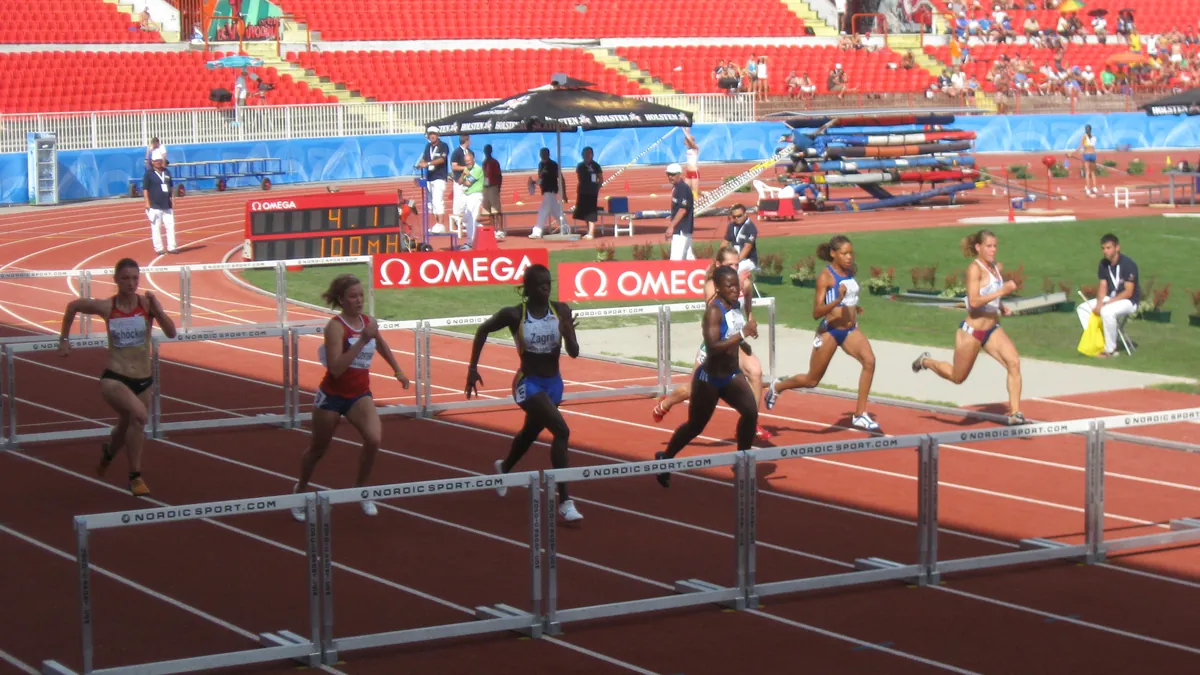
The Physiology: what stride pattern and one-lap economy actually measure
The 400 m hurdles is, metabolically, a fully glycolytic event with a substantial aerobic contribution that is often underappreciated. Buchheit and Laursen, in their HIIT framework, classify single-effort all-out work in the 40–60 s range as a regime in which both the phosphocreatine and the glycolytic systems are exhausted and a meaningful aerobic contribution becomes the determinant of late-race fade [1]. Joyner and Coyle’s three-factor endurance model, VO₂max, lactate threshold, running economy, remains the cleanest decomposition of the aerobic side of that contribution, and a 400 m hurdler’s velocity at lactate threshold is functionally the speed she can hold without the back-half collapse [2].
Faude, Kindermann and Meyer catalogued the methods used to identify “the” lactate threshold and showed that, regardless of the chosen method, the underlying biology is consistent, the velocity at which lactate production exceeds clearance and the system tips toward exponential accumulation [3]. For a 400 m hurdler, that velocity sits well below race pace; the race itself is run far above threshold, and the question is how long the athlete can resist the exponential before the rhythm-and-stride pattern between hurdles collapses. Wisløff, Castagna, Helgerud, Jones and Hoff anchored the F-side of the same equation, showing that maximal squat strength correlates strongly with sprint and jump performance, relevant for a hurdler who must lead-leg through a barrier without losing horizontal velocity [4].
Stølen, Chamari, Castagna and Wisløff’s update on the physiology of soccer is, despite its sport-specific framing, one of the cleanest summaries of the same intermittent-glycolytic + aerobic-recovery profile that defines one-lap hurdling: short maximal efforts on a continuous aerobic base, with the aerobic system’s role being not to power the maximal effort but to clear its by-products and protect the late-race rhythm [5]. The takeaway: a 400 m hurdler is a sprinter sitting on top of a half-miler’s aerobic engine, and the economy of that combination is what stride-count tells you.
The Case: McLaughlin-Levrone as stride-pattern lens
The inter-hurdle stride pattern is the discrete output of a continuous trade-off. Holding 14 strides between hurdles requires a slightly longer stride than holding 15; that longer stride costs ground-contact-time efficiency and, late in the race when fatigue is climbing, exposes the athlete to a forced shift to 15 and a corresponding velocity discontinuity [1, 4]. The athletes who can hold 14 across the entire race are the ones whose lactate-tolerance profile and stride-economy combine to delay that shift until the run-in. McLaughlin-Levrone has, in her record-setting performances, sustained the longer-stride pattern further into the lap than the historical women’s field, which is the visible signature of an unusually high sustainable fraction of her ceiling on a 400 m time trial.
Her anthropometry is consistent with the profile. At 1.75 m and ~60 kg with relatively long levers for the women’s field, the absolute stride distance available at given hip extension is generous; the relative oxygen cost, the mass-specific cost that actually appears in the late-race economy equation, remains competitive [2]. The squat-strength-to-mass profile that anchors the F-side of acceleration off each hurdle [4] is, for a one-lap hurdler, the difference between exiting a barrier at near-race-pace and exiting it with a small but cumulative deceleration that compounds across ten obstacles.
The aerobic-anaerobic blend is the deepest part of the case. A 400 m hurdler’s lactate accumulation rises sharply through the second half; Faude’s framework makes clear that the velocity at which production-clearance balance fails is the velocity the athlete can hold for far longer than 50 s, and the race-pace velocity sits well above it [3]. The trainable variable is how steeply the curve climbs above threshold, a function of buffering capacity, fibre-type recruitment patterns, and the aerobic clearance rate that Buchheit and Laursen’s framework targets directly [1, 5].
(Performance data: World Athletics)
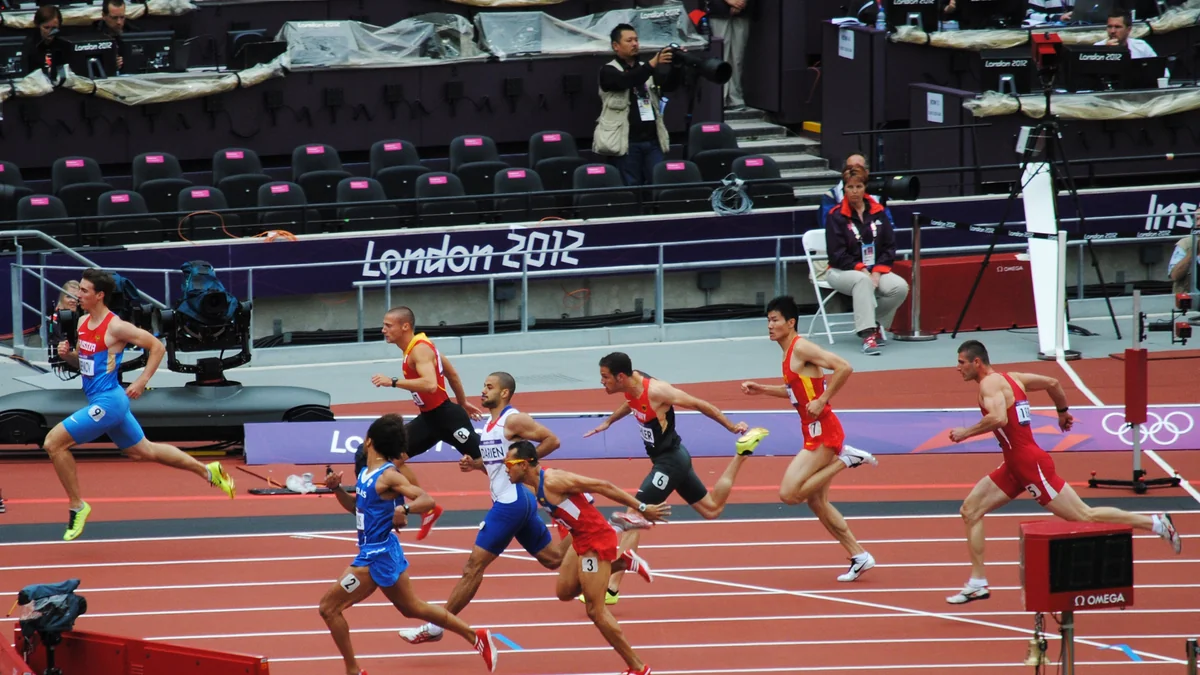
What This Means for the Reader
For the developing 400 m or 400 m hurdles athlete, the diagnostic question is rarely “how fast is my 100 m”, it is “where is my back-half velocity decay and what is forcing it.” A late-race fade is almost always the visible signature of a metabolic mismatch: race pace too far above the threshold velocity, or the threshold velocity itself sitting too low for the chosen race tactic [2, 3]. The training prescription follows the diagnosis. Threshold and tempo work raises the velocity at which clearance keeps up with production; HIIT in the 30–60 s window targets the lactate-tolerance side directly [1]; and strength work [4] anchors the per-hurdle re-acceleration cost so that a forced stride-pattern shift does not cascade into a collapse.
The second implication is rhythm. A 400 m hurdler who panics into a stride-pattern shift two hurdles too early loses more than the velocity discontinuity at that hurdle; she loses the cadence that the entire race plan was built around, and the back-half decay becomes psychological as well as metabolic [5]. The diagnostic question for the athlete: what is my inter-hurdle stride count at hurdle 5, hurdle 7, hurdle 9 and where is the forced shift hiding?
References
- Buchheit M, Laursen PB. (2013). High-intensity interval training, solutions to the programming puzzle. Sports Medicine, 43(5): 313–338. doi:10.1007/s40279-013-0029-x
- Joyner MJ, Coyle EF. (2008). Endurance exercise performance: the physiology of champions. The Journal of Physiology, 586(1): 35–44. doi:10.1113/jphysiol.2007.143834
- Faude O, Kindermann W, Meyer T. (2009). Lactate threshold concepts: how valid are they? Sports Medicine, 39(6): 469–490. doi:10.2165/00007256-200939060-00003
- Wisløff U, Castagna C, Helgerud J, Jones R, Hoff J. (2004). Strong correlation of maximal squat strength with sprint performance and vertical jump height in elite soccer players. British Journal of Sports Medicine, 38(3): 285–288. doi:10.1136/bjsm.2002.002071
- Stølen T, Chamari K, Castagna C, Wisløff U. (2005). Physiology of soccer: an update. Sports Medicine, 35(6): 501–536. doi:10.2165/00007256-200535060-00004
Performance data (descriptive only): World Athletics.

Hüseyin Akbulut is the founder of Sporeus and author of THRESHOLD (EŞİK), a 540-page Turkish-language book on endurance science.
- 540pp THRESHOLD Book
- MSc Sport Sciences
- Marmara University
The Athlete in One Paragraph
Sydney McLaughlin-Levrone (b. 1999-08-07, New Brunswick, New Jersey, United States) is the defining women's 400 m hurdler of her generation, a multiple world-record holder with a current best of 50.37 set at the Paris 2024 Olympic final and the Tokyo 2020 and Paris 2024 Olympic…
The Physiology: what stride pattern and one-lap economy actually measure
The 400 m hurdles is, metabolically, a fully glycolytic event with a substantial aerobic contribution that is often underappreciated. Buchheit and Laursen, in their HIIT framework, classify single-effort all-out work in the 40–60 s range as a regime in which both the phosphocreatine and the…
The Case: McLaughlin-Levrone as stride-pattern lens
The inter-hurdle stride pattern is the discrete output of a continuous trade-off. Holding 14 strides between hurdles requires a slightly longer stride than holding 15; that longer stride costs ground-contact-time efficiency and, late in the race when fatigue is climbing, exposes the athlete to a…
What This Means for the Reader
For the developing 400 m or 400 m hurdles athlete, the diagnostic question is rarely "how fast is my 100 m", it is "where is my back-half velocity decay and what is forcing it." A late-race fade is almost always the visible signature of a…