Preview
Hüseyin Akbulut, MSc (2026). Jimmy Butler and the Clutch-Time Cardiovascular Headroom of an Elite Forward. Sporeus. Retrieved, September 18, 2026. https://sporeus.com/en/science/jimmy-butler-clutch-time-cardiovascular-headroom/
The Athlete in One Paragraph
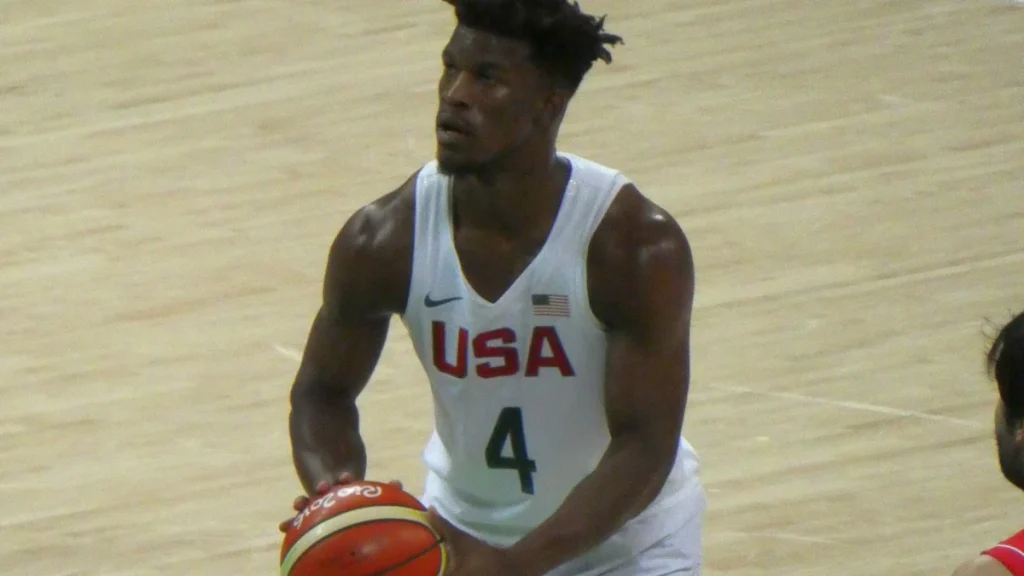
Jimmy Butler III (b. 1989-09-14, Houston, Texas, United States) is a forward for the Miami Heat and a long-time member of the United States national-team pool. Listed at 2.01 m and ~104 kg, he carries the anthropometry of a heavy wing-forward whose visible signature on the league is the closing five minutes of close playoff games — a window in which he routinely raises his on-court intensity rather than falling off it. The interesting case for sport science is not the clutch shot-making itself but the underlying metabolic structure that makes it possible — the way an athlete who has played heavy minutes at high intensity for three quarters still has aerobic and anaerobic capacity left in reserve when the rest of the floor is running on fumes. The variable underneath that story is clutch-time cardiovascular headroom — how a strong aerobic base sustains the anaerobic burst capacity that closing time demands, even after a long evening of accumulated load.
Table of Contents

The Physiology — what cardiovascular headroom actually is
Endurance performance in elite team-sport athletes is the integral of repeated high-intensity actions across a long match, and the discriminator between athletes who maintain output late and athletes who fade is the size of the aerobic platform underneath the anaerobic spikes [1, 4]. Joyner and Coyle’s framing of endurance physiology made the relationship explicit: maximal oxygen uptake sets the ceiling, but the fraction of that ceiling an athlete can sustain — the lactate-threshold velocity — is what determines how much room the system has before fatigue forces a reduction in output [1]. A larger ceiling and a higher sustainable fraction together create the headroom that lets an athlete deliver another high-intensity sequence when most peers cannot.
Stølen and colleagues’ physiology-of-soccer review and Bangsbo’s match-demand work generalise this principle across team sports: the aerobic base does not produce the high-intensity actions directly, but it determines how rapidly those actions are recovered between repetitions, how completely lactate is cleared, and how stable the technical-skill output remains as the match progresses [4, 5]. A weaker base does not necessarily reduce the first-quarter peak; it reduces the fourth-quarter floor, which is the part of the night that decides close games.
Buchheit and Laursen’s high-intensity interval training framework supplies the training side of the equation: the headroom that closing-time intensity requires is built by carefully programmed work above lactate threshold, where the metabolic cost is high enough to drive central and peripheral adaptations but the recovery between sets is structured enough to preserve quality [2]. Helgerud and colleagues’ aerobic-training work in elite soccer demonstrated that targeted interval blocks measurably raise both maximal oxygen uptake and time to exhaustion at high relative intensities, and that the gains transfer into match performance [3]. The mechanism is the same in basketball: a forward who has spent the off-season deliberately raising his aerobic ceiling will be operating at a smaller fraction of that ceiling at any given clutch moment, which is exactly what headroom means.
The cumulative-load picture matters too. Across an 82-game season plus playoffs, the repeated drawdown on aerobic and anaerobic systems is what determines whether headroom is preserved or eroded. The athlete who maintains training continuity, manages internal load deliberately, and protects sleep and recovery preserves a higher fraction of the off-season base; the athlete who lets continuity collapse spends headroom faster than he replaces it [4, 5].
The Case — Jimmy Butler as a closing-time headroom case study
For a 2.01 m / ~104 kg forward who plays heavy minutes against the league’s most demanding wing assignments, the metabolic bill of three quarters is non-trivial — accelerations, decelerations, contested rebounds, defensive rotations, and offensive isolations stack the internal load deep before the fourth quarter even begins [4, 5]. Butler’s signature is to enter that fourth quarter with apparent reserve where peers are visibly fatigued; the visible feature is composed shot-making and unbroken defensive intensity, but the invisible feature underneath is a cardiovascular base that allows the same quality of action to be expressed when most of the floor is operating at a higher percentage of maximum.
The training history publicly associated with Butler — early-morning continuous training across the off-season, structured high-intensity interval work, and a reputation for refusing to drop conditioning volume even mid-season — maps onto exactly the variables the literature highlights as protective for late-game headroom: a high maximal oxygen uptake [1], a high lactate-threshold fraction [1, 4], targeted interval programming above threshold [2, 3], and a refusal to let continuity collapse during the long competitive phase [4, 5]. None of this is unusual at the elite level taken alone; the consistency of it across a long career is the discriminator.
A second feature is the interaction between aerobic base and anaerobic burst. The clutch sequences in which Butler is most identifiable are not low-intensity grinds but anaerobic peaks layered on top of an already-fatigued background; the aerobic base does not produce those peaks but it produces the recovery between them [2, 3]. A forward whose base is shallow can still hit one peak; the one who can hit several across a six-minute window is the one with the larger underlying platform.
Match-context note: across his peak playoff runs, Butler’s per-100-possessions output and on-off scoring differentials in clutch windows have placed him among the top of the league for forwards (Match data: NBA.com / Basketball-Reference). The discriminator is not single-quarter peak but the per-minute output sustained inside the closing window relative to the first three quarters.
What This Means for the Reader
For amateur and developing athletes who play long, demanding games, the lesson is that the closing minutes are not won by what is added in the closing minutes — they are won by what was built into the aerobic base months earlier [1, 2, 3, 4, 5]. The off-season bias toward strength and skill at the expense of conditioning volume is a slow trade against late-game output, and the in-season collapse of conditioning continuity is a faster one.
Practical assessment: track three indicators across a block — a sub-maximal heart-rate index at a fixed running velocity, a high-intensity-interval session quality score (work performed at target intensity, in seconds), and a perceived-exertion drift across the back-half of a match. Drift in any of the three is the early signal that headroom is being spent rather than preserved.
The diagnostic question for the team-sport athlete: when the fourth quarter starts, am I operating at a smaller fraction of my ceiling than my opponent is, or am I starting to chase him at a higher one?
References
- Joyner MJ, Coyle EF. (2008). Endurance exercise performance: the physiology of champions. Journal of Physiology, 586(1): 35–44. doi:10.1113/jphysiol.2007.143834
- Buchheit M, Laursen PB. (2013). High-intensity interval training, solutions to the programming puzzle. Sports Medicine, 43(5): 313–338. doi:10.1007/s40279-013-0029-x
- Helgerud J, Engen LC, Wisløff U, Hoff J. (2001). Aerobic endurance training improves soccer performance. Medicine and Science in Sports and Exercise, 33(11): 1925–1931. doi:10.1097/00005768-200111000-00019
- Bangsbo J, Mohr M, Krustrup P. (2006). Physical and metabolic demands of training and match-play in the elite football player. Journal of Sports Sciences, 24(7): 665–674. doi:10.1080/02640410500482529
- Stølen T, Chamari K, Castagna C, Wisløff U. (2005). Physiology of soccer: an update. Sports Medicine, 35(6): 501–536. doi:10.2165/00007256-200535060-00004
Match-context data (descriptive only): NBA.com / Basketball-Reference.
The Athlete in One Paragraph
Jimmy Butler III (b. 1989-09-14, Houston, Texas, United States) is a forward for the Miami Heat and a long-time member of the United States national-team pool. Listed at 2.01 m and ~104 kg, he carries the anthropometry of a heavy wing-forward whose visible signature on…
The Physiology — what cardiovascular headroom actually is
Endurance performance in elite team-sport athletes is the integral of repeated high-intensity actions across a long match, and the discriminator between athletes who maintain output late and athletes who fade is the size of the aerobic platform underneath the anaerobic spikes [1, 4]. Joyner and…
The Case — Jimmy Butler as a closing-time headroom case study
For a 2.01 m / ~104 kg forward who plays heavy minutes against the league's most demanding wing assignments, the metabolic bill of three quarters is non-trivial — accelerations, decelerations, contested rebounds, defensive rotations, and offensive isolations stack the internal load deep before the fourth…
What This Means for the Reader
For amateur and developing athletes who play long, demanding games, the lesson is that the closing minutes are not won by what is added in the closing minutes — they are won by what was built into the aerobic base months earlier [1, 2, 3,…