Preview
Hüseyin Akbulut, MSc (2026). Mathieu van der Poel and the Aerobic-Anaerobic Blend of an Elite Multi-Discipline Cyclist. Sporeus. Retrieved, September 17, 2026. https://sporeus.com/en/science/mathieu-van-der-poel-multi-discipline-aerobic-anaerobic-blend/
The Athlete in One Paragraph
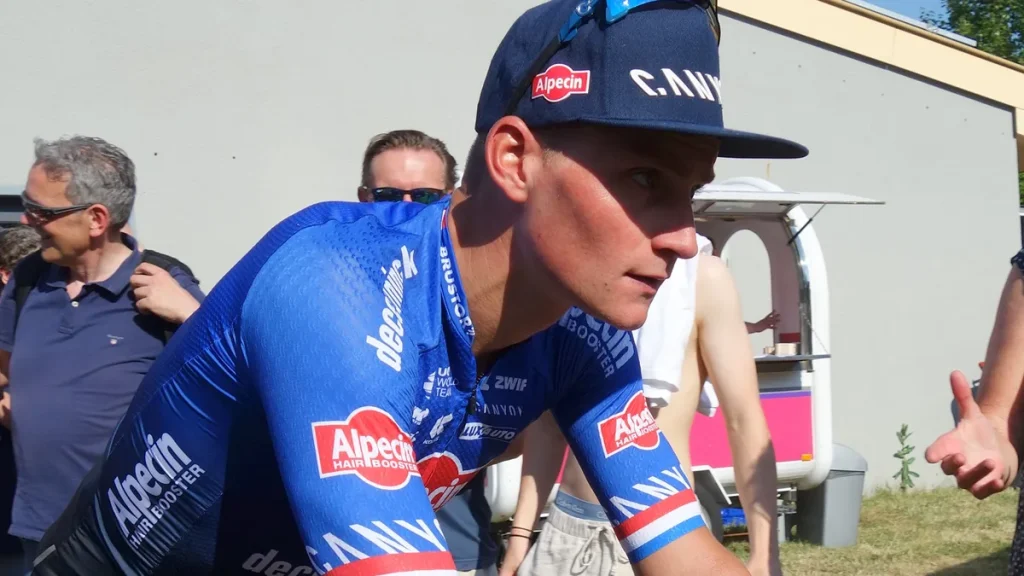
Mathieu van der Poel (b. 19 January 1995, Kapellen, Belgium) is a road, cyclocross and mountain-bike rider for Alpecin–Deceuninck and the Dutch national team. Listed at 1.84 m and ~75 kg, he is the rare contemporary professional whose competitive identity straddles three distinct disciplines: cobbled spring classics on the road, technical mud-and-running cyclocross in winter, and elite-level cross-country mountain biking on dirt. The interesting case for sport science is the metabolic-training intersection that allows a single athlete to win at the top level in disciplines with very different aerobic-anaerobic ratios: the multi-discipline aerobic-anaerobic blend — how a high VO₂max base is paired with repeated supra-threshold surges, deliberate cross-discipline transfer, and a recovery system trained to handle both ends of the intensity spectrum within the same season.
Table of Contents
The Physiology — what aerobic-anaerobic blending actually is
Endurance physiology, Joyner and Coyle argued, is governed by three variables — VO₂max, lactate threshold, and exercise economy — but the relative weighting of those variables shifts with the demands of the event [1]. A 40-minute cyclocross race demands a high VO₂max ceiling, a high threshold fraction, and the ability to recover from repeated supra-threshold surges over short course-features (running ascents, technical descents, sand pits). A six-hour spring classic on cobbles demands the same aerobic ceiling but spread over a much longer window, with sharper supra-threshold spikes on the cobbled sectors and recovery in between [3].
Buchheit and Laursen’s HIIT review formalised the principle that aerobic and anaerobic capacities are not opposed in intermittent endurance sport — the well-trained aerobic system is precisely what supports faster recovery from supra-threshold work, because the aerobic machinery clears lactate, restores phosphocreatine, and resaturates myoglobin [4]. The athlete who can repeat surges within a race is the athlete whose aerobic system pays the smallest residual cost for each surge.
Bangsbo and colleagues’ work on intermittent exercise in football extends the principle to any sport with stochastic intensity demands: the discriminator between elite and sub-elite performers is not peak sprint speed and not steady-state aerobic capacity in isolation, but the integration of the two — repeated high-intensity actions interspersed with active-recovery periods that operate at a high fraction of VO₂max [3]. A multi-discipline cyclist who trains across cyclocross, road and MTB exposes the same physiology to three different patterns of supra-threshold loading and three different recovery rhythms; the integrated profile is the result.
Helgerud and colleagues’ interval-training work on aerobic endurance demonstrated that VO₂max and the threshold-fraction-of-VO₂max can both be lifted by appropriate high-intensity stimulus on top of a long aerobic base [5]. The cyclocross winter — short races with very high glycolytic content — supplies the supra-threshold stimulus that lifts the anaerobic dimension, while the long road kilometres in spring rebuild the aerobic ceiling [2]. The result is an athlete whose VO₂max is high, whose threshold sits at a high fraction of it, and whose repeat-surge recovery is well-developed.
The Case — Van der Poel as multi-discipline integrator
For a 75 kg rider competing across cyclocross, cobbled classics and MTB, the metabolic profile is necessarily broader than a pure climber’s or a pure time-triallist’s. The 1.84 m frame carries enough cross-sectional area to penalise the rider on a sustained mountain climb but supplies the absolute power that wins on a short cobbled ramp; the trade-off is part of the discipline-fit decision, not a flaw [1].
Van der Poel’s race repertoire — the ability to sprint at the end of a six-hour classic, to hold a high tempo on a 40-minute cyclocross course, and to compete at the top in MTB cross-country — is consistent with a rider whose three governing endurance variables are all developed but distributed in a way that no single-discipline specialist would replicate. The pure stage-race climber pushes VO₂max-per-kilogram and threshold; the pure track sprinter pushes peak anaerobic power and neuromuscular recruitment. The multi-discipline rider has to develop both ends without letting either collapse [4, 5].
The cross-discipline transfer is the unspoken training advantage. A winter of cyclocross is, in metabolic terms, a structured block of high-intensity intervals embedded in race contexts — supra-threshold surges followed by short active-recovery sectors, repeated for 40–60 minutes [4]. A spring of road racing is a block of long aerobic accumulation with sharper supra-threshold spikes on cobbled or hilly sectors. The cyclist who alternates the two stimuli across the calendar receives the training benefit of both without the staleness of either; the calendar itself becomes the periodisation [3, 5].
(Performance data: UCI / ProCyclingStats)
What This Means for the Reader
For the amateur endurance athlete tempted to specialise prematurely — running only, cycling only, swimming only — the takeaway is that cross-discipline variation is not a luxury but a stimulus that the body responds to in measurable ways. The runner who cycles in winter receives a different supra-threshold pattern with lower impact load; the cyclist who runs in winter receives a different eccentric-loading pattern that protects connective tissue [2, 5]. The integrated profile is broader than any single-discipline block produces.
The training implication is that the aerobic-anaerobic blend is best built across seasons rather than within a single training week. A six-month aerobic-base block followed by a six-month higher-intensity block develops the integrated profile more reliably than a perpetually mixed week in which neither end is loaded heavily enough to drive adaptation [1, 4]. The amateur who wants to sprint hard in summer typically wins by training long and slow in winter.
The diagnostic question for the developing multi-discipline athlete: when you alternate a long aerobic session and a short high-intensity session within the same week, is your performance in the second session compromised by residual fatigue from the first? If yes, the recovery system is the limiting variable, not the workload.
References
- Joyner MJ, Coyle EF. (2008). Endurance exercise performance: the physiology of champions. The Journal of Physiology, 586(1): 35–44. doi:10.1113/jphysiol.2007.143834
- Saunders PU, Pyne DB, Telford RD, Hawley JA. (2004). Factors affecting running economy in trained distance runners. Sports Medicine, 34(7): 465–485. doi:10.2165/00007256-200434070-00005
- Bangsbo J, Mohr M, Krustrup P. (2006). Physical and metabolic demands of training and match-play in the elite football player. Journal of Sports Sciences, 24(7): 665–674. doi:10.1080/02640410500482529
- Buchheit M, Laursen PB. (2013). High-intensity interval training, solutions to the programming puzzle. Sports Medicine, 43(5): 313–338. doi:10.1007/s40279-013-0029-x
- Helgerud J, Engen LC, Wisløff U, Hoff J. (2001). Aerobic endurance training improves soccer performance. Medicine and Science in Sports and Exercise, 33(11): 1925–1931. doi:10.1097/00005768-200111000-00019
Performance data (descriptive only): UCI / ProCyclingStats.
The Athlete in One Paragraph
Mathieu van der Poel (b. 19 January 1995, Kapellen, Belgium) is a road, cyclocross and mountain-bike rider for Alpecin–Deceuninck and the Dutch national team. Listed at 1.84 m and ~75 kg, he is the rare contemporary professional whose competitive identity straddles three distinct disciplines: cobbled…
The Physiology — what aerobic-anaerobic blending actually is
Endurance physiology, Joyner and Coyle argued, is governed by three variables — VO₂max, lactate threshold, and exercise economy — but the relative weighting of those variables shifts with the demands of the event [1]. A 40-minute cyclocross race demands a high VO₂max ceiling, a high…
The Case — Van der Poel as multi-discipline integrator
For a 75 kg rider competing across cyclocross, cobbled classics and MTB, the metabolic profile is necessarily broader than a pure climber's or a pure time-triallist's. The 1.84 m frame carries enough cross-sectional area to penalise the rider on a sustained mountain climb but supplies…
What This Means for the Reader
For the amateur endurance athlete tempted to specialise prematurely — running only, cycling only, swimming only — the takeaway is that cross-discipline variation is not a luxury but a stimulus that the body responds to in measurable ways. The runner who cycles in winter receives…