
Preview
Hüseyin Akbulut, MSc (2026). Mauro Icardi and the Box-Finisher Shot-Conversion Economy of an Elite Striker. Sporeus. Retrieved, October 9, 2026. https://sporeus.com/en/science/mauro-icardi-box-finisher-shot-conversion-economy/
The Athlete in One Paragraph
Mauro Emanuel Icardi (b. 1993-02-19, Rosario, Santa Fe, Argentina) is a striker formerly of Galatasaray (2022–2026) and historically a fixture of the Argentina national-team conversation, with a senior career stretching back through Sampdoria and Inter Milan to a recent role as the figurehead of a Süper Lig title-chasing side. Listed at 1.81 m and ~75 kg, he is built within the modal centre-forward range rather than at the extreme of any single physical variable — neither the tallest, nor the fastest, nor the most explosive jumper among elite peers. The interesting case for sport science is the variable that defines his output: box-finisher shot-conversion economy, the tendency to overperform expected-goal models with a minimal-touch finishing pattern that converts half-chances at a rate the average forward does not. The underlying physiology is not raw output — it is positioning, first-touch quality and the perceptual-motor coupling that arrives a half-second earlier than the defender expects.
Table of Contents
The Physiology — what shot-conversion economy actually measures
Match-running and metabolic decomposition of football show that the striker’s profile is dominated by short, intense bursts inside a long low-intensity baseline rather than by sustained high-output running. Stølen, Chamari, Castagna and Wisløff’s physiology-of-soccer review framed the position-specific load: forwards cover less total distance than midfielders but produce a higher fraction of their distance at sprint intensity, with output concentrated into the final third [1]. The high-intensity work is short, frequent and tactically cued — exactly the demand profile under which a perceptual-motor specialist can outperform an athletic-output specialist.
Bangsbo, Mohr and Krustrup’s match-demand decomposition placed the same observation in metabolic terms: the elite forward absorbs hundreds of accelerations and decelerations per match, with each high-intensity burst short enough to be powered largely by the phosphocreatine and anaerobic-glycolytic systems rather than by aerobic substrate alone [2]. The forward who minimises the number of bursts required to arrive at a finishing position is the one who has phosphocreatine left for the burst that matters — the one that converts the half-chance into a goal.
Mohr, Krustrup and Bangsbo added the temporal dimension: high-intensity output drops across the match, and the discriminator across forwards is who maintains the timing of the late-match burst, not who runs the most early [3]. The shot-conversion economy variable is built around this discriminator. The forward whose movement pattern is set up to be in position before the cross or cutback arrives is launching the burst with the shortest possible delay between cue and contact — and the shortest burst with the highest finishing payoff.
Bradley and colleagues’ Premier League high-intensity-running analysis positioned forwards at the upper end of sprint-distance-per-match with the lowest total distance, and noted that the running profile is dominated by short bursts triggered by tactical cues rather than by pre-planned drills [4]. The cue-driven nature of the bursts is the operational link to finishing economy: the player whose cadence is set up to anticipate the next reception is launching the burst with the shortest possible delay between cue and movement — meaning the foot meets the ball at the cleanest possible point of the kinetic chain.
Young and Farrow’s review of agility framed the perceptual half of the equation. Reactive agility — the integration of cue recognition with movement initiation — is a separable and trainable variable distinct from straight-line speed or change-of-direction speed in isolation [5]. The forward who reads the cross trajectory, the defender’s body position and the goalkeeper’s set position one frame earlier is moving to the finishing zone with a half-second perceptual head start that compounds across a season into the kind of xG-overperformance that defines an elite finisher.
The Case — Icardi as minimal-touch finishing archetype
For a 1.81 m / 75 kg striker generating extended finishing volumes across Italian, French and Turkish football without elite top-end speed or jump output, the signature has to come from the perceptual-motor layer rather than from the athletic-output layer. The candidate is shot-conversion economy: the capacity to be in the finishing zone before the cross arrives, to take the shot in a single touch, and to direct the strike at the goalkeeper’s weakest reachable corner with the minimum kinetic-chain effort needed [1, 2]. The role demand is positional before it is athletic, and the elite specialist who survives across leagues has typically optimised the positioning layer at the expense of the brute-output layer.
Stølen’s integrated framework supplies the underlying mechanism: the forward’s match is dominated by short bursts inside a long baseline, and the bursts are tactically cued rather than evenly distributed [1]. The minimal-touch finisher arrives at the finishing zone with phosphocreatine reserves intact precisely because he has not wasted bursts on speculative runs — the perceptual layer is filtering which cues warrant a burst and which do not, and the metabolic substrate is the carrier for the bursts that survive the filter.
Bangsbo’s metabolic decomposition supplies the cost-side accounting. Each acceleration is metabolically expensive in absolute terms, and the forward whose game converts the same volume of bursts into a higher number of finishing opportunities is paying the same metabolic price for a higher external return [2]. The xG-overperformance signature is the finishing-economy signature: same shot count as a peer, more goals per shot.
The perceptual specialisation has its own developmental cost. Young’s reactive-agility framework implies that the cue-reading capacity is built through years of small-sided-game exposure under varied tactical constraints, in environments where the player is rewarded for arriving in the right zone rather than for covering the most ground [5]. Icardi’s career arc through South American academy football, Italian senior football and now Turkish senior football is consistent with that long-tail developmental investment in positioning rather than in raw athletic output.
The under-discussed dimension is the partnership cost. The minimal-touch finisher needs service — crosses, cutbacks, through balls — and the value of his finishing economy is bounded above by the supply line his side generates. The career-trajectory implication is that the finishing-economy specialist tends to thrive in possession sides that manufacture clean finishing zones and to underperform in sides that do not.
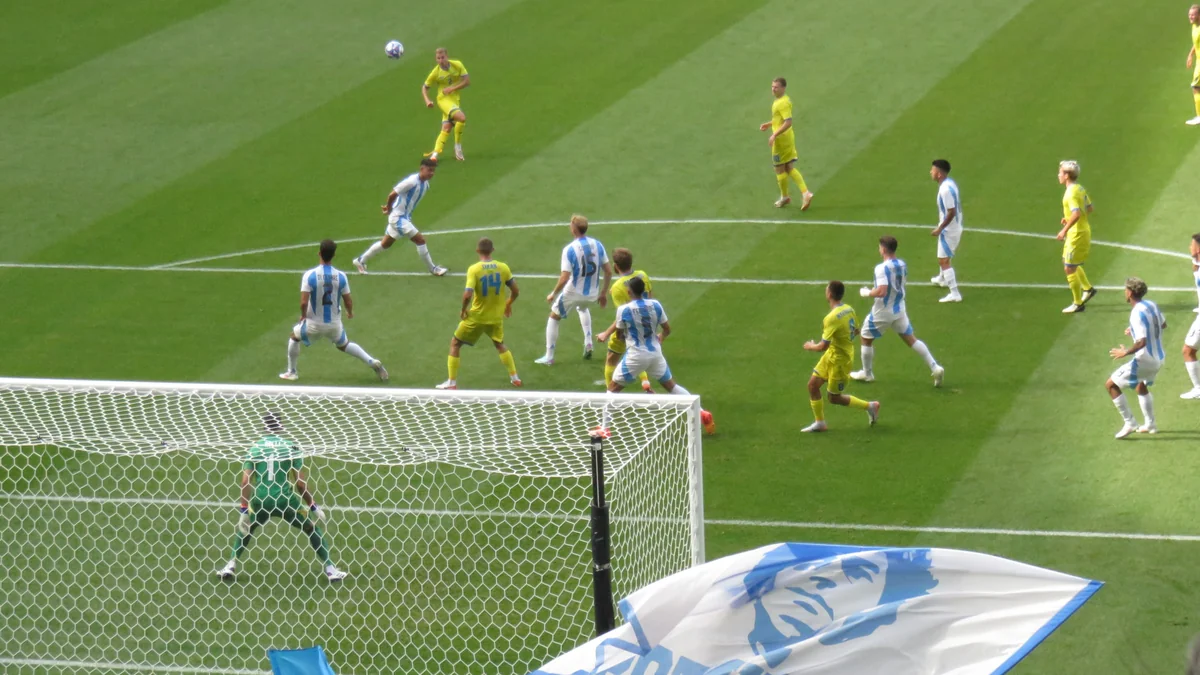
Match-context note: Icardi’s per-match shots and goal involvement across his Süper Lig and Champions League appearances sit in the upper band for centre-forwards (Match data: SofaScore), with the discriminator being the consistency of the conversion rate across half-chance shot quality rather than any single peak performance.
Flickr: Miami U. Libraries – Digital Collections.
What This Means for the Reader
For developing strikers and the coaches working with them, the takeaway is that shot-conversion economy is a real, trainable variable distinct from raw pace, jump and shot power. The transferable diagnostic uses three measurements: a shots-per-finishing-opportunity count in small-sided games (positional reading), a one-touch-vs-multi-touch finishing breakdown across a training block (kinetic-chain efficiency under cue), and a session-by-session log of arrival-time-relative-to-cross delivery to track whether the perceptual layer is sharpening or dulling under fatigue [3, 4, 5].
The training prescription targets the diagnostic finding. Athletes whose pure-output metrics are mid-range but whose finishing-zone arrival is consistently early benefit from continued investment in cue-reading drills, constraint-led small-sided games and crossing-and-finishing rehearsal under tactical variation; athletes whose finishing arrival drops sharply under fatigue benefit from aerobic-substrate work to lift the carrier, not just from more finishing reps [1, 2]. The most common error in amateur development is treating shot power and jump height as the discriminators and dismissing the positional-arrival specialist as “not athletic”; the elite literature treats the positional-arrival specialist as a fully realised variant.
The diagnostic question for the developing forward: when the cross arrives, am I already in the finishing zone, or am I still arriving? The honest answer changes the meaning of the conditioning programme.
References
- Stølen T, Chamari K, Castagna C, Wisløff U. (2005). Physiology of soccer: an update. Sports Medicine, 35(6): 501–536. doi:10.2165/00007256-200535060-00004
- Bangsbo J, Mohr M, Krustrup P. (2006). Physical and metabolic demands of training and match-play in the elite football player. Journal of Sports Sciences, 24(7): 665–674. doi:10.1080/02640410500482529
- Mohr M, Krustrup P, Bangsbo J. (2003). Match performance of high-standard soccer players with special reference to development of fatigue. Journal of Sports Sciences, 21(7): 519–528. doi:10.1080/0264041031000071182
- Bradley PS, Sheldon W, Wooster B, Olsen P, Boanas P, Krustrup P. (2009). High-intensity running in English FA Premier League soccer matches. Journal of Sports Sciences, 27(2): 159–168. doi:10.1080/02640410802512775
- Young W, Farrow D. (2006). A review of agility: practical applications for strength and conditioning. Strength and Conditioning Journal, 28(5): 24–29. doi:10.1519/00126548-200610000-00004
Match-context data (descriptive only): SofaScore.

Hüseyin Akbulut is the founder of Sporeus and author of THRESHOLD (EŞİK), a 540-page Turkish-language book on endurance science.
- 540pp THRESHOLD Book
- MSc Sport Sciences
- Marmara University
The Athlete in One Paragraph
Mauro Emanuel Icardi (b. 1993-02-19, Rosario, Santa Fe, Argentina) is a striker formerly of Galatasaray (2022–2026) and historically a fixture of the Argentina national-team conversation, with a senior career stretching back through Sampdoria and Inter Milan to a recent role as the figurehead of a…
The Physiology — what shot-conversion economy actually measures
Match-running and metabolic decomposition of football show that the striker's profile is dominated by short, intense bursts inside a long low-intensity baseline rather than by sustained high-output running. Stølen, Chamari, Castagna and Wisløff's physiology-of-soccer review framed the position-specific load: forwards cover less total distance than…
The Case — Icardi as minimal-touch finishing archetype
For a 1.81 m / 75 kg striker generating extended finishing volumes across Italian, French and Turkish football without elite top-end speed or jump output, the signature has to come from the perceptual-motor layer rather than from the athletic-output layer. The candidate is shot-conversion economy:…
What This Means for the Reader
For developing strikers and the coaches working with them, the takeaway is that shot-conversion economy is a real, trainable variable distinct from raw pace, jump and shot power. The transferable diagnostic uses three measurements: a shots-per-finishing-opportunity count in small-sided games (positional reading), a one-touch-vs-multi-touch finishing…