
Preview
Hüseyin Akbulut, MSc (2026). Lucy Charles-Barclay and the Swim-Strong Triathlete Front-Pack Economy of an Elite Long-Course Athlete. Sporeus. Retrieved, October 10, 2026. https://sporeus.com/en/science/lucy-charles-barclay-swim-strong-triathlete-front-pack-economy/
The Athlete in One Paragraph
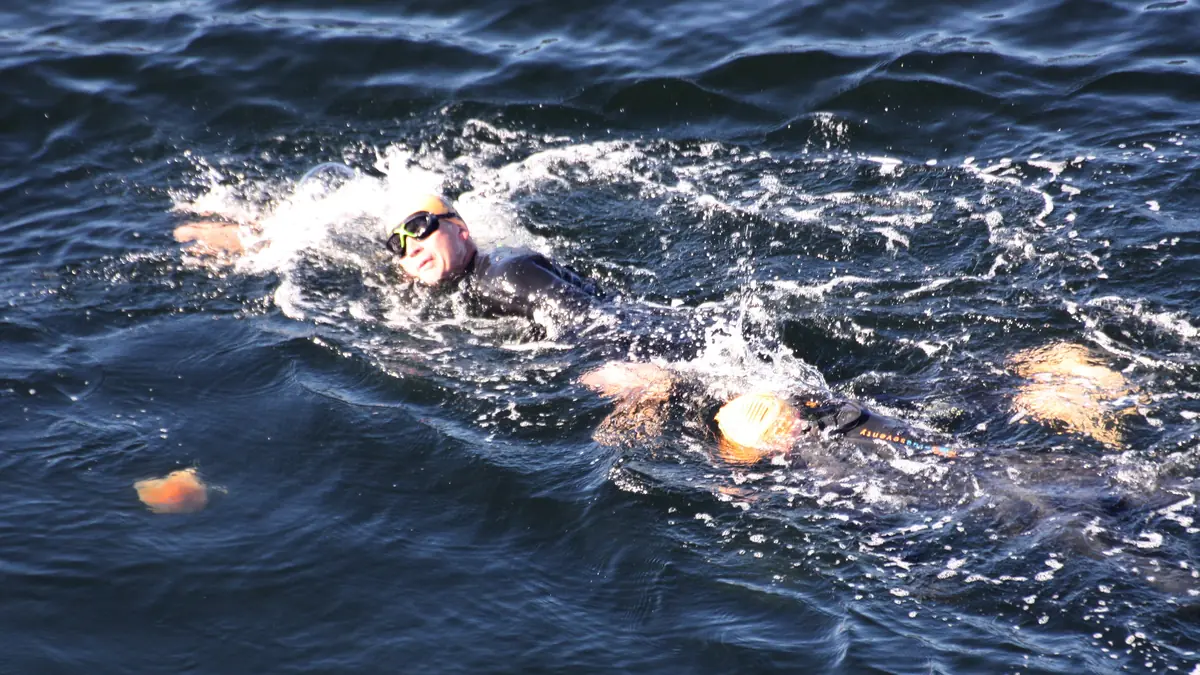
Lucy Charles-Barclay (b. 1993-08-08, Essex, England, United Kingdom) is a long-course triathlete and the 2023 IRONMAN World Champion, with a competitive lineage in elite-level swimming that preceded her transition to triathlon and that continues to define her race-day signature. Listed at 1.78 m and ~64 kg, she carries the long-frame, swim-shouldered, lean-lower-body anthropometry that the swim-strong long-course archetype tends to select for, and the racing pattern that follows from it: leading out of the water by a meaningful margin, riding the bike at the front rather than off another rider’s pace, and defending that position into the marathon. The interesting case for sport science is not any single Kona swim split but the underlying economic question: what does the physiological profile of a swim-strong triathlete who paces from the front actually require, and how does that profile differ from the run-strong archetype that arrives at the run from a mid-pack bike with the legs of the leader to chase down? The answer lives in the literature on running economy, lactate-threshold concepts, multi-modal endurance physiology, and the high-intensity-interval training that builds the substrate underneath all of it.
Table of Contents
The Physiology — what front-pack triathlon economy actually requires
Long-course triathlon is, at its core, a multi-hour sub-threshold pacing problem expressed across three biomechanically dissimilar modes of locomotion within a single continuous event. Joyner and Coyle’s framework of endurance-of-champions — the interaction of VO₂max, lactate threshold, and the economy with which oxygen is used — applies cleanly to each leg, but the multi-hour, three-modality structure introduces a fourth implicit factor: the carry-over of residual fatigue and the strategic allocation of submaximal intensity from the leg already finished into the leg yet to come [1]. The swim-strong front-pack athlete enters that allocation problem from a different starting condition than the run-strong chaser, and the constraint set she operates under is not the same.
Saunders and colleagues’ synthesis of the determinants of running economy — stride mechanics, tendon stiffness, neuromuscular efficiency, accumulated training history — explains why the run is the leg in which the day’s prior allocations finally get expressed [2]. A more economical runner uses less oxygen at a given pace, which means the same fraction of VO₂max yields a faster sustainable pace; for the front-pack rider arriving on the run with a lead, the run economy is what either defends or surrenders that lead.
Faude, Kindermann and Meyer’s review of lactate-threshold concepts adds the strategic-pacing layer [3]. Whether the threshold is identified by a non-linear lactate deflection, by maximal lactate steady state, or by a critical-power equivalent, the underlying biology is the same — the highest sustainable submaximal intensity at which production and clearance balance — and the long-course athlete’s bike pace must sit below the bike-leg threshold by enough margin to leave the run-leg threshold defendable. For the front-pack rider, the temptation is to defend the lead with intensity that compromises the marathon to come.
Buchheit and Laursen’s HIIT framework explains why the athlete with a higher VO₂max ceiling and a more refined HIIT-trained recovery system can hold a higher fraction of threshold for longer without paying the late-event price [4]. The training stimulus is not a single modality of work — it is a deliberate manipulation of work duration, intensity, recovery duration, and recovery modality across the three sport-specific environments, with the explicit constraint that the run-leg economy must survive the bike-leg load.
Helgerud, Engen, Wisløff and Hoff’s classic on aerobic-interval training rounds out the picture [5]. A higher aerobic engine is not just a higher-distance ceiling — it is a faster-recovery substrate between supra-threshold demands, and across a multi-hour event the cumulative recovery savings translate into a higher defendable submaximal pace from start to finish. The swim-strong front-pack athlete pays for the lead from the water with the aerobic substrate that defends it through the bike and into the run.
The Case — Charles-Barclay as front-pack economy lens
For a 1.78 m / ~64 kg long-course athlete with an elite-swimming pedigree and a 2023 Kona title to her record, the race profile is the cleanest applied case of front-pack pacing economy under championship conditions. The visible elements — leading out of the water by a margin that splits the field, riding the bike from the front rather than from a tactical draft window, and defending the marathon at race pace rather than chasing it — map onto exactly the pacing-and-economy variables the literature would expect of a swim-strong front-pack archetype [1, 3, 4].
The swim-strong starting condition has structural consequences for the bike. The front-pack rider does not get the (legal-or-otherwise) energy-cost reduction that comes from riding in another rider’s slipstream window where draft-illegal long-course pacing rules permit it; she rides the entire bike leg solo at the front, paying the full aerodynamic cost on her own substrate [1, 4]. The pacing discipline this imposes — holding a defendable wattage under the temptation to extend the lead — is what protects the run economy that follows.
The under-discussed dimension is the run-economy carry-over. Saunders’ framework reads like a description of a runner whose stride mechanics, tendon stiffness, and neuromuscular efficiency must survive arriving at the run start with quadriceps that have produced wattage solo for the entire bike [2]. The run economy that defends a Kona-winning marathon is not the same number as the open-marathon economy of the same athlete; the gap between them is what brick-work training closes.
The threshold-allocation layer is the pacing strategy made explicit. Faude’s review and Buchheit and Laursen’s HIIT prescription together describe the picture: the bike intensity must sit below the bike-leg threshold, and the bike-leg threshold itself must sit at an intensity that leaves enough run-leg threshold available to defend the marathon at race pace [3, 4]. The front-pack rider who treats the bike as a separable problem and pushes wattage toward the bike-leg threshold pays for it across the marathon to come.
(Performance data: World Triathlon / IRONMAN) Across her long-course record, Charles-Barclay’s swim splits, front-pack bike-pacing pattern, and Kona run defence in 2023 are the operational expression of an aerobic-substrate-and-economy profile that the front-pack archetype requires; the discriminator is less peak swim speed than the multi-leg allocation that lets that swim split survive the bike and the marathon.

What This Means for the Reader
For the developing long-course athlete, the lesson is that the swim-strong front-pack profile is not a swimming problem; it is a multi-leg economy problem that pays for the swim lead with disciplined bike pacing and protects the run economy with substrate accumulated across years of HIIT-trained aerobic interval work [1, 2, 3, 4, 5]. The athlete who leads out of the water and then rides the bike too aggressively converts a tactical advantage into a marathon-leg liability.
Practical assessment for amateurs: track three indicators across a training block — a sub-threshold sustainable-pace reference (a 30-to-60-minute time trial or critical-power test), a brick-economy reference (a bike-to-run transition workout with the run pace at a fixed perceived-exertion level as the variable of interest), and an aerobic-recovery reference (heart-rate recovery one minute after a standard interval). Drift in any one is the early signal that the front-pack economy is moving the wrong way [4, 5].
The diagnostic question for the athlete: at what bike intensity, expressed as a fraction of my threshold wattage, does my run pace begin to collapse — and is the wattage I am actually choosing on race day above or below that line?
References
- Joyner MJ, Coyle EF. (2008). Endurance exercise performance: the physiology of champions. Journal of Physiology, 586(1): 35–44. doi:10.1113/jphysiol.2007.143834
- Saunders PU, Pyne DB, Telford RD, Hawley JA. (2004). Factors affecting running economy in trained distance runners. Sports Medicine, 34(7): 465–485. doi:10.2165/00007256-200434070-00005
- Faude O, Kindermann W, Meyer T. (2009). Lactate threshold concepts: how valid are they? Sports Medicine, 39(6): 469–490. doi:10.2165/00007256-200939060-00003
- Buchheit M, Laursen PB. (2013). High-intensity interval training, solutions to the programming puzzle. Sports Medicine, 43(5): 313–338. doi:10.1007/s40279-013-0029-x
- Helgerud J, Engen LC, Wisløff U, Hoff J. (2001). Aerobic endurance training improves soccer performance. Medicine and Science in Sports and Exercise, 33(11): 1925–1931. doi:10.1097/00005768-200111000-00019
Performance-context data (descriptive only): World Triathlon / IRONMAN.
Hüseyin Akbulut is the founder of Sporeus and author of THRESHOLD (EŞİK), a 540-page Turkish-language book on endurance science.
- 540pp THRESHOLD Book
- MSc Sport Sciences
- Marmara University
The Athlete in One Paragraph
Lucy Charles-Barclay (b. 1993-08-08, Essex, England, United Kingdom) is a long-course triathlete and the 2023 IRONMAN World Champion, with a competitive lineage in elite-level swimming that preceded her transition to triathlon and that continues to define her race-day signature. Listed at 1.78 m and ~64…
The Physiology — what front-pack triathlon economy actually requires
Long-course triathlon is, at its core, a multi-hour sub-threshold pacing problem expressed across three biomechanically dissimilar modes of locomotion within a single continuous event. Joyner and Coyle's framework of endurance-of-champions — the interaction of VO₂max, lactate threshold, and the economy with which oxygen is used…
The Case — Charles-Barclay as front-pack economy lens
For a 1.78 m / ~64 kg long-course athlete with an elite-swimming pedigree and a 2023 Kona title to her record, the race profile is the cleanest applied case of front-pack pacing economy under championship conditions. The visible elements — leading out of the water…
What This Means for the Reader
For the developing long-course athlete, the lesson is that the swim-strong front-pack profile is not a swimming problem; it is a multi-leg economy problem that pays for the swim lead with disciplined bike pacing and protects the run economy with substrate accumulated across years of…