Preview
Hüseyin Akbulut, MSc (2026). Mete Gazoz and the Archery Postural Stability and Shoulder Isometric Endurance of an Elite Recurve Archer. Sporeus. Retrieved, October 3, 2026. https://sporeus.com/en/science/mete-gazoz-archery-postural-stability-and-shoulder-isometric-endurance/
The Athlete in One Paragraph
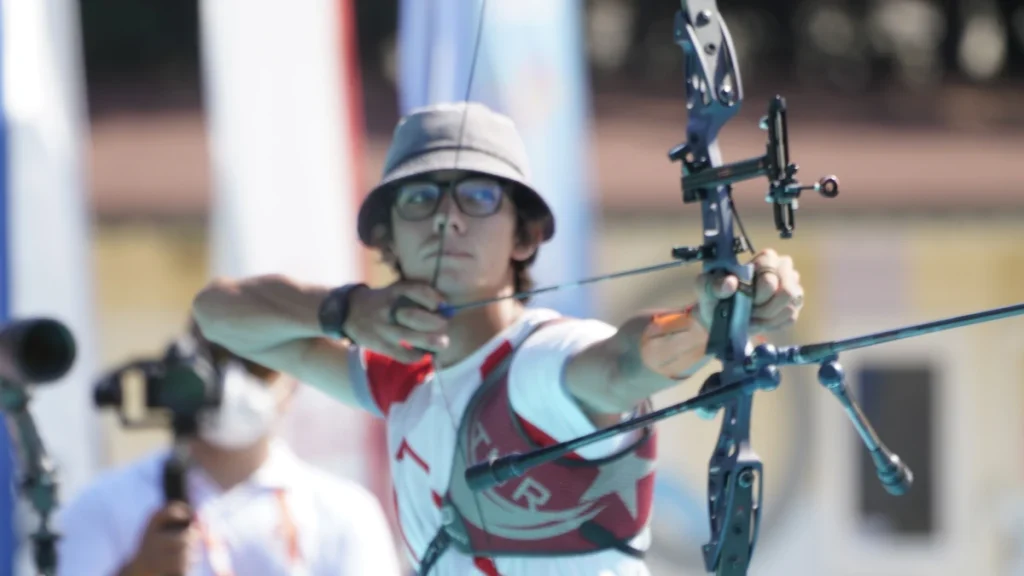
Mete Gazoz (b. 1999-07-08, İstanbul, Türkiye) is a recurve archer for Türkiye and the Tokyo 2020 Olympic champion in the men’s individual recurve, the first Turkish archer to win Olympic gold in the discipline. Listed at 1.83 m and roughly 78 kg, he carries the lean, long-spanned build characteristic of elite recurve — proportions that favour a long draw at consistent geometry, with the upper-body and scapular musculature supporting an isometric load held for the seconds between full draw and release. The interesting case for sport science is not any single ten-ring arrow; it is the structural question of how an archer holds the geometry of the bow constant across hundreds of arrows in a competition day, against a heart-rate that climbs in elimination matches, against the postural sway every standing human exhibits, against the small wind and balance perturbations that a release tunes out. The variable underneath that pattern is archery postural stability and shoulder isometric endurance — the integration of static-load endurance, postural sway minimisation under cardiovascular stress, and the breath-cycle coordination that anchors the release.
Table of Contents
The Physiology — what archery postural stability and shoulder isometric endurance actually are
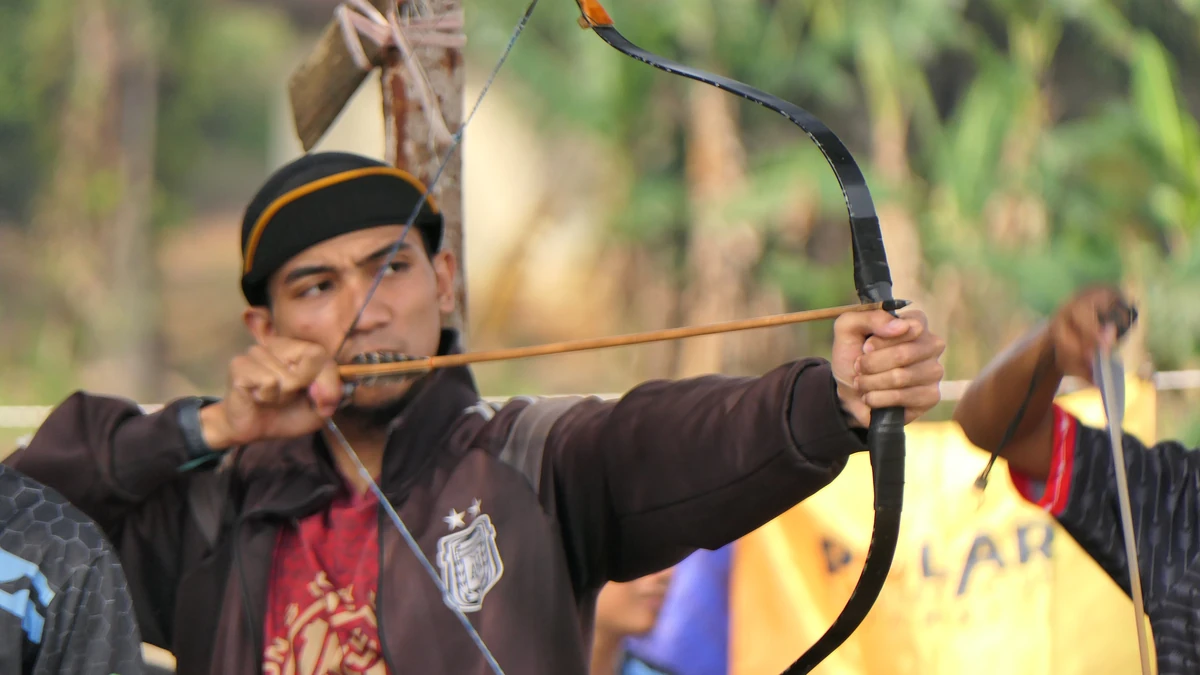
A recurve shot is, in mechanical terms, a sequence held in static equilibrium and then released through a near-instantaneous transition. The archer raises the bow, draws to a fixed anchor on the face, holds while aim, breath, and decision align, and releases the string by relaxing the fingers into a back-tension move. The duration of the hold is short in absolute terms — typically a few seconds — but the geometry of bow, body, and arrow during that hold determines where the arrow goes. Any loss of geometry — a drift in shoulder line, a sway in the trunk, a tremor in the draw arm — is a loss of accuracy. The performance variable is not maximum strength; it is the ability to keep a moderate isometric load stable, repeatedly, across a competition day [1, 4].
Wisløff and colleagues’ work on strength-power relationships establishes that the strength reserve underlying a sport-specific action is what determines whether that action is held effortlessly or held with tremor [1]. For the recurve archer, the relevant strength is not maximum back-squat but the back-and-shoulder isometric reserve at the draw position; an athlete whose isometric maximum at that geometry sits well above the draw weight holds the bow with a smaller fraction of available capacity, and therefore with less tremor and less neuromuscular cost. Stølen and colleagues’ broader review reinforces that endurance-of-effort variables — including isometric endurance — sit on a foundation of repeatable submaximal work tolerance, which is itself trainable [2].
Sheppard and Young’s agility framework, although developed for change-of-direction in field sports, includes a perceptual-motor component that translates directly: the ability to integrate sensory input — visual aim, proprioceptive position sense, vestibular balance — into a stable motor output under time pressure [3]. For the archer, that integration is not the change-of-direction problem; it is the postural-sway problem. Standing humans are never perfectly still; the centre of pressure under the feet oscillates continuously, and the archer’s task is to minimise the amplitude and frequency of that oscillation during the hold so that the bow geometry stays within tolerance.
Young and Farrow’s review of agility for strength and conditioning extends the same principle: motor control under stress requires both physical capacity (the strength and endurance to execute) and perceptual-cognitive capacity (the attentional control to direct that execution) [4]. For the archer in elimination matches, with heart rate elevated and the field reduced to a single arrow per shot, the perceptual-cognitive load competes with the postural-control load for the same attentional resource; the athletes who hold their geometry under that competition are the athletes who win.
Bangsbo, Mohr and Krustrup’s metabolic-demands work, although developed for intermittent team sport, frames the cardiovascular dimension: a heart rate elevated by anxiety or exertion is also an increased respiratory rate, a higher-amplitude breath cycle, and a body whose postural-control system is fighting the same internal perturbations the bow geometry needs damped [5]. The breath-cycle coordination is not optional decoration; it is a core element of the technique.
The Case — Gazoz as a recurve postural-stability and shoulder-endurance case
For a 1.83 m / ~78 kg recurve archer at the top of the discipline, the signature feat is not the gold-medal arrow at Tokyo but the cumulative consistency of arrow placement across hundreds of arrows in qualification rounds, head-to-head matches, and the elimination ladders that decide an Olympic title [1, 4]. The arithmetic of a competition day — roughly the equivalent of holding the draw, repeatedly, for several seconds at a time, across a sustained number of attempts — is paid through the integration of shoulder-and-back isometric endurance, postural-sway minimisation, and breath-cycle coordination.
His anthropometry is consistent with the recurve archetype. A long span, in proportion to the rest of the body, supports a long draw at consistent geometry; the lean upper-body distribution favours the static-load endurance profile over a maximum-power profile; and a stable trunk over a stable lower-body base is what keeps the bow geometry within the tolerance that a ten-ring arrow demands [1, 2]. The training implication is not bodybuilding-style hypertrophy of the back and shoulders, but isometric-endurance work at the draw geometry, programmed alongside specific postural-control work for the standing platform.
The postural-stability question is where archery diverges most clearly from the field sports. Sheppard and Young, alongside Young and Farrow, frame the perceptual-motor problem: the archer must hold geometry while perceiving aim, while feeling the back-tension move, while monitoring breath, while ignoring the perturbations the body’s own physiology is producing [3, 4]. The training implication is that postural-control work at the bow is not a warm-up; it is a primary stimulus, and time spent holding the geometry — empty-bow, light-resistance, full-draw — is time spent training the variable that separates a clean ten from a near-ten.
The cardiovascular dimension is where elimination matches turn. Bangsbo and colleagues’ work on heart rate and respiratory cost during sustained efforts reminds that the same cardiovascular surge that accompanies a high-stakes round is also a surge in postural-control noise [5]. The training implication is that breath-cycle coordination, practised under elevated heart-rate conditions — a deliberate stressor introduced into the training environment — is what makes the technique tournament-proof.
(Performance data: World Archery)
What This Means for the Reader
For the developing recurve archer, the lesson is that the technique is built on three legs that are usually trained separately but must operate together: shoulder-and-back isometric endurance at the draw geometry, postural-sway minimisation on the standing platform, and breath-cycle coordination that anchors the release across a heart-rate range [1, 3, 4]. The temptation to chase maximum draw weight — a strength-side variable — without the corresponding endurance and postural work is the temptation to build a strong but unstable shot.
The training prescription depends on the gap. Isometric-endurance-limited athletes need timed holds at the draw geometry, programmed across the training week; postural-control-limited athletes need standing-balance work on the bow platform, with and without the bow; cardiovascular-coordination-limited athletes need breath-cycle drills practised at elevated heart rate so the technique survives the elimination round [2, 5]. The three legs reinforce each other; collapsing one exposes the other two.
The diagnostic question for the developing archer: when my arrow drifts under pressure, is it because my shoulder gave out, my body swayed, or my breath cycle desynchronised from the release?
References
- Wisløff U, Castagna C, Helgerud J, Jones R, Hoff J. (2004). Strong correlation of maximal squat strength with sprint performance and vertical jump height in elite soccer players. British Journal of Sports Medicine, 38(3): 285–288. doi:10.1136/bjsm.2002.002071
- Stølen T, Chamari K, Castagna C, Wisløff U. (2005). Physiology of soccer: an update. Sports Medicine, 35(6): 501–536. doi:10.2165/00007256-200535060-00004
- Sheppard JM, Young WB. (2006). Agility literature review: classifications, training and testing. Journal of Sports Sciences, 24(9): 919–932. doi:10.1080/02640410500457109
- Young W, Farrow D. (2006). A review of agility: practical applications for strength and conditioning. Strength & Conditioning Journal, 28(5): 24–29. doi:10.1519/00126548-200610000-00004
- Bangsbo J, Mohr M, Krustrup P. (2006). Physical and metabolic demands of training and match-play in the elite football player. Journal of Sports Sciences, 24(7): 665–674. doi:10.1080/02640410500482529
Performance data (descriptive only): World Archery.
The Athlete in One Paragraph
Mete Gazoz (b. 1999-07-08, İstanbul, Türkiye) is a recurve archer for Türkiye and the Tokyo 2020 Olympic champion in the men's individual recurve, the first Turkish archer to win Olympic gold in the discipline. Listed at 1.83 m and roughly 78 kg, he carries the…
The Physiology — what archery postural stability and shoulder isometric endurance actually are
A recurve shot is, in mechanical terms, a sequence held in static equilibrium and then released through a near-instantaneous transition. The archer raises the bow, draws to a fixed anchor on the face, holds while aim, breath, and decision align, and releases the string by…
The Case — Gazoz as a recurve postural-stability and shoulder-endurance case
For a 1.83 m / ~78 kg recurve archer at the top of the discipline, the signature feat is not the gold-medal arrow at Tokyo but the cumulative consistency of arrow placement across hundreds of arrows in qualification rounds, head-to-head matches, and the elimination ladders…
What This Means for the Reader
For the developing recurve archer, the lesson is that the technique is built on three legs that are usually trained separately but must operate together: shoulder-and-back isometric endurance at the draw geometry, postural-sway minimisation on the standing platform, and breath-cycle coordination that anchors the release…