Preview
Hüseyin Akbulut, MSc (2026). Simone Biles and the Aerial Spatial Orientation of an Elite Gymnast. Sporeus. Retrieved, September 27, 2026. https://sporeus.com/en/science/simone-biles-gymnastics-aerial-spatial-orientation/
The Athlete in One Paragraph
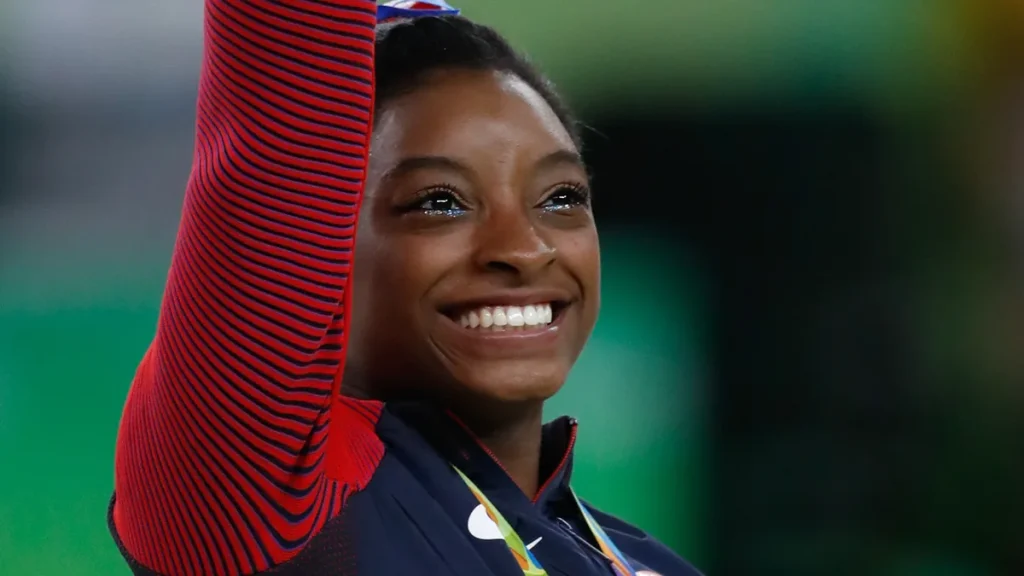
Simone Arianne Biles (b. 1997-03-14, Columbus, Ohio, United States) competes for the United States and is, by Olympic and World Championship medal count, the most decorated gymnast in the recorded history of the sport, with the Yurchenko double pike — a vault that no other woman has performed in international competition — codified in the FIG Code of Points under her name. Listed at 1.42 m and approximately 47 kg, Biles is small even by elite-gymnastics anthropometry, and the small lever arms shorten the rotational moment of inertia in a way that is mechanically advantageous for multi-axis aerial work; the variable that her career foregrounds, however, is not the body itself but the perceptual machinery that places that body in space — aerial spatial orientation, the integrated vestibular-and-visual capacity to track body position during multi-axis rotation. The 2021 Tokyo “twisties” episode, in which Biles withdrew from several event finals after losing the in-air sense of where her body was during a vault, made the variable visible to a general audience: when the perception-action coupling that places the gymnast in space breaks down, the most decorated athlete in the discipline is no safer than a club-level competitor.
Table of Contents
The Physiology — what aerial spatial orientation actually is
Aerial spatial orientation is the in-flight integration of three perceptual streams: the vestibular signal from the semicircular canals and otolith organs, the visual signal from intermittent fixation on the floor or apparatus during rotation, and the proprioceptive signal from the limb and trunk segments. Sheppard, Young, Doyle, Sheppard and Newton’s framing of agility as a perception-action coupled task — first articulated for change-of-direction work — extends to aerial gymnastics in the sense that the in-flight skill is also an open skill: the gymnast must read the rotation rate against the time-to-landing and modulate body position in real time, rather than executing a pre-loaded motor program from gun to landing [1]. A gymnast who is over-rotating must close the body to add angular velocity or open it to bleed angular velocity, and the decision is perceptual.
Young and Farrow’s review of agility distinguished perceptual factors from decision-making factors and from the underlying motor-output capacity [2]. Aerial gymnastics maps onto the same three layers: the perceptual layer reads vestibular and visual cues, the decision-making layer chooses tuck-versus-pike-versus-layout adjustments, and the motor-output layer executes hip and shoulder torque under gravitational and rotational load. A breakdown in any of the three produces the same observable failure — bad landing — but the appropriate intervention differs by layer.
Henry, Dawson, Lay and Young quantified the cost of decision errors in reactive contexts: a misread cue adds hundreds of milliseconds to the response, and in a gymnastics aerial — where the entire skill is bounded by approximately one to one-and-a-half seconds of flight time — there is no margin for that magnitude of delay [3]. The “twisties” phenomenon is the gymnastics-specific signature of a perception-action coupling that has decoupled: the gymnast initiates the skill, but the in-flight perceptual update that confirms body position relative to the landing surface fails to arrive on time, and the motor program runs without the corrective stream it depends on.
Wisløff, Castagna, Helgerud, Jones and Hoff’s strength-to-jump correlation, while developed in a soccer context, anchors the underlying neuromuscular capacity that the gymnast needs to enter the rotation with sufficient angular momentum to complete the skill in the available flight time [4]. A vault or a tumbling pass is bounded upstream by the takeoff impulse; if the gymnast is force-deficient, the rotation rate is too slow and no amount of in-air orientation can rescue the skill. Stølen, Chamari, Castagna and Wisløff’s wider physiology synthesis frames the same relationship between strength capacity and ballistic athletic output across disciplines [5].
The takeaway is that aerial spatial orientation is a multi-layer skill — perceptual, decisional, mechanical — and the failure modes are layer-specific: a force-deficient takeoff, a vestibular-visual integration breakdown and a decision error are three different problems with three different remediation pathways, even when the observable outcome is identical.
The Case — Biles as the lens for a perceptual variable
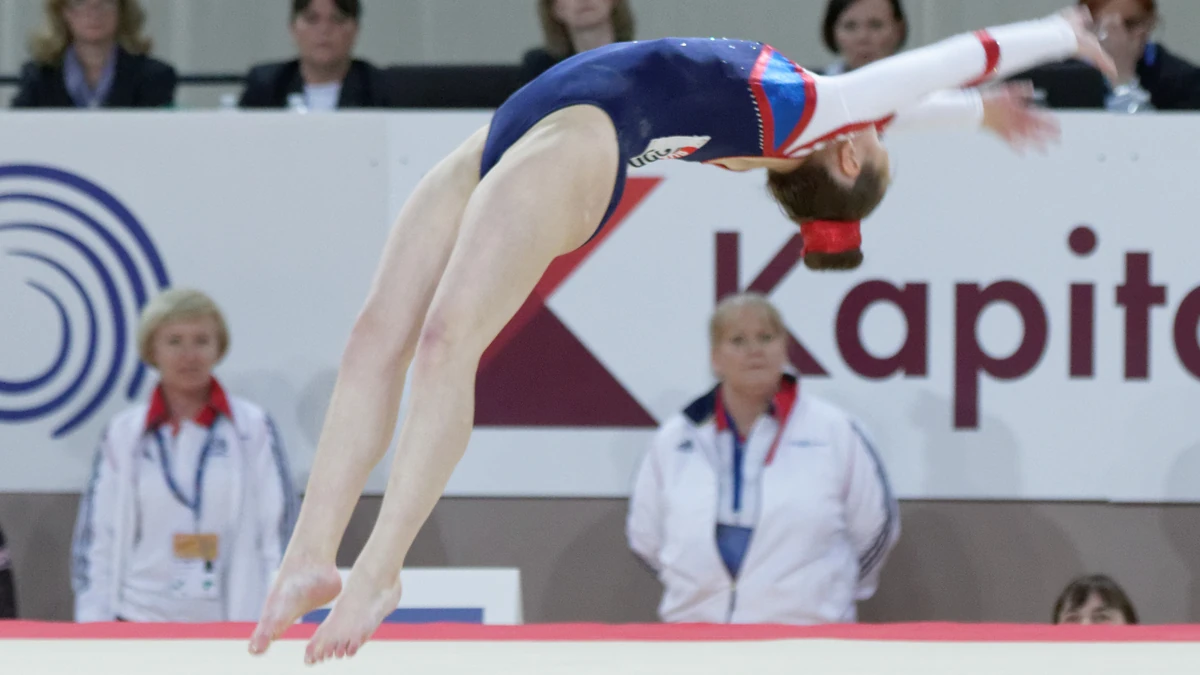
For a 1.42 m / 47 kg gymnast at the upper bound of recorded skill difficulty, the small body produces a low rotational moment of inertia that allows angular velocities other gymnasts cannot reach within the flight envelope; the upstream takeoff capacity is consistent with the strength-to-power relationships documented in the broader athletic literature [4, 5]. The Yurchenko double pike — two flips in the piked position from a Yurchenko entry — is, mechanically, an extreme demand on takeoff impulse and on the perceptual stream that reads the rotation against the landing.
The 2021 “twisties” episode is the case study for what the perceptual layer looks like when it fails. Biles described losing the sense of where her body was in the air during the vault rotation; the description maps directly onto a vestibular-visual integration breakdown rather than onto a strength or decision-making deficit [1, 2, 3]. The intervention — withdrawing from the event — was the appropriate one for a perceptual-layer failure, because the motor program runs without the corrective stream and the landing risk is not modifiable by trying harder. A gymnast can train through a strength deficit; a gymnast cannot train through a decoupled perception-action loop in real time without injury risk.
The under-discussed dimension is that the perceptual layer is itself trainable, and Biles’s return to international competition in 2023 and her Paris 2024 gold medals indicate that the integration breakdown is not necessarily permanent [1, 2]. The trainable surface includes graded re-exposure to rotation, visual-cue manipulation under controlled conditions, and the reduction of cognitive load that often accompanies recovery of a previously automatic in-air program.
(Performance data: FIG)

What This Means for the Reader
For a developing gymnast — and more broadly for any athlete in a discipline with significant aerial or rotational demand (diving, freestyle skiing, trampolining) — the diagnostic question is which layer is failing. A force-deficient takeoff appears as a chronically under-rotated skill regardless of in-air effort, and is addressed through plyometric and maximal-strength progression [4, 5]. A perceptual-layer failure appears as a sudden, episodic loss of in-air orientation in a previously automatic skill, and is addressed through graded re-exposure under reduced cognitive load, never through volume [1, 2, 3]. A decision-layer failure appears as an in-air adjustment that runs in the wrong direction, and is addressed through video-based debriefing and rotation-rate awareness work.
The single most useful framing is that aerial spatial orientation is not a courage variable; it is a perceptual-motor integration variable, and the absence of cue integration is not a character flaw to be over-ridden. The single diagnostic question is: when the skill fails, does it fail because of insufficient height, because of a wrong adjustment, or because the gymnast cannot place the body in space at all?
References
- Sheppard JM, Young WB, Doyle TLA, Sheppard TA, Newton RU. (2006). An evaluation of a new test of reactive agility and its relationship to sprint speed and change of direction speed. Journal of Science and Medicine in Sport, 9(4): 342–349. doi:10.1016/j.jsams.2006.05.019
- Young WB, Farrow D. (2006). A review of agility: Practical applications for strength and conditioning. Strength and Conditioning Journal, 28(5): 24–29. doi:10.1519/00126548-200610000-00004
- Henry GJ, Dawson B, Lay BS, Young WB. (2013). Decision-making accuracy in reactive agility: Quantifying the cost of poor decisions. Journal of Strength and Conditioning Research, 27(11): 3190–3196. doi:10.1519/JSC.0b013e31828b8da4
- Wisløff U, Castagna C, Helgerud J, Jones R, Hoff J. (2004). Strong correlation of maximal squat strength with sprint performance and vertical jump height in elite soccer players. British Journal of Sports Medicine, 38(3): 285–288. doi:10.1136/bjsm.2002.002071
- Stølen T, Chamari K, Castagna C, Wisløff U. (2005). Physiology of soccer: an update. Sports Medicine, 35(6): 501–536. doi:10.2165/00007256-200535060-00004
Performance data (descriptive only): FIG.
The Athlete in One Paragraph
Simone Arianne Biles (b. 1997-03-14, Columbus, Ohio, United States) competes for the United States and is, by Olympic and World Championship medal count, the most decorated gymnast in the recorded history of the sport, with the Yurchenko double pike — a vault that no other…
The Physiology — what aerial spatial orientation actually is
Aerial spatial orientation is the in-flight integration of three perceptual streams: the vestibular signal from the semicircular canals and otolith organs, the visual signal from intermittent fixation on the floor or apparatus during rotation, and the proprioceptive signal from the limb and trunk segments. Sheppard,…
The Case — Biles as the lens for a perceptual variable
For a 1.42 m / 47 kg gymnast at the upper bound of recorded skill difficulty, the small body produces a low rotational moment of inertia that allows angular velocities other gymnasts cannot reach within the flight envelope; the upstream takeoff capacity is consistent with…
What This Means for the Reader
For a developing gymnast — and more broadly for any athlete in a discipline with significant aerial or rotational demand (diving, freestyle skiing, trampolining) — the diagnostic question is which layer is failing. A force-deficient takeoff appears as a chronically under-rotated skill regardless of in-air…