Preview
Emre Köse (2026). Surface Physics: Why Tennis Plays Differently on Hard, Clay, and Grass. Sporeus. Retrieved, October 13, 2026. https://sporeus.com/en/tennis/tennis-surface-physics-hard-clay-grass/
A tennis ball does not behave the same on every surface, and this fact shapes every tactical decision a player makes more than they probably realize. The differences between hard, clay, grass, and indoor are not aesthetic preferences. They are different physics. The ball hits the ground with the same velocity, the same angle, the same spin — and leaves with different speeds, different angles, and different residual spin depending on what it just hit. Understanding the physics is the difference between adapting to a surface and being defeated by it.
Table of Contents
What happens at the bounce
When a tennis ball strikes the court, three things happen in roughly two milliseconds. The ball deforms against the surface. Friction between the ball and the surface acts horizontally, decelerating the horizontal velocity. The vertical velocity is reversed and rebounded, with some energy lost to deformation. The interaction between these processes — how much friction, how much vertical bounce, how the spin interacts with the friction — defines what we call “pace” of a surface.
The physical quantity that matters most is the coefficient of friction at the surface. High friction surfaces grip the ball; the horizontal velocity drops sharply, the spin transfers strongly into the bounce, and the ball leaves with reduced pace and modified angle. Low friction surfaces let the ball skid; horizontal velocity stays high, spin barely transfers, and the ball leaves with similar pace to what it arrived with. This is why clay courts feel slow and grass courts feel fast — they are.
The other quantity is the coefficient of restitution, which governs how much vertical energy survives the bounce. A bouncy surface restores more energy and produces higher bounces. A dead surface absorbs more and produces lower bounces. Most courts have similar restitution coefficients within a narrow range, so the dominant difference between surfaces is the friction, not the bounce height per se — but the friction interacts with spin to amplify the bounce-height difference.
Hard court physics
The default modern surface is acrylic-painted concrete or asphalt. The friction coefficient sits in a moderate range, the restitution is moderate-to-high, and the ball behaves close to a “neutral” reference for what a tennis ball does on a court. ATP and ITF court speed measurements place most hard courts in the “medium” to “medium-fast” range, depending on the texture additives in the surface paint.
What this means tactically: the ball arrives roughly as fast as it was sent, the spin still influences the bounce but does not dominate it, and rallies sit at a duration and pace that favor a balanced game. The hard-court game is the most stylistically diverse of any surface, because no single style has an overwhelming advantage. Big servers can win behind their serve. Aggressive baseliners can dictate from the back. Counter-punchers can survive long rallies because the bounces are predictable enough to track and time.
The variation within hard courts matters. A slow hard court — the Plexicushion formerly used at the Australian Open, for example — plays closer to clay in some respects, with longer rallies and more impact of topspin on bounce. A fast hard court — older US Open DecoTurf — plays closer to grass, with shorter rallies and rewards on flatter, lower trajectories. Players should ask before a tournament: which hard court speed bucket is this? The answer changes tactical preparation.
Clay court physics
Clay courts are crushed brick or shale on a base. The surface is loose, granular, and has the highest friction coefficient of any major surface. When the ball strikes, the horizontal velocity drops sharply. The vertical energy is preserved well — clay courts are not particularly absorptive — and the spin transfers strongly into the bounce.
The high friction has two big tactical consequences. First, the ball slows down on the bounce, so rallies last longer. The percentage of points won within the first four shots drops, and the percentage of points won after the tenth shot rises. Second, the high friction amplifies topspin. A ball hit with heavy topspin bounces noticeably higher on clay than on hard court, because the spin grips the surface and bites upward as the ball leaves. This is why kick serves and topspin forehands become outsized weapons on clay — they jump up to the shoulder rather than staying at hitting-zone height.
The sliding capacity of clay is its other defining feature. The granular surface lets players slide on shots, extending reach and decelerating over distance rather than abruptly. Sliding is a separate skill from running and is one of the discriminators between players who win on clay and players who suffer on it. Sliding capability is a physical skill that has to be developed; it does not come automatically just because the surface allows it.
Grass court physics
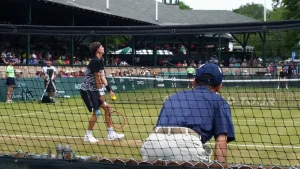
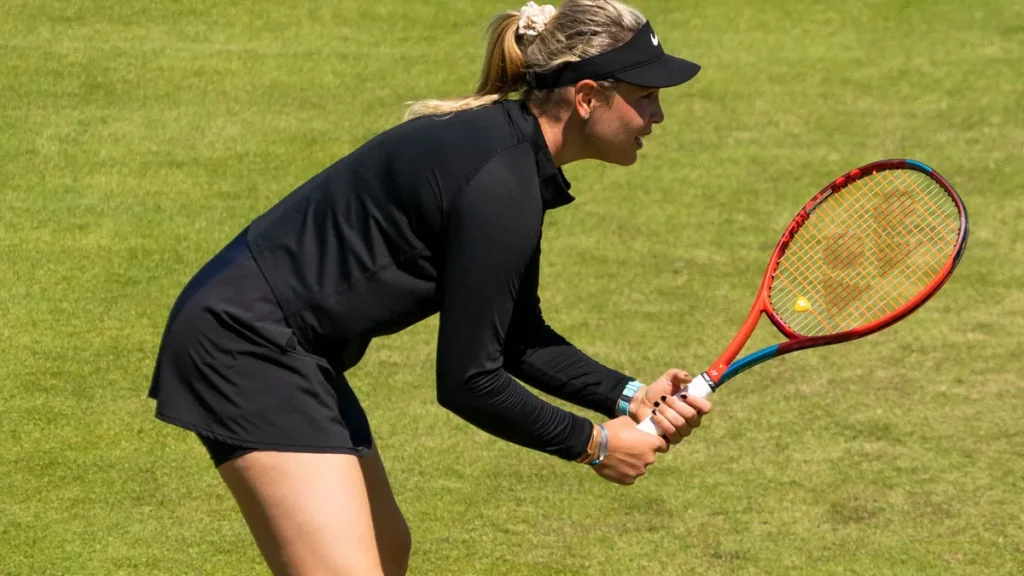
Grass is the most distinctive surface left in professional tennis. The friction coefficient is low, the restitution is moderate-to-low (the grass absorbs some energy), and the ball skids through the bounce with much of its horizontal velocity preserved. The result is fast, low-bouncing balls that arrive at the returner before the spin has had time to make a significant tactical contribution.
The tactical implication is profound. On grass, the serve is amplified — the server’s first serve points won percentages climb significantly compared to other surfaces. Returning is harder because the ball arrives sooner and lower. Topspin loses much of its tactical advantage because the low friction does not let the spin grip and kick up. Slice becomes more useful — a sliced ball already bounces low and grass amplifies the effect, producing balls that stay at ankle height for the returner. Net play becomes more rewarding because the conditions for passing shots are harder.
The grass season is short on the modern tour, and most adult players will not encounter the surface often. When they do, the adjustments are stark: lower trajectories, more flat groundstrokes, more slice, more net play, more emphasis on the serve and the first ball off it. Players who do not adjust find their topspin baseline game neutralized by physics they cannot override.
Indoor and synthetic surfaces
Indoor tennis is mostly carpet or built synthetic court, with friction and restitution coefficients varying widely between venues. The defining tactical feature of indoor is the absence of wind, sun, and outdoor environmental noise. Tactically, this rewards precision because there is no environmental factor for either player to blame.
The surface itself usually plays moderately fast and consistent — designed for tournament play, with predictable bounces and grip patterns. Many indoor surfaces play in the “medium-fast” range comparable to a quick hard court. Older carpets played quite fast; modern synthetics are typically slowed down to give returners a reasonable chance.
For an adult competitive player, indoor and outdoor hard courts produce different results that are not always attributable to the surface. Some of the difference is the lack of wind and sun. Some of it is the lighting, which makes timing the ball slightly different from sunlit play. Some of it is the audio environment, which affects the rhythm of point construction. None of these is the surface physics per se, but they all change how the surface plays in practice.
What changes between players on different surfaces
The published data on surface-specific win percentages by playing style is interesting. Across the open era, aggressive baseliners with heavy topspin show roughly twenty percent higher win rates on clay than on grass, when matched against opponents at similar overall level. Big servers show roughly the opposite pattern. Counter-punchers and defensive players cluster mildly toward clay, where extra time and predictable bounces favor patience.
For an adult competitive player, the practical question is which surface to train on if you have a choice. The answer depends on what you want to develop. Clay teaches patience, footwork, and shot construction better than any other surface, because mistakes are punished slowly and tactical play is rewarded. Hard court is the closest to a universal surface for general development. Grass is too rare and surface-specific for most adults to invest in. Indoor is a reasonable proxy for fast hard court for development purposes.
One thing to do on court tomorrow
If your next match is on a surface you do not usually play, get out forty-five minutes early and hit balls. Not warm-up, not stretching — actual ground strokes. Pay attention to two things: where the ball is bouncing relative to your hitting zone (higher than expected? lower?), and how much your topspin is jumping or dying on the bounce. Adjust your hitting trajectory before the match starts. The first set against an opponent who matched the surface in their preparation, while you were finding it in real time, is the set you lose.
Related in this series: Surface-Specific Tactics · Tennis Shoes: Surface-Specific Design · Sliding on Clay · Ball Pressurization and Ball Feel
Selected reading:
- Cross, R. (2002). Grip-slip behavior of a bouncing ball. American Journal of Physics, 70(11), 1093–1102.
- Brody, H., Cross, R., & Lindsey, C. (2002). The Physics and Technology of Tennis. Racquet Tech Publishing.
- O’Donoghue, P., & Ingram, B. (2001). A notational analysis of elite tennis strategy. Journal of Sports Sciences, 19(2), 107–115.
- ITF (International Tennis Federation). Court Pace Rating system. ITF Technical.

Tennis coach at Istanbul Beykoz Tennis Club for over 12 years. Graduate of the Coaching Education programme at Marmara University Faculty of Sport Sciences.
- 12+ Years on Court
- Graduate of Marmara University Faculty of Sport Sciences
What happens at the bounce
When a tennis ball strikes the court, three things happen in roughly two milliseconds. The ball deforms against the surface. Friction between the ball and the surface acts horizontally, decelerating the horizontal velocity. The vertical velocity is reversed and rebounded, with some energy lost to…
Hard court physics
The default modern surface is acrylic-painted concrete or asphalt. The friction coefficient sits in a moderate range, the restitution is moderate-to-high, and the ball behaves close to a "neutral" reference for what a tennis ball does on a court. ATP and ITF court speed measurements…
Clay court physics
Clay courts are crushed brick or shale on a base. The surface is loose, granular, and has the highest friction coefficient of any major surface. When the ball strikes, the horizontal velocity drops sharply. The vertical energy is preserved well — clay courts are not…
Grass court physics
Grass is the most distinctive surface left in professional tennis. The friction coefficient is low, the restitution is moderate-to-low (the grass absorbs some energy), and the ball skids through the bounce with much of its horizontal velocity preserved. The result is fast, low-bouncing balls that…
Indoor and synthetic surfaces
Indoor tennis is mostly carpet or built synthetic court, with friction and restitution coefficients varying widely between venues. The defining tactical feature of indoor is the absence of wind, sun, and outdoor environmental noise. Tactically, this rewards precision because there is no environmental factor for…