Preview
Hüseyin Akbulut, MSc (2026). The Goalkeeper: A Completely Different Physiology. Sporeus. Retrieved, November 6, 2026. https://sporeus.com/en/physiology/goalkeeper-physiology-demands-fitness/
Introduction
Every article in this series about football physiology has, implicitly, been about outfield players. But the goalkeeper occupies a position so physiologically distinct from every other player on the pitch that treating them the same way in fitness testing, conditioning, and recovery would be a fundamental error. A goalkeeper who runs 6 km and makes 3 explosive dives has worked harder in ways the GPS data cannot capture than a midfielder who ran 11 km. Understanding GK-specific physiology requires a different framework entirely.
Table of Contents
The Science
Goalkeepers cover dramatically less total distance than outfield players: 5–6 km per match on average, compared to 10–13 km for outfield players. But this comparison is misleading. GK performance is defined not by running volume, but by:
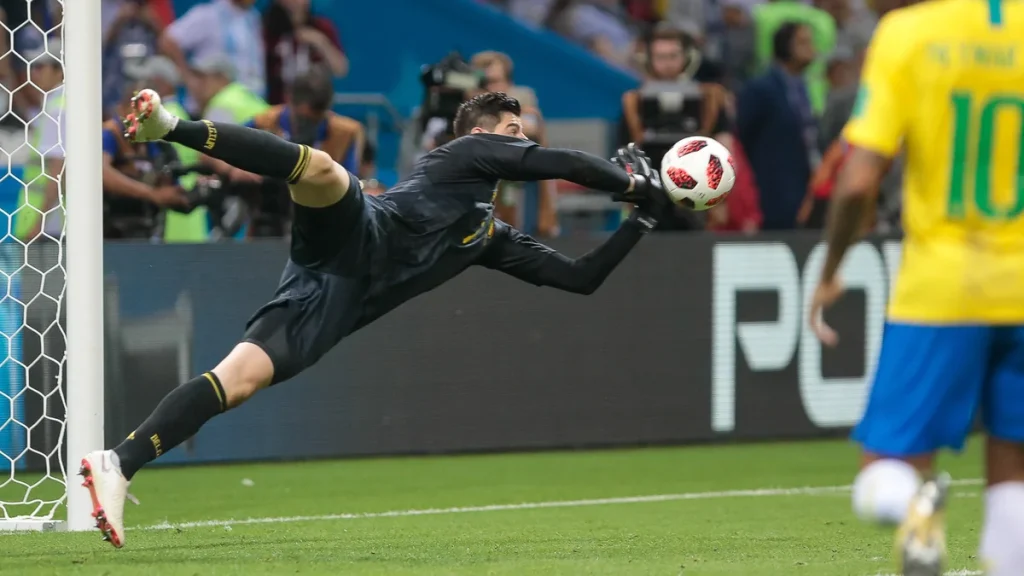
Explosive power and speed over very short distances (0–5 metres). A goalkeeper diving to their left to save a near-post shot must travel approximately 2–3 metres horizontally while simultaneously extending vertically, in under 0.5 seconds from the moment of shot contact. This requires Type II muscle fibre activation patterns that rival those of any position in the sport.
Reaction time and anticipation. The visual stimulus (ball struck), motor decision (dive direction), and movement execution all occur within 200–400 ms. At close range (penalty spot), the ball reaches the goalkeeper in approximately 350–500 ms, faster than the unassisted reaction time for most adults. Elite GKs rely on anticipatory cues (body position, hip angle) rather than reacting to the ball in flight.
Isometric loading. Goalkeepers frequently hold static positions, ready stance, aerial challenge preparation, wall alignment, involving sustained isometric contractions of the hip flexors, quadriceps, and core. This postural loading pattern differs fundamentally from the rhythmic, dynamic loading of outfield running.
Heart rate profile. GK average HR is 65–75% HRmax, significantly below the 85–90% of outfield players. But peak HR during high-intensity save sequences and aerial duels regularly reaches 90%+ for brief periods. GK cardiovascular training should target both the long, moderate-intensity base and the capacity to spike to maximal intensity from standing recovery.
Upper body and shoulder strength. Goalkeepers are the only position for whom arm and shoulder strength are primary performance capacities. Ball handling under pressure, punch clearances, and distribution from long volleys all require shoulder girdle power and stability that outfield conditioning programmes do not develop.
What Research Says
Ziv and Lidor (2011) published a comprehensive review of GK physical characteristics in International Journal of Sports Physiology and Performance, confirming that elite GKs were taller (mean 188 cm), heavier (mean 84 kg), and had higher body fat percentages (10–14%) than outfield players, anthropometric profiles consistent with their position’s demands for reach, aerial dominance, and physical contact with strikers.
Di Salvo et al. (2008) analysed the match activity of 62 goalkeepers across 109 English Premier League matches using the Prozone system, finding that goalkeepers covered a mean total distance of roughly 5,600 m with only ~11 m of sprinting and around 10 high-intensity actions per match, a fraction of outfield players’ output. More importantly, GK explosive actions (dives, jumps, sprints to close down) were clustered in match-critical moments that occurred at irregular intervals, meaning GK readiness must be maintained for very brief but extremely intense efforts after extended periods of low activity.
Cular et al. (2011) assessed the reaction time profiles of elite versus recreational GKs across standardised visual stimulus protocols and confirmed that elite GKs showed significantly faster simple reaction times (175 ms vs. 215 ms) AND superior choice reaction times, demonstrating that GK reactions are a trainable, not merely innate, capacity.
Did You Know? Research on modern GKs shows that distribution distance and accuracy have become as important as shot-stopping in elite football analysis. Manuel Neuer’s playing style, functioning as a “sweeper-keeper” who acts as an additional outfield player, has driven aerobic conditioning requirements for GKs that did not exist a generation ago. Modern elite GKs may cover up to 7–8 km per match in high-pressing systems, blurring the traditional GK/outfield physiological distinction.
Applied to Football
GK-specific conditioning addresses position-specific demands:
- Prioritise explosive power and lateral speed. Diving mechanics, jump training, and lateral shuffle drills develop the specific power profile GKs need. Standard outfield aerobic conditioning is insufficient.
- Train reaction and anticipation explicitly. Footvolley reaction drills, tennis ball facing-away catches, and video-based anticipation training all develop GK-specific perceptual speed.
- Programme upper body strength. Press variations, pull-up variations, and shoulder stability work should be integrated into GK strength training at a volume outfield players do not need.
- Account for psychological load. GKs are the most psychologically exposed position in football, every error is attributable to a specific individual. Mental skills training (emotional regulation post-mistake, focus reset) is a GK-specific training need.
- Test GKs with GK-specific metrics. Yo-Yo IR1 distances, standing broad jump, and 5-metre sprint times are more relevant GK fitness benchmarks than the 10-km total distance norms used for outfield players.
What to Remember
- GKs cover 5–6 km per match; performance is defined by explosive power, reaction time, and positional reach
- Average HR is 65–75% HRmax but spikes to 90%+ during save sequences and aerial duels
- Reaction time and anticipatory cue reading are trainable GK-specific capacities
- Upper body strength and shoulder stability are primary performance capacities for goalkeepers
- GK conditioning programmes must be specifically designed for the position, not adapted from outfield programmes
References
- Ziv, G., & Lidor, R. (2011). Physical characteristics, physiological attributes, and on-field performances of soccer goalkeepers. International Journal of Sports Physiology and Performance, 6(4), 509–524.
- Di Salvo, V., Benito, P. J., Calderón, F. J., Di Salvo, M., & Pigozzi, F. (2008). Activity profile of elite goalkeepers during football match-play. Journal of Sports Medicine and Physical Fitness, 48(4), 443–446.
- Cular, D., Katic, R., & Milat, S. (2011). Latent structure of reaction speed in handball goalkeeper. Collegium Antropologicum, 35(3), 903–908.
Next in Series: Women’s Football Physiology: Key Differences the Science Reveals
Discuss this in the forum: Conditioning for goalkeepers: what is different?

Hüseyin Akbulut is the founder of Sporeus and author of THRESHOLD (EŞİK), a 540-page Turkish-language book on endurance science.
- 540pp THRESHOLD Book
- MSc Sport Sciences
- Marmara University
Introduction
Every article in this series about football physiology has, implicitly, been about outfield players. But the goalkeeper occupies a position so physiologically distinct from every other player on the pitch that treating them the same way in fitness testing, conditioning, and recovery would be a…
The Science
Goalkeepers cover dramatically less total distance than outfield players: 5–6 km per match on average, compared to 10–13 km for outfield players. But this comparison is misleading. GK performance is defined not by running volume, but by:
What Research Says
Ziv and Lidor (2011) published a comprehensive review of GK physical characteristics in International Journal of Sports Physiology and Performance, confirming that elite GKs were taller (mean 188 cm), heavier (mean 84 kg), and had higher body fat percentages (10–14%) than outfield players, anthropometric profiles…
Applied to Football
GK-specific conditioning addresses position-specific demands: