Preview
Hüseyin Akbulut, MSc (2026). Bruno Fernandes and the High-Intensity Action Frequency of an Elite Attacking Midfielder. Sporeus. Retrieved, October 10, 2026. https://sporeus.com/en/science/bruno-fernandes-high-intensity-action-frequency/
The Athlete in One Paragraph
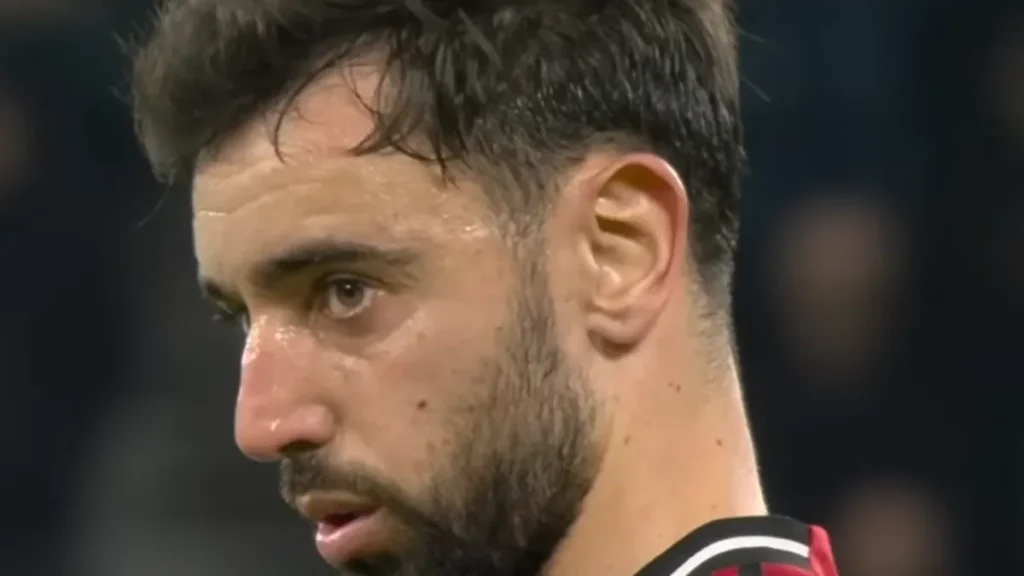
Bruno Miguel Borges Fernandes (b. 1994-09-08, Maia, Portugal) is, as of September 2026, the Manchester United captain and an attacking midfielder for the Portugal national team. Listed at 1.79 m and 69 kg, he is built lean and average-tall for the role, with a body composition skewed toward repeatable mechanical work rather than peak ballistic output. What sets him apart is not the kilometres he covers — though those are high — and not the top speed he reaches, but the density of high-intensity actions per match: the passes attempted under pressure, the off-ball runs, the tackles, the shots and the recovery sprints stacked one after another with very little dead time between them. The interesting case for sport science is the variable that defines his profile: high-intensity action frequency, the count of decisive on- and off-ball actions delivered per minute over a full 90.
Table of Contents
The Physiology — what high-intensity action frequency actually measures
Match running in elite football is the canonical intermittent stimulus: short, repeated bouts of near-maximal output layered onto a continuous low-intensity background. Bangsbo, Mohr and Krustrup decomposed the demand into the now-standard pattern — total distance ~10–12 km per match, of which ~8–12% is run above the high-intensity threshold, with the remainder distributed across walking, jogging and standing recovery [1]. The traditional metric of total distance is a coarse summary of the load; the granular metric is what happens inside the high-intensity portion — how many discrete efforts, how short the recoveries, how much of that effort is on the ball.
Mohr, Krustrup and Bangsbo showed that top-class players differ from moderate-class players not only in the volume of high-intensity running but in the rate at which it is produced and recovered [2]. The action frequency profile — number of high-intensity events per match, mean recovery interval between events, percentage of those events involving a ball action — is the layer that separates a player who covers 11 km in long, smooth phases from one who covers 11 km in dozens of short, decisive bursts.
Bradley and colleagues’ analysis of Premier League high-intensity running added the positional layer. Central and attacking midfielders sit at the upper end of the high-intensity-distance distribution, with the running profile dominated by short bursts of 1–4 seconds [3]. For an attacking midfielder operating between the lines, the mechanical translation of those short bursts into ball actions — first touch under pressure, vertical pass, off-ball arrival into the box — is the variable that converts a high-intensity runner into a high-intensity playmaker.
Carling, Le Gall and Dupont’s work on repeated high-intensity running in professional soccer sharpened the recovery half of the equation. The capacity to repeat near-maximal efforts with short rest is bounded by both the aerobic substrate (lactate clearance, phosphocreatine resynthesis) and the cumulative load already absorbed during the match [4]. Action frequency is therefore not a fixed trait but a state variable that decays with fatigue; the elite midfielder is the one whose decay slope is shallow.
Impellizzeri, Marcora and Coutts’ framework on internal versus external training load closes the loop. The same external action count — say, 80 high-intensity actions per match — produces a different internal cost in different athletes, and the athlete who absorbs that external load with a lower internal cost (lower session-RPE, lower heart-rate response, faster recovery) is the athlete who can sustain the action frequency across a 50-game season [5]. High-intensity action frequency is, in this framing, the visible output of an aerobic engine sized to a tactical role that demands continuous decision-making under physical stress.
The Case — Bruno Fernandes as action-frequency archetype
For a 1.79 m / 69 kg attacking midfielder operating in a system that asks the number ten to press, recover, link play and arrive in the box, the running profile is consistent with a high-volume, high-action-density pattern: total distance in the upper range for attacking midfielders, high-intensity distance distributed across many short bursts rather than long sprints, and an unusually high share of those bursts terminating in a ball action rather than a recovery jog [1, 3]. The lean anthropometry favours the repeatability dimension — less mass to move per burst, lower absolute energy cost per metre, faster between-burst recovery at a given aerobic ceiling.
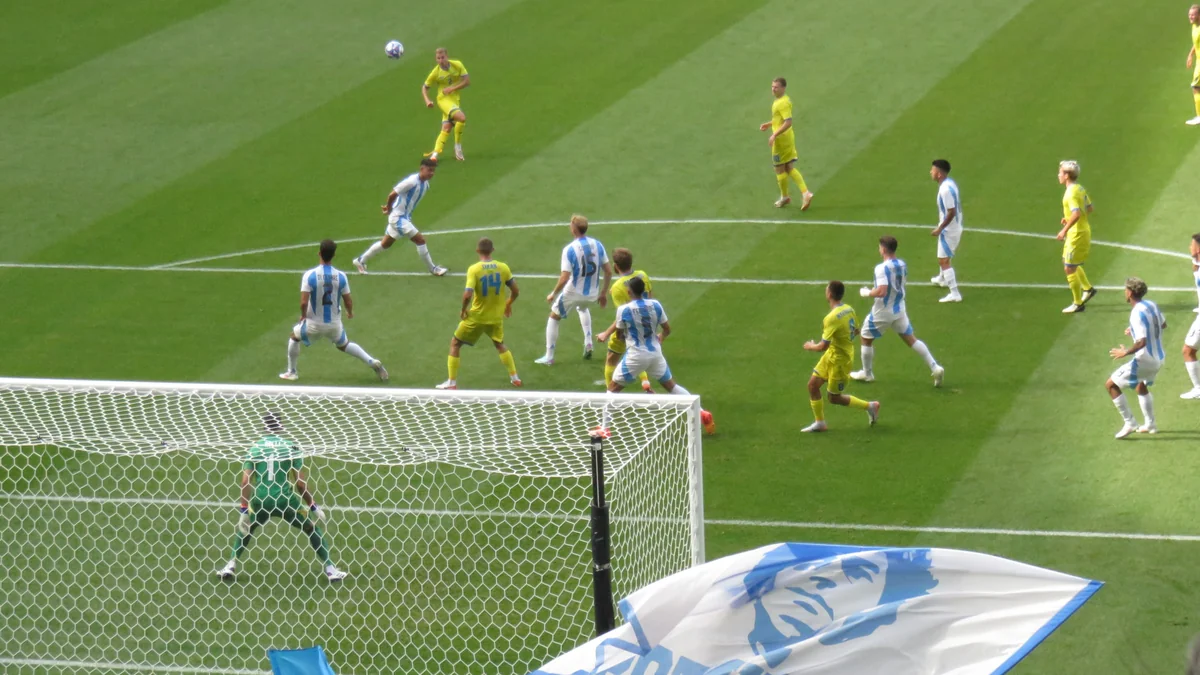
The tactical context fits the physiology. An attacking midfielder who is also the captain and the primary creator pays a continuous cognitive tax on top of the physical one; every burst is preceded by a scan, a decision, a pre-orientation [2]. The action-frequency signature in such a player implies not only a robust aerobic substrate but a well-trained ability to maintain decision quality under accumulated load — the late-match through ball, the 80th-minute pressing trigger, the corner whipped in after a 6-second sprint back into shape [4].
The captaincy and the volume of fixture exposure across club and country compound the load. The midfielder who plays 50+ matches per season at the top of two competitions is, by definition, operating with a chronic workload high enough that any short-term spike must be absorbed without injury or performance decline; the players who hold their action frequency across that schedule are the ones whose internal-to-external load ratio is favourable [5].
Match-context note: Bruno Fernandes’ per-match touches, key-pass count and shot involvement in Premier League and European play sit in the upper band for attacking midfielders (Match data: SofaScore), with the discriminator being the consistency of those numbers across the late stages of matches and across the densest fixture weeks rather than any single peak performance.
The profile is not a single physiological constant; it is the output of an aerobic system trained to support repeated decision-making under physical stress. Bangsbo and colleagues note that the players who maintain high-intensity output across full matches and across congested fixtures are those whose aerobic base is robust enough to absorb cumulative load without measurable late-match decline [1, 4].
Flickr: Miami U. Libraries – Digital Collections.
What This Means for the Reader
For a developing attacking midfielder, the takeaway is that high-intensity action frequency is not raw running but trained repeatability of decisive actions — and the system underneath it is trainable in pieces. Three measurements diagnose the limiting variable: a Yo-Yo Intermittent Recovery test for repeated-effort capacity, an action count from a single match (passes attempted, off-ball runs, tackles, shots) plotted minute-by-minute to see where the curve falls off, and a session-RPE log to track the internal cost of training relative to the external load [4, 5].
The training prescription targets the diagnostic finding: athletes whose action count holds steady but whose Yo-Yo score is low need short-interval aerobic work to widen the recovery window; athletes whose action count collapses in the final third of matches need to combine aerobic work with high-decision small-sided games that train action production under fatigue [1, 3]. The single diagnostic question for the developing playmaker: when my action count drops in the 70th minute, is it because I cannot recover between bursts, or because I am no longer producing the right action when I do recover?
References
- Bangsbo J, Mohr M, Krustrup P. (2006). Physical and metabolic demands of training and match-play in the elite football player. Journal of Sports Sciences, 24(7): 665–674. doi:10.1080/02640410500482529
- Mohr M, Krustrup P, Bangsbo J. (2003). Match performance of high-standard soccer players with special reference to development of fatigue. Journal of Sports Sciences, 21(7): 519–528. doi:10.1080/0264041031000071182
- Bradley PS, Sheldon W, Wooster B, Olsen P, Boanas P, Krustrup P. (2009). High-intensity running in English FA Premier League soccer matches. Journal of Sports Sciences, 27(2): 159–168. doi:10.1080/02640410802512775
- Carling C, Le Gall F, Dupont G. (2012). Analysis of repeated high-intensity running performance in professional soccer. Journal of Sports Sciences, 30(4): 325–336. doi:10.1080/02640414.2011.652655
- Impellizzeri FM, Marcora SM, Coutts AJ. (2019). Internal and external training load: 15 years on. International Journal of Sports Physiology and Performance, 14(2): 270–273. doi:10.1123/ijspp.2018-0935
Match-context data (descriptive only): SofaScore.

Hüseyin Akbulut is the founder of Sporeus and author of THRESHOLD (EŞİK), a 540-page Turkish-language book on endurance science.
- 540pp THRESHOLD Book
- MSc Sport Sciences
- Marmara University
The Athlete in One Paragraph
Bruno Miguel Borges Fernandes (b. 1994-09-08, Maia, Portugal) is, as of September 2026, the Manchester United captain and an attacking midfielder for the Portugal national team. Listed at 1.79 m and 69 kg, he is built lean and average-tall for the role, with a body…
The Physiology — what high-intensity action frequency actually measures
Match running in elite football is the canonical intermittent stimulus: short, repeated bouts of near-maximal output layered onto a continuous low-intensity background. Bangsbo, Mohr and Krustrup decomposed the demand into the now-standard pattern — total distance ~10–12 km per match, of which ~8–12% is run…
The Case — Bruno Fernandes as action-frequency archetype
For a 1.79 m / 69 kg attacking midfielder operating in a system that asks the number ten to press, recover, link play and arrive in the box, the running profile is consistent with a high-volume, high-action-density pattern: total distance in the upper range for…
What This Means for the Reader
For a developing attacking midfielder, the takeaway is that high-intensity action frequency is not raw running but trained repeatability of decisive actions — and the system underneath it is trainable in pieces. Three measurements diagnose the limiting variable: a Yo-Yo Intermittent Recovery test for repeated-effort…