Preview
Hüseyin Akbulut, MSc (2026). Filippo Ganna and the Aerodynamic Power Output of an Elite Time-Triallist. Sporeus. Retrieved, September 29, 2026. https://sporeus.com/en/science/filippo-ganna-time-trial-aerodynamic-power-output/
The Athlete in One Paragraph
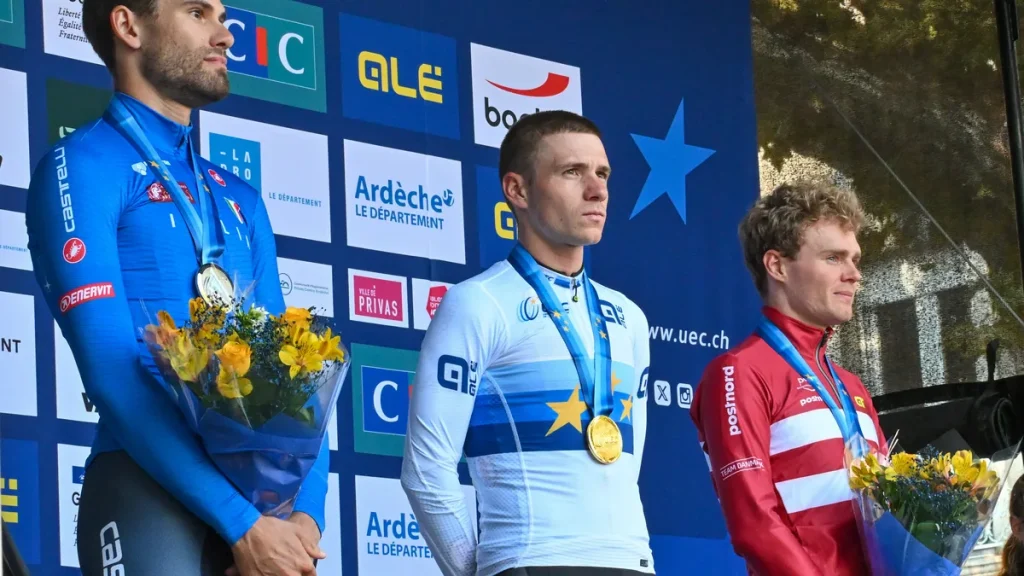
Filippo Ganna (b. 25 July 1996, Verbania, Italy) is a road and track cyclist for Ineos Grenadiers and the Italian national team. Listed at 1.93 m and ~83 kg, he is the contemporary archetype of the time-trial and individual-pursuit specialist — a tall, broad-shouldered rider whose competitive profile is built around 30–60 minute sustained efforts against the clock and 4 km track pursuits decided in single-digit seconds. Multiple world titles in time trial and pursuit sit on a profile that looks unusual relative to the climbers: more absolute power, more frontal area, and a much heavier body weight. The interesting case for sport science is the aero-physiology trade-off that defines his discipline: time-trial aerodynamic power output — sustaining 6 W/kg-plus at the smallest possible frontal area, paying the aerodynamic penalty that comes with a tall body and offsetting it with absolute wattage that smaller riders cannot match.
Table of Contents
The Physiology — what aerodynamic power output actually means
In flat-ground time trialling, aerodynamic drag accounts for the dominant share of the rider’s total resistance — roughly 80% at competition speeds — with rolling resistance and drivetrain losses sharing the remainder [3]. Drag scales with the product of frontal area and drag coefficient (CdA) and with the cube of velocity; at race speed, the difference between two riders’ CdA values translates almost linearly into the difference between their finishing times, even when their absolute wattage is identical.
The Joyner and Coyle framework — VO₂max, lactate threshold and economy as the three controlling endurance variables — applies, but the variable weighting in time trialling shifts towards absolute power output sustained at threshold for the duration of the event [1]. A 40-minute time trial is, in physiological terms, an effort held at or just below the maximal lactate steady state for the full duration; Faude and colleagues’ review establishes this as the gold-standard reference intensity for sustained 30–60 minute efforts [2].
The aero-position cost is an under-appreciated dimension. Holding a deep, narrow time-trial tuck for 40 minutes constrains diaphragmatic excursion and reduces breathing efficiency relative to a standing or hood position; the rider therefore pays an oxygen-cost penalty in the aero position, and economy — Saunders and colleagues’ third controlling variable, transferred from running to cycling by analogy — is differentially trained for the aero position rather than for an upright climbing posture [4]. Helgerud and colleagues’ interval-training framework demonstrates that aerobic ceiling and threshold both respond to high-intensity stimulus on top of a long aerobic base, and the time-triallist’s training year is structured around lifting both [5].
The discipline-fit anthropometry is the most visible part of the trade-off. The tall rider has a larger frontal area, which is an aero penalty, but the same body produces higher absolute power at threshold because of greater muscle cross-section and lung volume. The smaller climber has the opposite trade-off: lower frontal area but lower absolute power. On a flat 40 km course the larger rider wins; on a 10% sustained climb the smaller rider wins; the discipline-fit decision is largely anthropometric [3, 4].
The Case — Ganna as TT-pursuit archetype
For an 83 kg, 1.93 m rider, the aerodynamic engineering window is genuinely different from a 60 kg climber’s. The frontal area is necessarily larger; the absolute power produced is necessarily higher; the time-trial position is engineered to minimise CdA without compromising the wattage that the position can sustain. Ganna’s competitive identity — winning hour records, world TT titles and individual-pursuit golds — is consistent with a rider whose absolute threshold wattage sits at the upper bound of the contemporary peloton and whose CdA is engineered to give back as little of that absolute advantage as possible [1, 3].
The 4 km track pursuit is, in metabolic terms, a different problem from the 40 km road TT but governed by the same controlling variables: a four-and-a-half-minute effort at supra-threshold intensity, with the first kilometre supplying anaerobic energy and the remaining three kilometres maintained by aerobic-glycolytic flux [2, 5]. The rider who excels at both has integrated the supra-threshold and threshold systems in a way that pure-endurance specialists do not require. Ganna’s success across both formats — and his ability to compete in the cobbled classics on the road — is descriptively consistent with this integrated profile.
The hour-record context illustrates the absolute discipline of TT physiology: the rider holds threshold-level intensity for 60 minutes in a fixed aero position, with no opportunity to recover or to adjust pacing tactically. The hour record is therefore the cleanest expression of the threshold-power-and-CdA combination; it is decided in a controlled environment where every variable except the rider’s physiology and aero efficiency is fixed [3, 4].
(Performance data: UCI / ProCyclingStats)
What This Means for the Reader
For the amateur time-triallist or triathlete, the takeaway is that the chase for higher wattage at threshold is only half of the discipline. The other half is the chase for lower CdA in the position that produces the wattage, and the two are not independent: a more aggressive aero position usually costs sustainable wattage, and the optimum for the individual rider is the position-wattage combination that produces the highest sustained speed on race day [1, 3].
The training implication is that aero-position-specific work — completing threshold intervals in the time-trial tuck rather than on the hoods — develops the position-specific economy that the race demands [4]. The amateur who trains exclusively in an upright position and then races in a deep aero tuck loses time not because absolute fitness is missing but because the position has not been trained.
The diagnostic question for the developing time-triallist: at what fraction of your upright-position threshold wattage can you hold steady-state effort in your race position for 30 minutes? The fraction — not the upright peak — predicts the time-trial result.
References
- Joyner MJ, Coyle EF. (2008). Endurance exercise performance: the physiology of champions. The Journal of Physiology, 586(1): 35–44. doi:10.1113/jphysiol.2007.143834
- Faude O, Kindermann W, Meyer T. (2009). Lactate threshold concepts: how valid are they? Sports Medicine, 39(6): 469–490. doi:10.2165/00007256-200939060-00003
- Stølen T, Chamari K, Castagna C, Wisløff U. (2005). Physiology of soccer: an update. Sports Medicine, 35(6): 501–536. doi:10.2165/00007256-200535060-00004
- Saunders PU, Pyne DB, Telford RD, Hawley JA. (2004). Factors affecting running economy in trained distance runners. Sports Medicine, 34(7): 465–485. doi:10.2165/00007256-200434070-00005
- Helgerud J, Engen LC, Wisløff U, Hoff J. (2001). Aerobic endurance training improves soccer performance. Medicine and Science in Sports and Exercise, 33(11): 1925–1931. doi:10.1097/00005768-200111000-00019
Performance data (descriptive only): UCI / ProCyclingStats.
The Athlete in One Paragraph
Filippo Ganna (b. 25 July 1996, Verbania, Italy) is a road and track cyclist for Ineos Grenadiers and the Italian national team. Listed at 1.93 m and ~83 kg, he is the contemporary archetype of the time-trial and individual-pursuit specialist — a tall, broad-shouldered rider…
The Physiology — what aerodynamic power output actually means
In flat-ground time trialling, aerodynamic drag accounts for the dominant share of the rider's total resistance — roughly 80% at competition speeds — with rolling resistance and drivetrain losses sharing the remainder [3]. Drag scales with the product of frontal area and drag coefficient (CdA)…
The Case — Ganna as TT-pursuit archetype
For an 83 kg, 1.93 m rider, the aerodynamic engineering window is genuinely different from a 60 kg climber's. The frontal area is necessarily larger; the absolute power produced is necessarily higher; the time-trial position is engineered to minimise CdA without compromising the wattage that…
What This Means for the Reader
For the amateur time-triallist or triathlete, the takeaway is that the chase for higher wattage at threshold is only half of the discipline. The other half is the chase for lower CdA in the position that produces the wattage, and the two are not independent:…