Preview
Hüseyin Akbulut, MSc (2026). Tom Pidcock and the Power Bursts and Handling of an Elite MTB Cross-Country Cyclist. Sporeus. Retrieved, October 7, 2026. https://sporeus.com/en/science/tom-pidcock-mtb-cross-country-power-bursts-and-handling/
The Athlete in One Paragraph
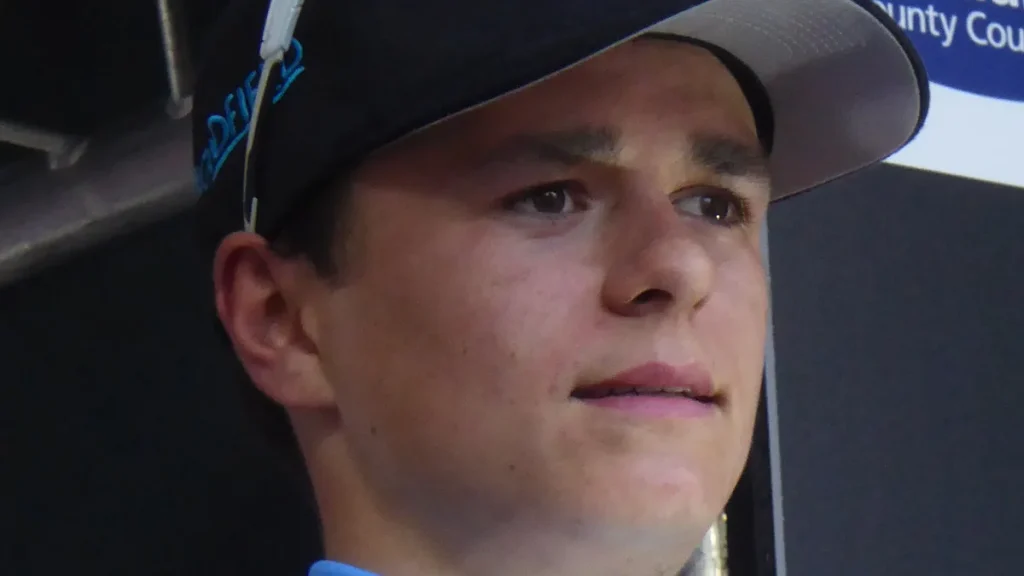
Thomas Pidcock (b. 30 July 1999, Leeds, United Kingdom) is, as of September 2026, a multi-discipline cyclist riding for Q36.5 Pro Cycling Team and the British national team. Listed at 1.72 m and ~58 kg, he is the rare contemporary professional whose competitive identity straddles three distinct disciplines: road racing, cyclocross and mountain-bike cross-country, where he is the back-to-back Olympic champion (Tokyo 2020 and Paris 2024). The interesting case for sport science is the discriminator that decides every modern cross-country mountain-bike race: power bursts and handling — how repeated 30–90 second efforts above lactate threshold are layered on top of technical terrain demands so that raw wattage is gated, in real time, by the rider’s ability to choose a clean line, brake late and unweight the bike across roots, rocks and step-ups.
Table of Contents
The Physiology — what MTB cross-country power bursts and handling actually are
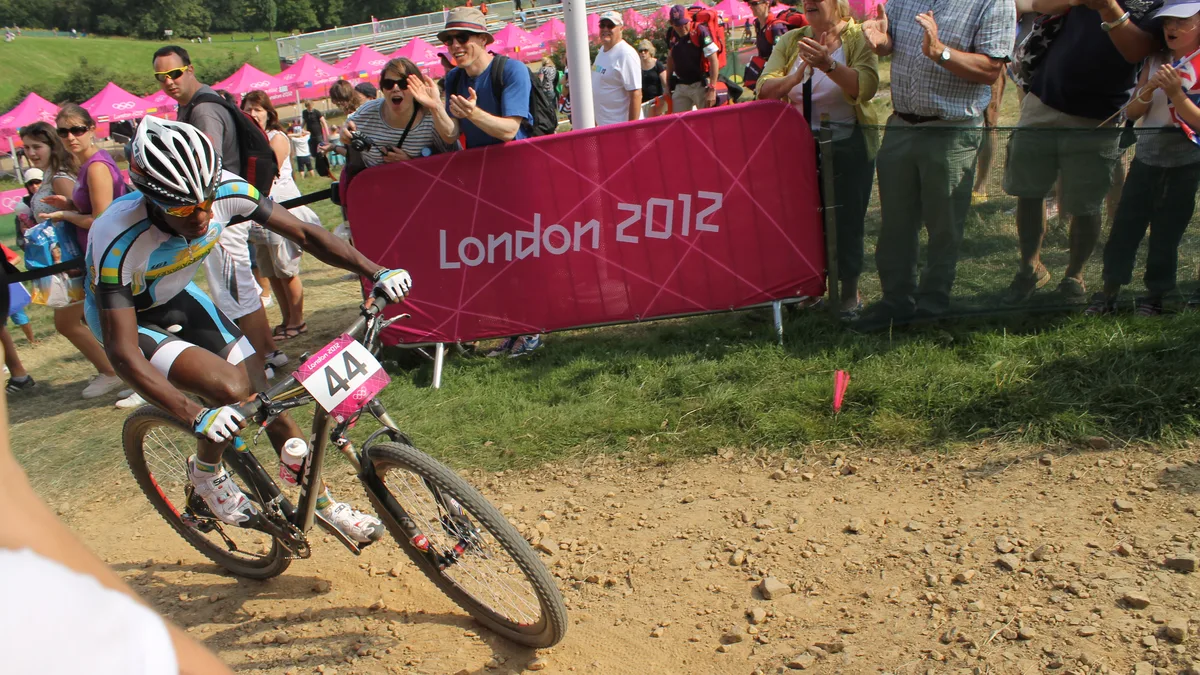
Joyner and Coyle’s framework for endurance performance — VO₂max, lactate threshold and exercise economy — applies directly to mountain-bike cross-country, but the relative weighting shifts compared with a long road race [1]. A modern XCO event lasts 80–95 minutes; the course profile imposes repeated short climbs, technical descents, step-ups and rock gardens, each of which forces the rider above threshold for 30–90 seconds at a time, separated by short, often involuntary recoveries dictated by terrain rather than choice. The aerobic ceiling sets the upper bound; the threshold fraction sets the sustainable repeat rate; the recovery efficiency between bursts sets how many of those repeats are still available in the closing lap.
Buchheit and Laursen’s high-intensity interval training framework formalised the principle that aerobic and anaerobic capacities are not opposed in intermittent endurance sport — the well-trained aerobic system clears lactate, restores phosphocreatine and resaturates myoglobin between supra-threshold efforts [2]. The XCO athlete who can repeat 45-second above-threshold surges at lap five with the same wattage as at lap one is the athlete whose aerobic ceiling pays the smallest residual cost for each surge. The training implication is direct: the supra-threshold capacity is upstream of the aerobic ceiling, and an XCO season built only on intervals plateaus when the ceiling stops rising.
Faude and colleagues’ review of lactate-threshold concepts established that the maximal lactate steady state is the highest sustainable steady-state intensity — the point above which blood lactate accumulates uncontrollably [3]. In XCO, that steady state is approached on the longer climbs, briefly exceeded on the short technical efforts, and then re-approached on the recovery sectors; the rider’s race is a stochastic oscillation around threshold rather than a steady ride at it. Bangsbo and colleagues’ work on intermittent exercise extended the principle to any sport with stochastic intensity demands: the discriminator between elite and sub-elite performers is the integration of repeated supra-threshold actions with active-recovery periods that operate at a high fraction of VO₂max [4].
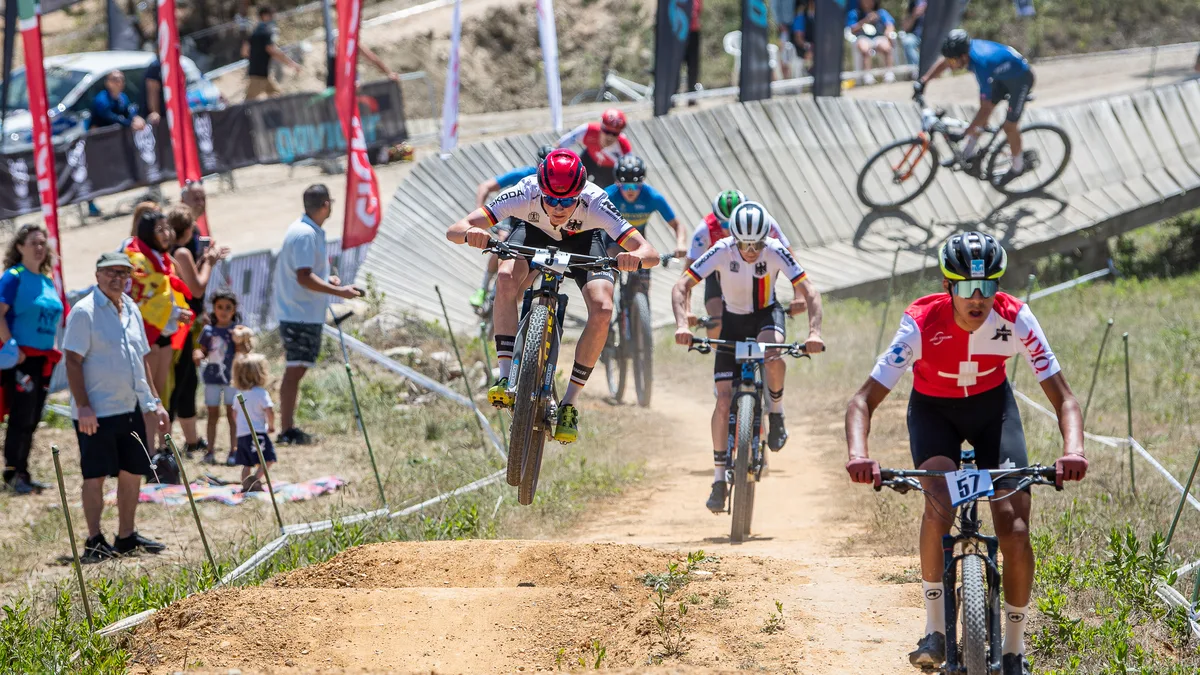
The handling layer is where MTB cross-country diverges from road. Stølen and colleagues’ soccer-physiology review supplies the analogue: high-skill ball-sport actions (turns, dribbles, decisions) gate the expression of underlying physical capacity in real time, and the player whose technical output is fluent at sub-maximal cognitive load can deploy more of the underlying engine [5]. The MTB equivalent is line choice, body position over the front wheel and brake-modulation: power is irrelevant if the rider crashes on the rock garden, and a clean line at lap four costs less heart-rate and less concentration than a messy line. Power output × bike-handling skill is the compound that travels.
The Case — Pidcock as the modern MTB integrator
For a 1.72 m, 58 kg rider, the cross-country arithmetic is unforgiving and clean: the small frame supplies the climbing watts-per-kilogram on the punchy ascents, and the lean upper body supplies the relative quickness needed to throw the bike through a rock garden without losing line [1, 5]. Pidcock’s anthropometric profile sits within the contemporary XCO archetype, and the Olympic results — back-to-back gold in cross-country at Tokyo 2020 and Paris 2024 — are descriptively consistent with a rider whose handling scales with his power.
The interesting wrinkle in Pidcock’s case is the cross-discipline transfer. A winter of cyclocross is, in metabolic terms, a structured block of high-intensity intervals embedded in race contexts — supra-threshold surges followed by short active-recovery sectors, repeated for 50–60 minutes, plus running sections that load the lower limb eccentrically [2, 4]. A spring of road racing is a block of long aerobic accumulation with sharper supra-threshold spikes on cobbled or hilly sectors. The rider who alternates the two stimuli across the calendar receives the benefit of both without the staleness of either; the calendar itself becomes part of the periodisation, and the road-XCO transfer is a direct consequence of the same engine being trained against different terrain rhythms [3, 5].
The technical-cognitive dimension is the unspoken constraint underneath the wattage. A cyclocross winter is, alongside its metabolic content, a long-form drill in line choice, weight transfer, dismounts and remounts under fatigue; that handling library transfers cleanly to MTB cross-country, where the same skills are loaded onto a different surface and a longer race window. The rider who arrives at XCO from a cyclocross background carries a handling base that a pure road rider must build separately [1, 5].
(Performance data: UCI / Q36.5)
What This Means for the Reader
For the amateur cyclist tempted by power numbers in isolation, the takeaway is that wattage on a smooth indoor trainer is not the variable that wins on technical terrain. The relevant compound is how much of your sustainable threshold output you can still express when line choice, brake modulation and weight transfer are competing for attention. The handling layer is gated by skill practice, not by intervals.
The training implication is that supra-threshold work is best built on a long aerobic base — Buchheit and Laursen’s prescription on top of an already-developed aerobic ceiling, rather than as a substitute for it [2]. The amateur who chases short intervals while neglecting the long, low-intensity aerobic stimulus typically plateaus at a threshold output that will not respond to more intervals; the ceiling has not been raised, and the threshold cannot move higher than the ceiling allows [1, 3]. The handling library is built on volume, not on intensity — long, low-pressure rides on technical terrain teach the eyes to look ahead and the hands to choose lines.
The diagnostic question for the developing cross-country athlete: when you ride a familiar technical sector at lap one versus lap five, does your line choice degrade, your braking get heavier, your weight transfer get later? If yes, the handling layer is consuming cognitive resource that the engine cannot spare; the fix is more terrain hours, not more interval reps.
References
- Joyner MJ, Coyle EF. (2008). Endurance exercise performance: the physiology of champions. The Journal of Physiology, 586(1): 35–44. doi:10.1113/jphysiol.2007.143834
- Buchheit M, Laursen PB. (2013). High-intensity interval training, solutions to the programming puzzle. Sports Medicine, 43(5): 313–338. doi:10.1007/s40279-013-0029-x
- Faude O, Kindermann W, Meyer T. (2009). Lactate threshold concepts: how valid are they? Sports Medicine, 39(6): 469–490. doi:10.2165/00007256-200939060-00003
- Bangsbo J, Mohr M, Krustrup P. (2006). Physical and metabolic demands of training and match-play in the elite football player. Journal of Sports Sciences, 24(7): 665–674. doi:10.1080/02640410500482529
- Stølen T, Chamari K, Castagna C, Wisløff U. (2005). Physiology of soccer: an update. Sports Medicine, 35(6): 501–536. doi:10.2165/00007256-200535060-00004
Performance data (descriptive only): UCI / Q36.5.
Hüseyin Akbulut is the founder of Sporeus and author of THRESHOLD (EŞİK), a 540-page Turkish-language book on endurance science.
- 540pp THRESHOLD Book
- MSc Sport Sciences
- Marmara University
The Athlete in One Paragraph
Thomas Pidcock (b. 30 July 1999, Leeds, United Kingdom) is, as of September 2026, a multi-discipline cyclist riding for Q36.5 Pro Cycling Team and the British national team. Listed at 1.72 m and ~58 kg, he is the rare contemporary professional whose competitive identity straddles…
The Physiology — what MTB cross-country power bursts and handling actually are
Joyner and Coyle's framework for endurance performance — VO₂max, lactate threshold and exercise economy — applies directly to mountain-bike cross-country, but the relative weighting shifts compared with a long road race [1]. A modern XCO event lasts 80–95 minutes; the course profile imposes repeated short…
The Case — Pidcock as the modern MTB integrator
For a 1.72 m, 58 kg rider, the cross-country arithmetic is unforgiving and clean: the small frame supplies the climbing watts-per-kilogram on the punchy ascents, and the lean upper body supplies the relative quickness needed to throw the bike through a rock garden without losing…
What This Means for the Reader
For the amateur cyclist tempted by power numbers in isolation, the takeaway is that wattage on a smooth indoor trainer is not the variable that wins on technical terrain. The relevant compound is how much of your sustainable threshold output you can still express when…