Preview
Hüseyin Akbulut, MSc (2026). Kristian Blummenfelt and the Thermoregulation and Heat Strategy of an Elite Long-Distance Triathlete. Sporeus. Retrieved, September 29, 2026. https://sporeus.com/en/science/kristian-blummenfelt-triathlon-thermoregulation-and-heat-strategy/
The Athlete in One Paragraph
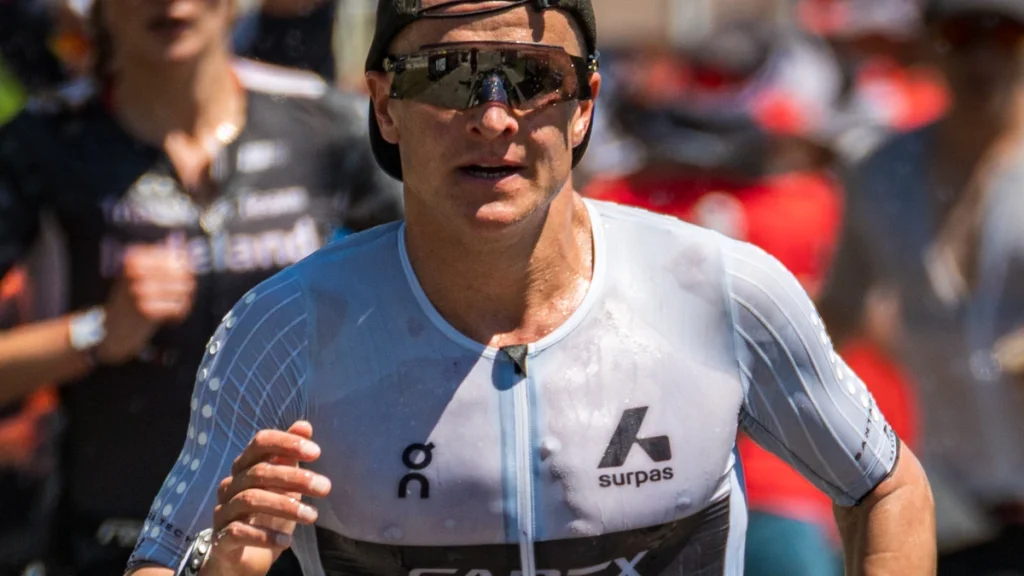
Kristian Blummenfelt (b. 1994-02-29, Bergen, Norway) is a long-distance triathlete and one of the most decorated multi-distance athletes of his generation; Olympic gold medallist over the standard distance, IRONMAN World Champion, and a defining figure of the Norwegian triathlon programme alongside Gustav Iden. Listed at 1.78 m and roughly 73 kg, he carries a relatively muscular long-distance physique into a discipline whose hardest hours are spent racing into the warmest part of the day, often in tropical or sub-tropical conditions where the rate-limiting variable is no longer cardiac output or lactate clearance but the body’s ability to dump heat. The interesting case for sport science is that an Ironman raced in heat is not simply an Ironman with a higher fluid demand; it is a fundamentally different physiological problem, in which core-temperature pacing has to be solved alongside metabolic pacing, and the two are coupled in ways that decide the back half of the marathon. The variable underneath that pattern is thermoregulation under sustained sub-threshold load — heat-acclimation status, sweat-rate management, and the convergence of core temperature, metabolic rate, and substrate availability over a multi-hour event.
Table of Contents
The Physiology — what thermoregulation across a long-format triathlon actually means
Long-distance triathlon, like every endurance event, is bounded by the Joyner and Coyle framework — VO₂max, lactate threshold, and exercise economy — applied across three sequential modalities and four-to-nine total hours of competition [1]. What heat does to that framework is shift each of the three components against the athlete: as core temperature rises, peripheral blood flow demands compete with working-muscle perfusion; cardiac output has to support both thermoregulatory and metabolic demands simultaneously; the same submaximal wattage costs more oxygen, the same perceived effort produces less work, and the threshold-defendable fraction of VO₂max contracts.
The threshold-based variables describe the highest sustainable steady-state intensity. Faude and colleagues catalogued the methods used to identify the lactate threshold and showed that whichever method is used, the underlying biology is the same — a non-linear deflection in lactate, the highest steady-state at which production and clearance balance, the velocity or wattage that can be held to exhaustion for ~60 minutes [3]. In hot conditions, that defendable steady-state is lower than the temperate-laboratory number; the athlete who races on the laboratory pace pays for it as core temperature rises through the bike segment and, more decisively, through the marathon that follows.
Running economy — the oxygen cost per unit distance at submaximal velocity — is the third determinant, and the one most aggressively perturbed by hyperthermia. Saunders and colleagues identified the determinants of running economy in trained distance runners — stride mechanics, tendon stiffness, neuromuscular efficiency, accumulated training history [2] — and showed that economy is the slowest-improving of the three Joyner–Coyle variables. Heat does not change those determinants directly; it raises the oxygen cost of producing the same submaximal pace, which is the practical consequence the athlete has to defend against.
The Stølen physiology-of-soccer review, while modality-specific to football, formalises a generalisable principle that applies to multi-hour events as well: the athlete’s effective pace is not bounded by any single ceiling but by the cumulative interaction of cardiac, thermoregulatory, and metabolic load over the course of the competition [3]. Long-distance triathletes operate exactly in this convergence zone for hours.
Buchheit and Laursen’s HIIT review formalises that the well-trained aerobic engine supports faster recovery and a higher defendable submaximal pace [4]; the heat-acclimation literature extends that — repeated heat exposures in training drive plasma-volume expansion, earlier sweat onset, lower sweat sodium, and a lower core-temperature drift at the same external work rate, all of which raise the practical defendable intensity in the heat. Saunders’ framework of stride mechanics and economy [2] still applies, but the mass-specific oxygen-cost numbers shift against the under-acclimated athlete, and shift back toward the acclimated one.
The Case — Blummenfelt as thermoregulation lens
Blummenfelt’s race profile across both Olympic-distance and full-distance world championships is the cleanest applied demonstration of the principle. Long-distance outcomes for an athlete of his anthropometry — 1.78 m, ~73 kg, more muscular than the lean climber-runner archetype — depend disproportionately on heat strategy because higher absolute body mass produces more metabolic heat per unit external work, and the dissipation problem scales with surface-area-to-mass ratio rather than mass alone [1, 3]. The athlete who arrives in a hot championship under-acclimated does not simply run a slower marathon; he runs a marathon at a lower defendable fraction of threshold, with a wider gap between perceived and actual sustainable intensity.
His anthropometry is consistent with the muscular long-distance archetype. The slightly higher body mass relative to a pure runner-climber profile costs a small amount of mass-specific oxygen cost on the run, but supports the swim and bike with greater force production; the trade-off is sport-specific, and only matters in heat to the extent that absolute heat-production rate scales with absolute work rate [1]. Saunders’ framework reads, in this light, as a warning that the heat-acclimated triathlete and the under-acclimated triathlete with identical laboratory economy will not produce the same race-day performance [2].
The pacing strategy itself is the operational expression of the underlying physiology. A long-distance triathlete’s heat strategy — pre-cooling where regulations allow, on-course fluid and electrolyte intake matched to estimated sweat rate, intentional under-pacing of the bike split to bank thermoregulatory headroom for the run, and deliberate body-cooling at every aid station of the marathon — is not a soft-day adjustment; it is the only allocation of a multi-hour aerobic budget that respects the underlying threshold biology when core temperature is the rate-limiting state variable [3, 4].
(Performance data: World Triathlon / IRONMAN)

What This Means for the Reader
For the developing triathlete, the takeaway is that the long-distance event raced in heat is a thermoregulation problem layered on top of the metabolic one. Many age-group athletes train in temperate conditions and race in hot ones without specific heat preparation; the higher-yield block is a deliberate two-to-three-week heat-acclimation phase before any major hot-weather event, in which repeated short exposures drive the cardiovascular and sudomotor adaptations that shift the defendable threshold upward [4, 5]. The marathon split improves because the heat penalty has been pre-paid in training, not because the run ceiling rose.
The second implication is fluid and pacing discipline. The athlete who races the bike at temperate-laboratory wattage, in hot conditions, converts a larger share of the day’s substrate budget into core-temperature drift that cannot be reclaimed in the run; intentional bike-split conservatism in heat is the only allocation that respects the threshold biology of the events that follow [1, 3]. The fastest cyclist on the bike in heat is not the fastest triathlete on the day.
The diagnostic question for the athlete: at what core-temperature trajectory does my run pace begin to collapse — and what bike intensity, on this expected race-day weather, keeps that trajectory inside my acclimation envelope?
References
- Joyner MJ, Coyle EF. (2008). Endurance exercise performance: the physiology of champions. J Physiology, 586(1): 35–44. doi:10.1113/jphysiol.2007.143834
- Saunders PU, Pyne DB, Telford RD, Hawley JA. (2004). Factors affecting running economy in trained distance runners. Sports Medicine, 34(7): 465–485. doi:10.2165/00007256-200434070-00005
- Stølen T, Chamari K, Castagna C, Wisløff U. (2005). Physiology of soccer: an update. Sports Medicine, 35(6): 501–536. doi:10.2165/00007256-200535060-00004
- Faude O, Kindermann W, Meyer T. (2009). Lactate threshold concepts: how valid are they? Sports Medicine, 39(6): 469–490. doi:10.2165/00007256-200939060-00003
- Buchheit M, Laursen PB. (2013). High-intensity interval training, solutions to the programming puzzle. Sports Medicine, 43(5): 313–338. doi:10.1007/s40279-013-0029-x
Performance data (descriptive only): World Triathlon / IRONMAN.
The Athlete in One Paragraph
Kristian Blummenfelt (b. 1994-02-29, Bergen, Norway) is a long-distance triathlete and one of the most decorated multi-distance athletes of his generation; Olympic gold medallist over the standard distance, IRONMAN World Champion, and a defining figure of the Norwegian triathlon programme alongside Gustav Iden. Listed at…
The Physiology — what thermoregulation across a long-format triathlon actually means
Long-distance triathlon, like every endurance event, is bounded by the Joyner and Coyle framework — VO₂max, lactate threshold, and exercise economy — applied across three sequential modalities and four-to-nine total hours of competition [1]. What heat does to that framework is shift each of the…
The Case — Blummenfelt as thermoregulation lens
Blummenfelt's race profile across both Olympic-distance and full-distance world championships is the cleanest applied demonstration of the principle. Long-distance outcomes for an athlete of his anthropometry — 1.78 m, ~73 kg, more muscular than the lean climber-runner archetype — depend disproportionately on heat strategy because…
What This Means for the Reader
For the developing triathlete, the takeaway is that the long-distance event raced in heat is a thermoregulation problem layered on top of the metabolic one. Many age-group athletes train in temperate conditions and race in hot ones without specific heat preparation; the higher-yield block is…