Preview
Hüseyin Akbulut, MSc (2026). Karim Benzema and the Late-Career Conditioning of an Elite Striker. Sporeus. Retrieved, September 28, 2026. https://sporeus.com/en/science/karim-benzema-late-career-conditioning/
The Athlete in One Paragraph
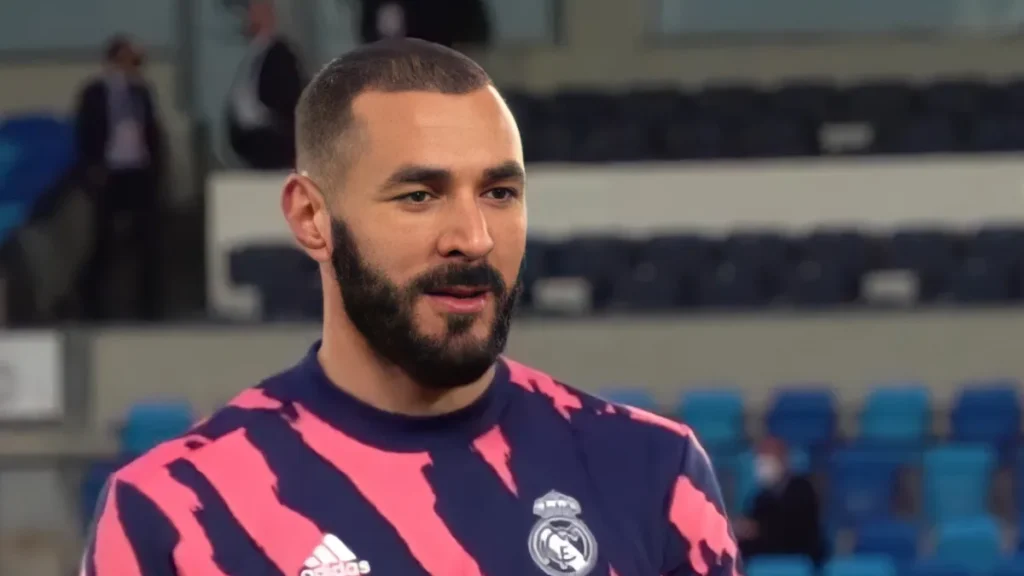
Karim Mostafa Benzema (b. 1987, Lyon, France) is a striker for Al-Ittihad, formerly of Real Madrid and the France national team. Listed at 1.85 m and ~81 kg, he won the 2022 Ballon d’Or at age 34 — at an age when most strikers have begun their physiological decline — and continued to score at elite rates well into his thirties. The interesting case for sport science is not his peak years but the variable that determined his unusual late-career arc: how the elite skeletal-muscle system ages, and what training adaptations slow that decline. The variable underneath is late-career conditioning in the context of age-associated muscle changes.
Table of Contents

The Physiology — what changes in aging skeletal muscle
Skeletal muscle changes in characteristic ways from the late twenties onward. Faulkner, Larkin, Claflin and Brooks’s foundational review identified the core age-related changes: progressive loss of muscle fibre count (particularly type II fast-twitch), reduction in motor unit number, slower contraction velocity, and decline in maximal force production [1]. The decline in untrained adults averages ~1% per year from age 30 onwards, accelerating in the sixties.
Tanaka and Seals examined Masters athletes — competitive athletes over 40 — and documented that the rate of decline is meaningfully attenuated in those who maintain high training volumes [2]. Endurance-event masters retain VO₂max at ~95% of peak through their thirties, slowing to ~85–90% by mid-forties. Sprint-event masters lose top-end speed faster (sprint requires a steep contribution from type II fibres, which atrophy first), but absolute strength and power are preserved relatively well into the late thirties with appropriate training [2].
Cruz-Jentoft and the European Working Group on Sarcopenia in Older People (EWGSOP2) formalised the diagnostic criteria for sarcopenia: low muscle strength (handgrip or chair-rise speed), low muscle quantity (DEXA-measured), and impaired physical performance (gait speed) [3]. The distinction between normal aging and pathological sarcopenia matters: an active 35-year-old elite athlete is in the upper tail of muscle quality for their age, with type II fibre composition closer to a 25-year-old’s than a sedentary peer.
Reaburn and Dascombe’s masters-athlete review highlighted a less-cited adaptation: the cardiovascular and metabolic substrate underlying repeated exercise tolerance is more robust to aging than the neuromuscular peak. An active 35-year-old can still perform repeated sub-maximal high-intensity efforts at near-peak capacity even when isolated peak strength has begun to decline [4]. For a striker, this is the relevant fact: the work demand is repeated, sub-maximal, and with intermittent peaks — exactly the demand profile most resilient to age.
Mascher and colleagues’ work on protein synthesis pathways adds the final piece: post-exercise protein synthesis remains responsive to training stimulus into the forties, and the molecular signalling for hypertrophy and repair is preserved with adequate protein intake and resistance training [5]. The mechanism for “training the way out of decline” is therefore preserved at the cellular level — the limitation is behavioural and recovery-related, not absolute.
The Case — Benzema’s late-career signature
For a 1.85 m / 81 kg striker continuing to score at elite rates past age 34, the physiological picture is consistent with several preserved variables: maintained type II fibre quality through structured strength training, maintained aerobic substrate through in-season conditioning, and avoidance of the chronic injury accumulation that erodes elite performance in the late thirties. Benzema’s documented commitment to recovery practices (sleep optimisation, periodised low-intensity active recovery) and his post-2018 transformation into a more central role at Real Madrid (less peak-velocity sprinting, more orchestration) align with the literature on age-appropriate role evolution [2, 4].
The shift in role is itself a sport-science finding. Tanaka and Seals noted that masters athletes who continue to compete at elite levels do not preserve the same performance profile as their peak — they shift towards energy-efficiency and skill-leverage roles where neural integration and motor pattern accuracy can substitute for raw output [2]. In football, that map cleanly onto the central forward / number-9 / playmaker drift that veteran strikers undergo; the body adapts the role rather than fighting the decline.
The protein-synthesis dimension also matters for in-season management. Mascher and colleagues’ findings imply that elite veterans need higher relative protein intake and longer recovery windows to reach the same anabolic stimulus as younger players [5]. The training-injury-recovery cycle becomes asymmetric: missed recovery does not just blunt adaptation, it accumulates cumulative microtrauma that the older athlete clears more slowly.
The Cruz-Jentoft sarcopenia framework, while developed for clinical contexts, has been applied to elite veteran athletes for early identification of decline. A drop in handgrip strength below age-matched norms or a reduction in DEXA-measured fat-free mass is a leading indicator of performance decline several months before it shows in match output [3]. The veteran athlete who tracks these markers with their performance staff has an advance warning that programmes can address.
The interaction with cumulative training load is also relevant. Faulkner’s review identified that cumulative loading history — total years of structured training — is a more powerful predictor of late-career performance than chronological age alone [1]. The athlete with 25 years of accumulated training base has a different decline curve from one whose elite training began at 22.
Match-context note: Benzema’s per-match high-intensity distance and total covered distance dropped into a typical centre-forward range across his late Real Madrid years (Match data: SofaScore), but his goal-and-assist contribution rose — a clean expression of the role-shift adaptation.
Flickr: Miami U. Libraries – Digital Collections.
What This Means for the Reader
For a recreational athlete entering their thirties or forties, the takeaway is that “decline” is not monolithic — it is a pattern of differential change across muscle fibre types, neural drive, recovery capacity, and protein synthesis [1, 2, 5]. Three measurements diagnose where the decline is concentrated: a 1RM strength test (force ceiling), a 30-second repeated-sprint test (RSA / type II fibre status), and a recovery-day perceived-readiness score (cumulative load tolerance).
The training prescription is bidirectional: maintain or increase resistance training volume to defend type II fibre quality, accumulate aerobic substrate to defend recovery cheapness, and re-architect the role or training mix to leverage skill rather than raw output [2, 4]. The veteran athlete who tries to train the same way at 38 as at 25 typically breaks first.
The diagnostic question for the aging athlete: is my decline in the variable that matters for my sport, or in a variable I can train around? The honest answer determines whether to fight the decline or work with it.
References
- Faulkner JA, Larkin LM, Claflin DR, Brooks SV. (2007). Age-related changes in the structure and function of skeletal muscles. Clinical and Experimental Pharmacology and Physiology, 34(11): 1091–1096. doi:10.1111/j.1440-1681.2007.04752.x
- Tanaka H, Seals DR. (2008). Endurance exercise performance in Masters athletes: age-associated changes and underlying physiological mechanisms. The Journal of Physiology, 586(1): 55–63. doi:10.1113/jphysiol.2007.141879
- Cruz-Jentoft AJ, Bahat G, Bauer J, et al. (2019). Sarcopenia: revised European consensus on definition and diagnosis. Age and Ageing, 48(1): 16–31. doi:10.1093/ageing/afy169
- Reaburn P, Dascombe B. (2008). Endurance performance in masters athletes. European Review of Aging and Physical Activity, 5(1): 31–42. doi:10.1007/s11556-008-0029-2
- Mascher H, Andersson H, Nilsson PA, Ekblom B, Blomstrand E. (2007). Changes in signalling pathways regulating protein synthesis in human muscle in the recovery period after endurance exercise. Acta Physiologica, 191(1): 67–75. doi:10.1111/j.1748-1716.2007.01712.x
Match-context data (descriptive only): SofaScore.
The Athlete in One Paragraph
Karim Mostafa Benzema (b. 1987, Lyon, France) is a striker for Al-Ittihad, formerly of Real Madrid and the France national team. Listed at 1.85 m and ~81 kg, he won the 2022 Ballon d'Or at age 34 — at an age when most strikers have…
The Physiology — what changes in aging skeletal muscle
Skeletal muscle changes in characteristic ways from the late twenties onward. Faulkner, Larkin, Claflin and Brooks's foundational review identified the core age-related changes: progressive loss of muscle fibre count (particularly type II fast-twitch), reduction in motor unit number, slower contraction velocity, and decline in maximal…
The Case — Benzema's late-career signature
For a 1.85 m / 81 kg striker continuing to score at elite rates past age 34, the physiological picture is consistent with several preserved variables: maintained type II fibre quality through structured strength training, maintained aerobic substrate through in-season conditioning, and avoidance of the…
What This Means for the Reader
For a recreational athlete entering their thirties or forties, the takeaway is that "decline" is not monolithic — it is a pattern of differential change across muscle fibre types, neural drive, recovery capacity, and protein synthesis [1, 2, 5]. Three measurements diagnose where the decline…