Preview
Hüseyin Akbulut, MSc (2026). Joško Gvardiol and the Defender Sprint Recovery Profile of an Elite High-Line Centre-Back. Sporeus. Retrieved, October 1, 2026. https://sporeus.com/en/science/josko-gvardiol-defender-sprint-recovery/
The Athlete in One Paragraph
Joško Gvardiol (b. 2002, Zagreb, Croatia) is, as of September 2026, a centre-back — and, by tactical assignment, a left-sided defender — for Manchester City and the Croatia national team. Listed at 1.85 m and ~80 kg, he is built around a profile that the modern high-line system depends on but that the position has historically not been required to deliver: a centre-back who can sprint, brake at high eccentric load, and re-accelerate within the same defensive sequence. The interesting case for sport science is the variable that defines this assignment: defender sprint recovery, the capacity to produce repeated emergency sprints and to dissipate the eccentric load of decelerations across a 90-minute match without the late-game collapse that turns a recovery sprint into a foul or a goal.
Table of Contents

The Physiology — what defender sprint recovery actually measures
Repeated high-intensity running in football is not a steady aerobic stress; it is a sequence of brief maximal efforts separated by partial recoveries, layered onto a continuous low-intensity background [1]. The variable that determines whether the next sprint arrives at the same intensity as the last is the rate of recovery between bursts — a function of aerobic capacity, lactate clearance, phosphocreatine resynthesis and the local muscular ability to repeat near-maximal contractions without progressive force loss.
Carling, Le Gall and Dupont’s analysis of repeated high-intensity running in professional soccer formalised the pattern: the most demanding clusters in a match are the ones in which two or more high-intensity efforts arrive within ~20 seconds of each other, and the players who maintain output through those clusters are not necessarily the fastest individual sprinters but the ones with the best inter-effort recovery [1]. For a defender in a high-line system, those clusters are decisive — the second sprint is the one that prevents the goal.
Bangsbo, Mohr and Krustrup decomposed the wider match demand: total distance ~10–12 km, ~8–12% of which is high-intensity, with the high-intensity output declining toward the end of each half in players whose aerobic substrate cannot sustain the recovery rate [2]. Bradley and colleagues’ Premier League positional analysis added that centre-backs typically sit at the lower end of the high-intensity-distance distribution — but that the sprints they do perform are disproportionately decisive, frequently initiated under fatigue, and increasingly required in possession-dominant systems where the defensive line operates 30 to 50 metres further upfield than in the past [3].
Buchheit and Laursen’s high-intensity-interval-training framework provides the training-side mirror. The aerobic adaptations that support repeated high-intensity efforts — cardiac output, mitochondrial density, capillarisation, lactate clearance — are best developed by short-interval work at 90–95% of VO₂max with brief recoveries; the format accumulates the time-at-VO₂max that drives the central and peripheral adaptation, and it is the same format that supports sprint-cluster recovery in match play [4]. The defender who trains this system trains his sprint-recovery capacity directly.
Stølen, Chamari, Castagna and Wisløff’s review tied the threads together: match VO₂ averages roughly 70–80% of maximum, peak demands intermittently approach 100%, and the players who maintain higher fractional utilisation of VO₂max — typically 80–85% rather than 70–75% at the same absolute pace — are the ones whose late-match performance does not collapse [5]. Sprint recovery, in this framing, is the visible output of high VO₂max, high lactate threshold relative to VO₂max, and the eccentric-strength capacity that absorbs the braking load of each deceleration without progressive tissue cost.
The Case — Gvardiol as eccentric-capable recovery defender
For a 1.85 m / 80 kg centre-back operating in a high-line possession system, the running profile is consistent with a centre-back demand layered with a wide-defender demand: total distance in the upper centre-back band, sprint count above the central-defender norm, and a high share of those sprints initiated under fatigue and terminated by a high-eccentric deceleration [2, 3]. The mechanical signature is favourable: enough mass for aerial duels, enough relative power for repeated short bursts, and the eccentric-strength capacity to brake at speed without buckling.
The eccentric dimension is the interesting one. A recovery sprint that is not followed by a controlled deceleration is a recovery sprint that produces a foul, a yellow card, or a re-acceleration window in which the attacker keeps the ball; the eccentric-strength substrate that allows the defender to brake at high velocity and then immediately re-accelerate is the substrate that turns a sprint into a tackle [4]. The literature on repeated high-intensity running notes that the eccentric load of decelerations accumulates as cumulative tissue stress across the match, and the players who carry the load best are the ones whose strength substrate is built around the brake as well as the drive [1, 4].
The dual-position assignment matters. Gvardiol’s deployment as both a centre-back and a left-sided defender exposes him to the running profile of two distinct positions across the season — the wide-defender profile pushes the sprint count up, the centre-back profile pushes the eccentric-deceleration count up — and the cumulative load is more demanding than either profile alone [3, 5]. The compensating physiology is a high VO₂max that supports the aerobic substrate of recovery between bursts, and a strong eccentric-strength base that protects the tissue from the deceleration cost.
Match-context note: Gvardiol’s high-intensity-running and sprint counts in Premier League and Champions League play sit toward the upper band for centre-backs (Match data: SofaScore), with the discriminator being the consistency of his late-match recovery sprints rather than peak speed alone.
The tactical context fits the physiology. In a high-line system, the centre-back operates 10 to 20 metres further upfield than in a conservative block; when the line is broken, the recovery sprint is longer, more frequent, and decisively eccentric on its termination [3]. The position rewards exactly the variable Gvardiol carries: a recovery profile built on aerobic capacity, lactate clearance, and an eccentric-strength substrate that absorbs the brake without breaking. The high line is a defensive style; sprint recovery is its physiology.
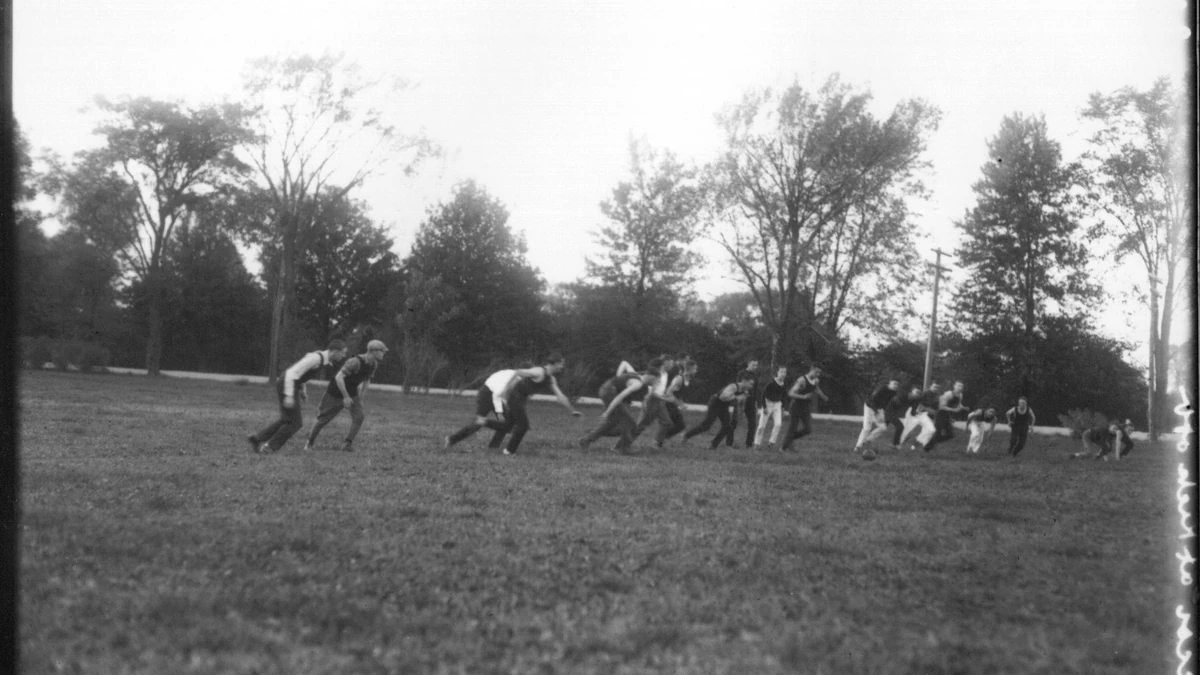
Flickr: Miami U. Libraries – Digital Collections.
What This Means for the Reader
For the developing or competitive amateur defender, the takeaway is that defensive emergency speed is not a single-trait variable; it is a system — aerobic capacity, lactate clearance, sprint-cluster recovery, and eccentric-strength capacity — and the system is trainable in pieces. Three measurements diagnose the limiting variable: a Yo-Yo Intermittent Recovery test as a sprint-recovery surrogate, a 30 m sprint with a controlled deceleration at the line as a brake-and-re-accelerate surrogate, and a Nordic-hamstring or single-leg eccentric protocol as an eccentric-strength surrogate [1, 4].
The training prescription targets the diagnostic finding: defenders with a low Yo-Yo score need short-interval HIIT work to build the aerobic substrate of recovery; defenders with a poor deceleration profile need eccentric loading and braking drills to build the brake before more sprint volume is added; defenders with both need a longer aerobic base block before the high-intensity work compounds [4, 5]. The single diagnostic question for the recovering defender: when the line breaks at minute 70, can I produce the second sprint at the same intensity as the first, and can I stop at the end of it without giving away a foul?
References
- Carling C, Le Gall F, Dupont G. (2012). Analysis of repeated high-intensity running performance in professional soccer. Journal of Sports Sciences, 30(4): 325–336. doi:10.1080/02640414.2011.652655
- Bangsbo J, Mohr M, Krustrup P. (2006). Physical and metabolic demands of training and match-play in the elite football player. Journal of Sports Sciences, 24(7): 665–674. doi:10.1080/02640410500482529
- Bradley PS, Sheldon W, Wooster B, Olsen P, Boanas P, Krustrup P. (2009). High-intensity running in English FA Premier League soccer matches. Journal of Sports Sciences, 27(2): 159–168. doi:10.1080/02640410802512775
- Buchheit M, Laursen PB. (2013). High-intensity interval training, solutions to the programming puzzle. Sports Medicine, 43(5): 313–338. doi:10.1007/s40279-013-0029-x
- Stølen T, Chamari K, Castagna C, Wisløff U. (2005). Physiology of soccer: an update. Sports Medicine, 35(6): 501–536. doi:10.2165/00007256-200535060-00004
Match-context data (descriptive only): SofaScore.
The Athlete in One Paragraph
Joško Gvardiol (b. 2002, Zagreb, Croatia) is, as of September 2026, a centre-back — and, by tactical assignment, a left-sided defender — for Manchester City and the Croatia national team. Listed at 1.85 m and ~80 kg, he is built around a profile that the…
The Physiology — what defender sprint recovery actually measures
Repeated high-intensity running in football is not a steady aerobic stress; it is a sequence of brief maximal efforts separated by partial recoveries, layered onto a continuous low-intensity background [1]. The variable that determines whether the next sprint arrives at the same intensity as the…
The Case — Gvardiol as eccentric-capable recovery defender
For a 1.85 m / 80 kg centre-back operating in a high-line possession system, the running profile is consistent with a centre-back demand layered with a wide-defender demand: total distance in the upper centre-back band, sprint count above the central-defender norm, and a high share…
What This Means for the Reader
For the developing or competitive amateur defender, the takeaway is that defensive emergency speed is not a single-trait variable; it is a system — aerobic capacity, lactate clearance, sprint-cluster recovery, and eccentric-strength capacity — and the system is trainable in pieces. Three measurements diagnose the…