Preview
Hüseyin Akbulut, MSc (2026). Jayson Tatum and the Playoff-Run Cumulative Fatigue of an Elite Forward. Sporeus. Retrieved, October 7, 2026. https://sporeus.com/en/science/jayson-tatum-playoff-load-cumulative-fatigue/
The Athlete in One Paragraph
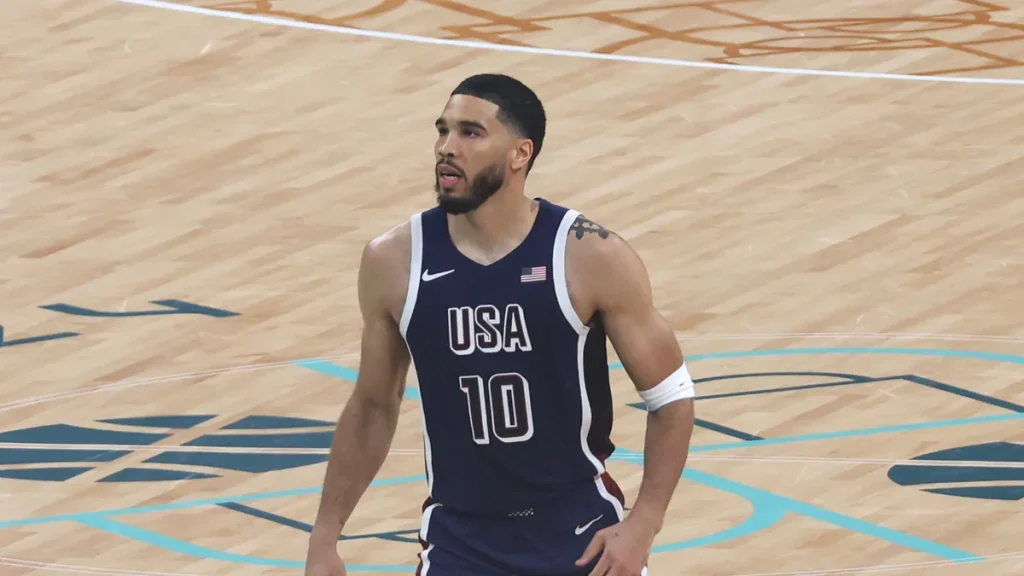
Jayson Christopher Tatum (b. 1998-03-03, St. Louis, Missouri, United States) is, as of September 2026, a forward for the Boston Celtics and a regular member of the United States national team, with a 2024 NBA championship on his résumé. Listed at 2.03 m and ~95 kg, he carries the anthropometry of a long, high-mileage wing-forward who logs heavy minutes through an 82-game regular season and then re-loads on top of that for a multi-round playoff run — back-to-back 35-plus-minute games, compressed travel windows, and a mental load that sits on top of the physical one. The interesting case for sport science is not any single 40-point game but the way physiological cost accumulates across the second half of a season into the playoffs; the discriminator between players who finish the run intact and players who taper into the conference finals is rarely talent. The variable underneath that story is playoff-run cumulative fatigue — how acute and chronic load, recovery between bouts, and internal training load interact to determine whether the system holds up when the stakes are highest.
Table of Contents

The Physiology — what cumulative load actually does to the system
Cumulative fatigue in a long, dense competitive season is the integral of acute training stress on top of an underlying chronic baseline; the dose-response between the two is non-linear, and spikes in the ratio between recent and rolling-mean load are the operational variable that predicts injury and performance loss [1, 2]. Gabbett’s framing of the training–injury prevention paradox makes the underlying principle explicit: athletes who are well-prepared by chronic training tolerate large acute loads, while athletes whose acute load outpaces their chronic baseline accumulate risk faster than the calendar would suggest [1].
Hulin and colleagues, working with elite team-sport athletes, formalised this as the acute:chronic workload ratio (ACWR) — the ratio of the most recent week’s load to the rolling four-week average — and showed that ratios outside a narrow “sweet spot” predict injury risk in a roughly U-shaped curve [2]. Bowen and colleagues extended the work and demonstrated that spikes in ACWR were associated with five-to-seven-times-greater injury rates in a season-long professional dataset [3]. The mechanism is not mysterious: when acute exposure outruns the tissue and neuromuscular adaptations laid down by the chronic baseline, the protective margin collapses, and the same external action that the athlete absorbed comfortably six weeks earlier now exceeds capacity.
Foster’s session-RPE framework provides the lightweight monitoring tool that ties the load story to internal cost: a simple post-session perceived-exertion score, multiplied by session duration, captures the internal training load that the athlete actually experienced — and across weeks it tracks closely with more expensive physiological measurements [4]. Impellizzeri and colleagues’ fifteen-year retrospective on internal versus external load reinforces the principle: external load (distance run, jumps performed, minutes played) is the stimulus, but internal load is the response, and the response is where injury and adaptation actually live [5].
For a basketball player, the playoff frame compresses all of this. The chronic baseline accumulated through October–April becomes the floor on which the post-season is built, and the acute spikes — back-to-back 40-minute games, cross-country flights, the loss of normal recovery windows — sit on top of a baseline that is already at or near its annual peak [1, 2, 4, 5].
The Case — Tatum as a playoff-load case study
For a 2.03 m / ~95 kg wing-forward who plays heavy minutes through the regular season and is then asked to absorb the additional acute load of multiple playoff series, the calculus is unforgiving. Each playoff round adds a compressed schedule layered onto a chronic baseline that has already been near its annual ceiling for months; the athlete’s acute:chronic workload ratio in mid-May or June is structurally different from the ratio he carried in mid-November, and the same single-game output now sits closer to the upper edge of his protective margin [1, 2, 3].
Tatum’s role compounds the load. A primary scoring forward who initiates offence, finishes through contact, and is asked to defend on the perimeter against guards generates a high external-load profile that is densely packed with acceleration, deceleration, and contact actions; the internal-load response — captured by perceived exertion, sleep quality, and morning readiness markers — is what determines whether the system can absorb another round [4, 5]. The training implication is that the playoff phase is not the place to build fitness; it is the place to spend the chronic reserve already built, while keeping the acute spikes within the band that the baseline can tolerate.
A second feature is the mental load that sits on top of the physical one. Internal-load monitoring frameworks treat psychological stress as an input into the same system; a high-pressure series adds to the integral whether or not the external-load metric registers it [4, 5]. The discipline is not to ignore that input but to treat it as part of the load-management decision — minutes restrictions, off-day protection, recovery emphasis — that shapes whether the athlete arrives at the conference finals with reserve still in the bank.
Match-context note: across recent seasons, Tatum’s per-game minute load and post-season volume have placed him among the highest-loaded wings in the league (Match data: NBA.com / Basketball-Reference). The discriminator across playoff runs is not single-game peak but the trajectory of internal-load markers from round to round.

What This Means for the Reader
For amateur and developing athletes thinking about a competitive run — a tournament weekend, a championship phase, a peak block — the lesson is to plan for the integral, not the peak [1, 2, 3]. Build the chronic baseline well in advance; protect the acute:chronic ratio when the schedule compresses; treat sleep, perceived exertion, and morning readiness as inputs to the load decision rather than soft signals to be overridden.
Practical assessment: track three indicators across a competitive phase — session-RPE multiplied by duration as a daily internal-load score, the rolling acute:chronic ratio of that score across one and four weeks, and a simple subjective wellness score (sleep, soreness, mood) collected at wake [1, 2, 4, 5]. A spike in acute load against a flat or falling chronic baseline, paired with a drift in subjective wellness, is the early signal that the protective margin is shrinking — not the post-injury imaging report, which is the late signal.
The diagnostic question for the deep-run athlete: am I spending my chronic reserve at a rate that the schedule can sustain, or am I overdrawing it because the games keep coming?
References
- Gabbett TJ. (2016). The training–injury prevention paradox: should athletes be training smarter and harder? British Journal of Sports Medicine, 50(5): 273–280. doi:10.1136/bjsports-2015-095788
- Hulin BT, Gabbett TJ, Lawson DW, Caputi P, Sampson JA. (2016). The acute:chronic workload ratio predicts injury: high chronic workload may decrease injury risk in elite rugby league players. British Journal of Sports Medicine, 50(4): 231–236. doi:10.1136/bjsports-2015-094817
- Bowen L, Gross AS, Gimpel M, Li FX. (2020). Spikes in acute:chronic workload ratio (ACWR) associated with a 5-7 times greater injury rate in professional soccer players: a comprehensive 3-year study. British Journal of Sports Medicine, 54(12): 731–738. doi:10.1136/bjsports-2018-099422
- Foster C, Florhaug JA, Franklin J, et al. (2001). A new approach to monitoring exercise training. Journal of Strength and Conditioning Research, 15(1): 109–115. doi:10.1519/00124278-200102000-00019
- Impellizzeri FM, Marcora SM, Coutts AJ. (2019). Internal and external training load: 15 years on. International Journal of Sports Physiology and Performance, 14(2): 270–273. doi:10.1123/ijspp.2018-0935
Match-context data (descriptive only): NBA.com / Basketball-Reference.

Hüseyin Akbulut is the founder of Sporeus and author of THRESHOLD (EŞİK), a 540-page Turkish-language book on endurance science.
- 540pp THRESHOLD Book
- MSc Sport Sciences
- Marmara University
The Athlete in One Paragraph
Jayson Christopher Tatum (b. 1998-03-03, St. Louis, Missouri, United States) is, as of September 2026, a forward for the Boston Celtics and a regular member of the United States national team, with a 2024 NBA championship on his résumé. Listed at 2.03 m and ~95…
The Physiology — what cumulative load actually does to the system
Cumulative fatigue in a long, dense competitive season is the integral of acute training stress on top of an underlying chronic baseline; the dose-response between the two is non-linear, and spikes in the ratio between recent and rolling-mean load are the operational variable that predicts…
The Case — Tatum as a playoff-load case study
For a 2.03 m / ~95 kg wing-forward who plays heavy minutes through the regular season and is then asked to absorb the additional acute load of multiple playoff series, the calculus is unforgiving. Each playoff round adds a compressed schedule layered onto a chronic…
What This Means for the Reader
For amateur and developing athletes thinking about a competitive run — a tournament weekend, a championship phase, a peak block — the lesson is to plan for the integral, not the peak [1, 2, 3]. Build the chronic baseline well in advance; protect the acute:chronic…