
Preview
Hüseyin Akbulut, MSc (2026). Ryan Crouser and the Shot Put Explosive Rotational Power of an Elite Thrower. Sporeus. Retrieved, October 25, 2026. https://sporeus.com/en/science/ryan-crouser-shot-put-explosive-rotational-power/
The Athlete in One Paragraph
Ryan Crouser (b. 1992-12-18, Boring, Oregon, United States) is an American shot putter, multi-Olympic gold medallist, and the world record holder at 23.56 m, a mark established in 2023 that pushed the outer envelope of the men’s event past where the discipline had sat for decades. Listed at 2.01 m and approximately 145 kg, he carries the anthropometry that the modern event selects for at the very top, long levers that make the implement’s release point comparatively high above the ground, and a heavy enough lower-body and trunk mass to produce the absolute force that throwing 7.26 kg over 23 m demands. He is also the originator of the so-called “Crouser slide”, a modification of the rotational technique in which the rear-leg drive across the throwing circle generates additional horizontal velocity before the conventional rotational sequence begins, effectively adding a glide-like preparation phase to a rotational throw. The interesting case for sport science is the variable underneath that signature: shot put explosive rotational power, how a thrower converts the kinetic energy of body rotation across the circle into the angular and linear release velocity of the shot, and how technical refinements at the rear-leg drive and across the kinetic chain reshape that conversion at the upper bound of human performance.
Table of Contents

The Physiology: what shot put explosive rotational power actually integrates
Shot put is, mechanically, a single-effort kinetic-chain task: the athlete generates kinetic energy across the throwing circle through whole-body rotation and translation, transmits that energy proximal-to-distal through the lower limbs, trunk, shoulder and arm, and releases the implement at a velocity, angle and height that determine the parabolic flight distance. The release variables, velocity, angle, height, are the immediate determinants of the throw, and release velocity is by far the most sensitive of the three because the distance equation contains the velocity term squared. Stølen, Chamari, Castagna and Wisløff’s integrative framing of athletic physiology, that elite performance is the alignment of multiple subsystems rather than the maximisation of any one, applies cleanly to a rotational shot put, where a force-only thrower with poor technique and a technique-only thrower with insufficient force both fall short of what the integrated thrower produces [1].
The maximal-force reservoir is the canonical foundation. Wisløff, Castagna, Helgerud, Jones and Hoff established the strong correlation between maximal squat strength and explosive output across athletic populations [2]; in shot put, a deeper maximal-force reservoir in the hip-knee-ankle extension chain underwrites a larger ground-reaction-force impulse, which is the input that the rotational and translational kinetics across the circle ultimately depend on. Cormie, McGuigan and Newton’s framework on maximal neuromuscular power adds the velocity dimension: power is the product of force and velocity, and shot put’s release velocity is the product of force applied at speed across the kinetic chain, a thrower with a very high force ceiling but a slow rate of force development converts less of that force into release velocity than a thrower with a slightly lower ceiling and a faster RFD [3].
Komi’s stretch-shortening-cycle framework adds the elastic-energy dimension. Across the kinetic chain, particularly at the trunk-rotation phase and the shoulder-arm delivery phase, there are rapid eccentric-to-concentric transitions in which stored elastic energy in the muscle-tendon unit contributes to concentric output [4]. The thrower whose connective tissue is well-conditioned to fast eccentric-to-concentric transitions extracts more useful force from the same muscle contraction than one who relies on concentric-only mechanics; the rotational shot put, with its trunk pre-tension during the wind-up and the rapid concentric reversal at the block phase, is one of the densest examples of SSC use in throws.
The integrative throw-specific layer is where technique converts the underlying physiology into release velocity. The rotational shot put has historically been described as a sequence of phases, entry, drive across the circle, block, delivery and the kinetic chain transmits energy proximal-to-distal across them; Markovic and Mikulic’s plyometric synthesis and the broader strength-power literature underwrite the trainable substrate, and the technical signature is what distinguishes one thrower from another at the upper bound [5]. The “Crouser slide” reshapes the entry-and-drive phases by extending the rear-leg’s contribution to horizontal velocity before the rotational sequence begins; the downstream phases inherit a higher upstream input than the conventional rotational pattern produces.
The Case: Crouser as the explosive rotational reference
For a 2.01 m, 145 kg shot putter holding the world record at 23.56 m, the case is that the three subsystems, maximal-force reservoir, rate-of-force-development capacity, and the technique that channels both into release velocity, have been brought into alignment to a degree that has redrawn the upper envelope of the event [1, 2, 3]. The strength-reservoir layer is implied by the published competition record and by the absolute loads required to throw a 7.26 kg implement over 23 m; the RFD layer is implied by the speed of the rotational sequence on film; the technique layer is the visible signature on which the records have been broken.
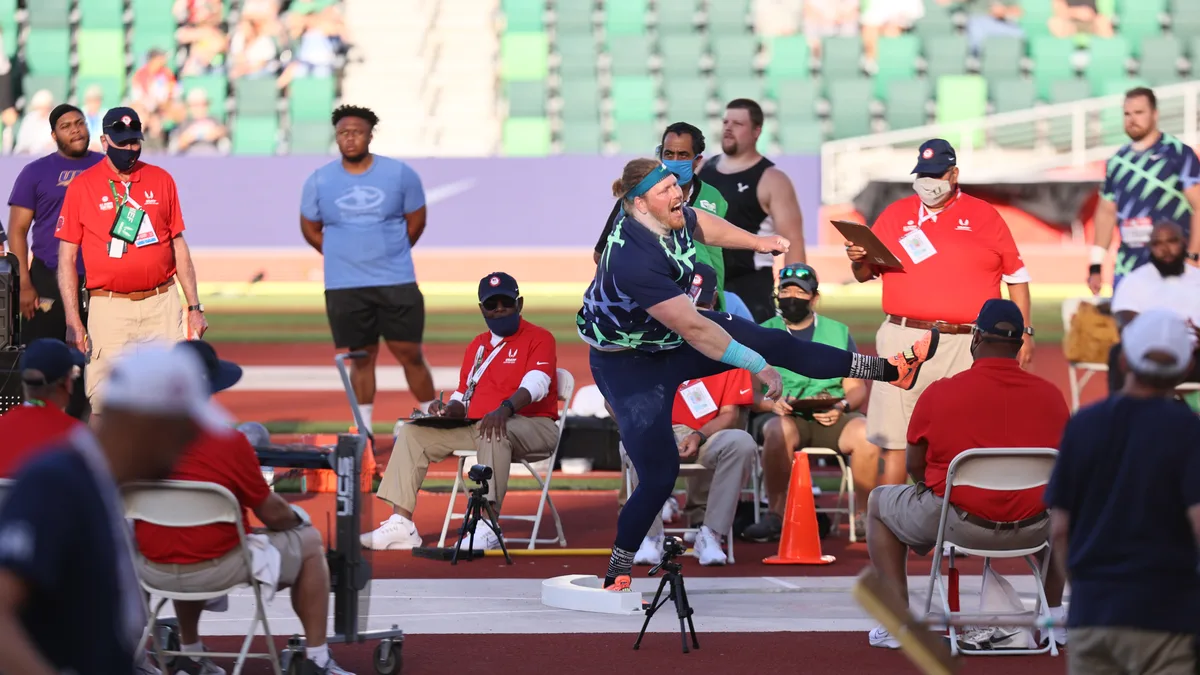
The “Crouser slide” itself is the technical case study. The conventional rotational sequence converts the entry-rotation kinetic energy into the throw; the slide adds a rear-leg drive phase that generates additional horizontal velocity across the circle before the rotational sequence begins, effectively raising the upstream input that the rest of the chain operates on. Because release velocity enters the distance equation squared, even modest gains in upstream kinetic energy produce disproportionately large gains in the distance the implement travels, provided the downstream chain is technically clean enough to convert the larger input rather than to leak it into non-propulsive motion [3, 4]. The technical refinement is therefore not separable from the physiology; it is what lets the underlying force-and-velocity substrate be expressed at the release point.
The proximal-to-distal sequencing is the layer on which technical leaks become most visible. A trunk that decelerates too early bleeds rotational energy that the arm cannot recover; a shoulder that disconnects from the trunk loses the elastic pre-tension that the SSC needs at delivery; an elbow that collapses inside the block phase leaves stored energy on the body rather than on the implement [4]. Crouser’s technical signature on film shows clean proximal-to-distal sequencing across all of these phases, which is why a record-breaking strength-and-power athlete with a less efficient chain would not throw 23 m, and a technically clean thrower with a less developed force reservoir would not either [1, 2, 3, 4, 5].
(Performance data: World Athletics)
What This Means for the Reader
For a developing thrower or any athlete who depends on a rotational kinetic chain, the takeaway is that release velocity is the product of three layers, maximal-force reservoir, rate-of-force-development capacity, and the proximal-to-distal sequencing that channels both into the implement [1, 2, 3, 4, 5]. The athlete who trains absolute strength alone hits a force ceiling that does not become release velocity; the athlete who trains technique alone has nothing to channel; the athlete who neglects RFD applies force too slowly to convert it into the parabolic flight that the distance equation rewards.
Three measurements diagnose the limiting variable: a maximal-strength reference (e.g., back squat, clean) relative to body mass, a measure of force-application rate at moderate-heavy loads (e.g., bar velocity), and a movement-quality assessment of the rotational chain on video, entry-and-drive, block, delivery [3, 4, 5]. Drift in any of the three is the early signal that the engine is degrading at one of its operating layers.
The single diagnostic question for the developing thrower: when my best throw plateaus, is it my force reservoir, my rate of force development, or the proximal-to-distal sequencing that has stopped progressing? The answer determines training emphasis and the modern world record is the reminder that, when the three layers are aligned and a technical refinement at the entry phase raises the upstream input, the upper bound of the event itself moves.
References
- Stølen T, Chamari K, Castagna C, Wisløff U. (2005). Physiology of soccer: an update. Sports Medicine, 35(6): 501–536. doi:10.2165/00007256-200535060-00004
- Wisløff U, Castagna C, Helgerud J, Jones R, Hoff J. (2004). Strong correlation of maximal squat strength with sprint performance and vertical jump height in elite soccer players. British Journal of Sports Medicine, 38(3): 285–288. doi:10.1136/bjsm.2002.002071
- Cormie P, McGuigan MR, Newton RU. (2011). Developing maximal neuromuscular power: Part 1, biological basis of maximal power production. Sports Medicine, 41(1): 17–38. doi:10.2165/11537690-000000000-00000
- Komi PV. (2000). Stretch-shortening cycle: a powerful model to study normal and fatigued muscle. Journal of Biomechanics, 33(10): 1197–1206. doi:10.1016/s0021-9290(00)00064-6
- Markovic G, Mikulic P. (2010). Neuro-musculoskeletal and performance adaptations to lower-extremity plyometric training. Sports Medicine, 40(10): 859–895. doi:10.2165/11318370-000000000-00000
Performance data (descriptive only): World Athletics.

Hüseyin Akbulut is the founder of Sporeus and author of THRESHOLD (EŞİK), a 540-page Turkish-language book on endurance science.
- 540pp THRESHOLD Book
- MSc Sport Sciences
- Marmara University
The Athlete in One Paragraph
Ryan Crouser (b. 1992-12-18, Boring, Oregon, United States) is an American shot putter, multi-Olympic gold medallist, and the world record holder at 23.56 m, a mark established in 2023 that pushed the outer envelope of the men's event past where the discipline had sat for…
The Physiology: what shot put explosive rotational power actually integrates
Shot put is, mechanically, a single-effort kinetic-chain task: the athlete generates kinetic energy across the throwing circle through whole-body rotation and translation, transmits that energy proximal-to-distal through the lower limbs, trunk, shoulder and arm, and releases the implement at a velocity, angle and height that…
The Case: Crouser as the explosive rotational reference
For a 2.01 m, 145 kg shot putter holding the world record at 23.56 m, the case is that the three subsystems, maximal-force reservoir, rate-of-force-development capacity, and the technique that channels both into release velocity, have been brought into alignment to a degree that has…
What This Means for the Reader
For a developing thrower or any athlete who depends on a rotational kinetic chain, the takeaway is that release velocity is the product of three layers, maximal-force reservoir, rate-of-force-development capacity, and the proximal-to-distal sequencing that channels both into the implement [1, 2, 3, 4, 5].…