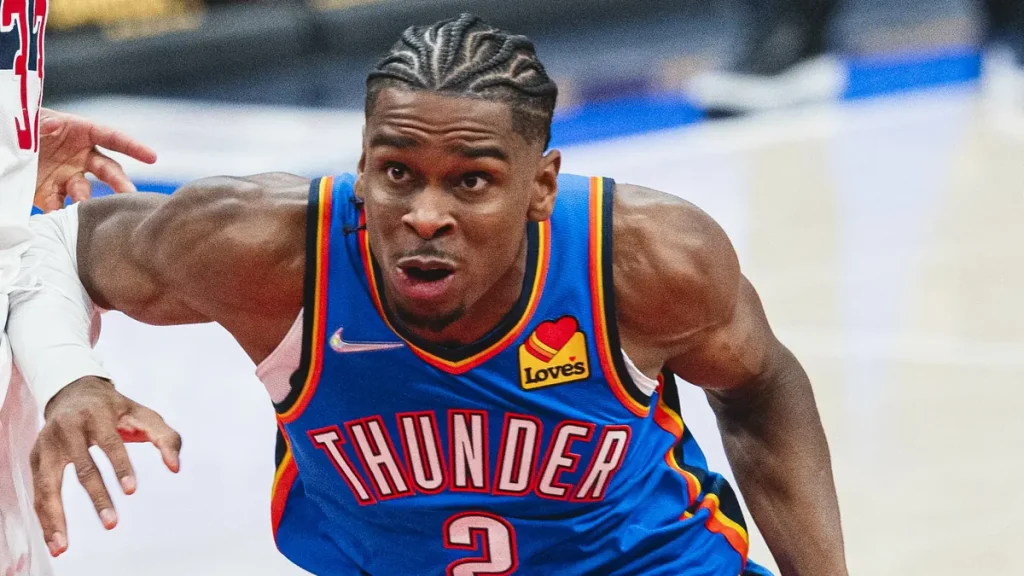
Preview
Hüseyin Akbulut, MSc (2026). Shai Gilgeous-Alexander and the Mid-Range Pull-Up Mechanics of an Elite Guard. Sporeus. Retrieved, October 23, 2026. https://sporeus.com/en/science/shai-gilgeous-alexander-mid-range-pull-up-mechanics/
The Athlete in One Paragraph
Shai Gilgeous-Alexander (b. 1998-07-12, Toronto, Ontario, Canada) is, as of September 2026, a guard for the Oklahoma City Thunder and the leading scorer of the Canadian national team programme, and a recent NBA scoring leader. Listed at 1.98 m and ~88 kg, he carries the anthropometry of a long, slender lead guard whose game lives, more than almost any other primary scorer in the modern league, in the deceleration-into-shot zone, the mid-range, the elbow, the change of pace into a balanced base before the defender catches up. The interesting case for sport science is not any single pull-up but the mechanical sequence underneath: the eccentric brake that absorbs the change of speed, the foot-placement geometry that lets the body load and reverse without falling away, and the shot-prep timing that gates whether the release ever comes from a clean platform. The variable underneath that story is mid-range pull-up mechanics, how deceleration, base balance, and shot-prep timing interact to make an unblockable shot in a league that has otherwise abandoned the middle of the floor.
Table of Contents

The Physiology: what pull-up mechanics actually require
Change-of-direction performance in team-sport athletes: and pull-up shooting is, mechanically, a controlled change-of-direction terminating in a shot rather than another step, is governed by the events at the plant foot during deceleration: the eccentric brake that absorbs the velocity, the orientation of ground reaction force into the new direction, and the strength reserve that allows both to be expressed without postural collapse [1]. Spiteri and colleagues, working with team-sport athletes, demonstrated that faster change-of-direction performers produced larger eccentric and concentric ground reaction forces and shorter ground-contact times than slower performers, with maximal-strength reserve as the primary discriminator [1]. The pull-up shooter’s task is the same brake, terminated not in a re-acceleration but in a vertical impulse into the shot.
Wisløff and colleagues’ work tied maximal squat strength to both sprint and vertical-jump performance in elite footballers; the same underlying principle, strength as the foundation underneath any explosive expression, applies to the pull-up because the brake-and-rise sequence is itself an expression of the strength base, expressed against body mass [2]. Sheppard and Young’s review of agility frames the broader principle: change-of-direction performance integrates physical capacities (strength, power, reactive strength) and technical execution (foot placement, body lean, shot-prep timing), and the technical layer cannot compensate fully for a deficient physical base [3].
The match-running and sprint-action literature adds the load context. Stølen and colleagues’ update on football physiology, used here for general sport-physiology framing, places the discussion in the language of role-specific action profiles: a primary ball-handler is asked to repeat short, high-intensity actions with brief recoveries, and the cumulative cost of those actions must be absorbed without degradation of the late-game shot [5]. Andrzejewski and colleagues’ analysis of sprinting activities in professional players reinforces the point that the relevant sprint-and-deceleration profile is a high-frequency, short-distance one, and that the mechanical and metabolic cost is paid disproportionately in the deceleration phase rather than the acceleration [4]. The takeaway is that the pull-up is not a shooting drill problem; it is a deceleration-mechanics problem with a shot at the end.
The underlying physiological machinery, then, is the same eccentric-brake reserve that the change-of-direction literature describes and the shot quality is downstream of whether the brake left the body in a balanced base [1, 2, 3].
The Case: Gilgeous-Alexander as a deceleration-into-shot case study
For a 1.98 m / ~88 kg lead guard whose primary creation lives in the mid-range, the pull-up is, in the language of the literature, a sustained demonstration that the eccentric-brake side of the change-of-direction equation has been built well enough to terminate not in a re-acceleration but in a vertical release [1, 3]. The visible signature, a change of pace that defenders read but cannot answer, a stride control that ends in a balanced base, and a release that arrives before the recovering defender does, is the mechanical sequence: brake first, organise the base second, rise third [1, 2].
Gilgeous-Alexander’s role compounds the demand. A primary scoring guard who lives in the mid-range absorbs many more deceleration actions per game than a guard whose game lives at the rim or behind the arc, and the cumulative eccentric load on the lower-body kinetic chain is proportionally higher [4, 5]. The training implication is direct: the maximal-strength reserve that supports the pull-up’s eccentric brake is the same reserve that protects the joints from the volume of decelerations that the role generates; allowing the strength base to drift quietly degrades both the shot quality and the availability across the season [2, 4].
A second feature is shot-prep timing. The mechanical brake is necessary but not sufficient; the release must arrive while the body is still in a balanced base, before the defender’s recovery step closes the line. This is, in the agility literature’s framing, a perceptual-action coupling problem, the player reads the defender’s recovery cue early in the change of pace and pre-organises the foot placement and shot-prep before the brake completes [3]. The result is the pull-up that looks unhurried because, mechanically and perceptually, it was organised before the brake started.
Match-context note: across recent seasons, Gilgeous-Alexander’s per-game scoring profile has placed him among the highest mid-range volume scorers in a league that otherwise prizes the rim and the three (Match data: NBA.com / Basketball-Reference). The discriminator is not raw shot-making but the deceleration-into-shot repeatability that creates the look in the first place.

What This Means for the Reader
For developing guards and creators: basketball lead guards, the ball-handlers across other invasion sports, the lesson is that the pull-up shot is downstream of the brake, not the other way around [1, 2, 3]. Train the eccentric deceleration; train the strength base that allows the brake to be expressed without postural collapse; treat the shot-prep timing as a perceptual layer that sits on top of the mechanics, not as a substitute for them.
Practical assessment: track three indicators: relative back-squat strength against body mass, an eccentric-deceleration test (e.g., a modified change-of-direction drill timing the brake phase), and a video-based shot-prep timing review that captures whether the base was balanced before the release [1, 3, 4, 5]. A relative squat below 1.6× body mass in a primary creator is a development priority before chasing the higher-volume mid-range repertoire that the body cannot yet underwrite [2].
The diagnostic question for the pull-up shooter: am I balanced enough to release on time, or am I rising late because the brake left the body fighting?
References
- Spiteri T, Newton RU, Binetti M, Hart NH, Sheppard JM, Nimphius S. (2015). Mechanical determinants of faster change of direction and agility performance in female basketball athletes. Journal of Strength and Conditioning Research, 29(8): 2205–2214. doi:10.1519/JSC.0000000000000876
- Wisløff U, Castagna C, Helgerud J, Jones R, Hoff J. (2004). Strong correlation of maximal squat strength with sprint performance and vertical jump height in elite soccer players. British Journal of Sports Medicine, 38(3): 285–288. doi:10.1136/bjsm.2002.002071
- Sheppard JM, Young WB. (2006). Agility literature review: classifications, training and testing. Journal of Sports Sciences, 24(9): 919–932. doi:10.1080/02640410500457109
- Andrzejewski M, Chmura J, Pluta B, Strzelczyk R, Kasprzak A. (2013). Analysis of sprinting activities of professional soccer players. Journal of Strength and Conditioning Research, 27(8): 2134–2140. doi:10.1519/JSC.0b013e318279423e
- Stølen T, Chamari K, Castagna C, Wisløff U. (2005). Physiology of soccer: an update. Sports Medicine, 35(6): 501–536. doi:10.2165/00007256-200535060-00004
Match-context data (descriptive only): NBA.com / Basketball-Reference.

Hüseyin Akbulut is the founder of Sporeus and author of THRESHOLD (EŞİK), a 540-page Turkish-language book on endurance science.
- 540pp THRESHOLD Book
- MSc Sport Sciences
- Marmara University
The Athlete in One Paragraph
Shai Gilgeous-Alexander (b. 1998-07-12, Toronto, Ontario, Canada) is, as of September 2026, a guard for the Oklahoma City Thunder and the leading scorer of the Canadian national team programme, and a recent NBA scoring leader. Listed at 1.98 m and ~88 kg, he carries the…
The Physiology: what pull-up mechanics actually require
Change-of-direction performance in team-sport athletes: and pull-up shooting is, mechanically, a controlled change-of-direction terminating in a shot rather than another step, is governed by the events at the plant foot during deceleration: the eccentric brake that absorbs the velocity, the orientation of ground reaction force…
The Case: Gilgeous-Alexander as a deceleration-into-shot case study
For a 1.98 m / ~88 kg lead guard whose primary creation lives in the mid-range, the pull-up is, in the language of the literature, a sustained demonstration that the eccentric-brake side of the change-of-direction equation has been built well enough to terminate not in…
What This Means for the Reader
For developing guards and creators: basketball lead guards, the ball-handlers across other invasion sports, the lesson is that the pull-up shot is downstream of the brake, not the other way around [1, 2, 3]. Train the eccentric deceleration; train the strength base that allows the…