Preview
Hüseyin Akbulut, MSc (2026). Thibaut Courtois and the Anthropometric Reach Envelope of an Elite Goalkeeper. Sporeus. Retrieved, October 16, 2026. https://sporeus.com/en/science/thibaut-courtois-goalkeeper-anthropometric-reach/
The Athlete in One Paragraph
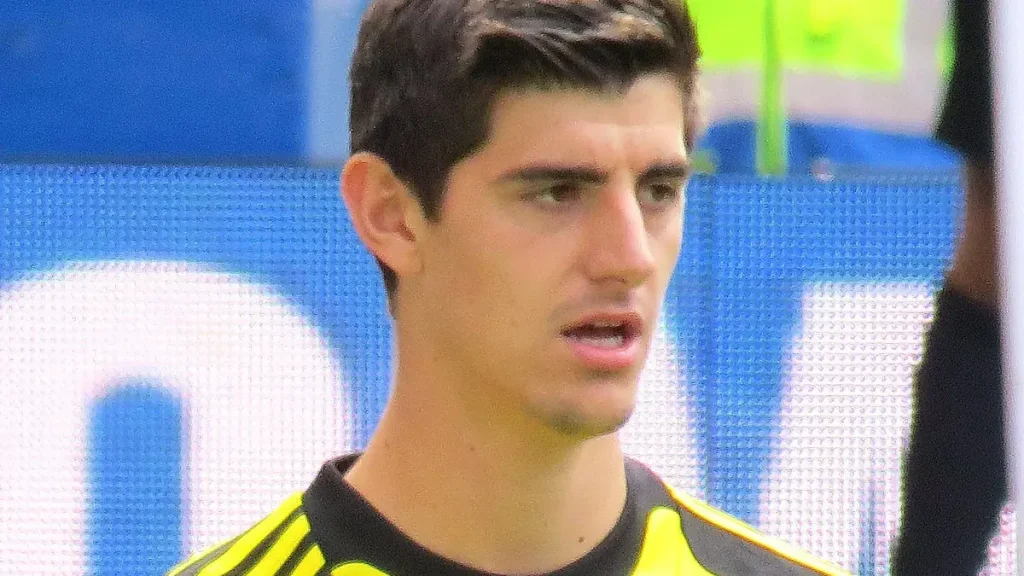
Thibaut Nicolas Marc Courtois (b. 1992-05-11, Bree, Belgium) is, as of September 2026, the goalkeeper for Real Madrid and the Belgium national team. Listed at 1.99 m and ~96 kg, he is one of the tallest first-choice goalkeepers operating at the top of European football, with an arm span and standing-reach footprint that converts into goal-mouth coverage before any movement is initiated. The interesting question for sport science is not whether he is tall — that is plain — but how the anthropometric envelope combines with trainable extensions (jump height, dive technique, foot-plant angle) to define the area a goalkeeper can credibly defend in the time available between shot and ball-line. The variable underneath that is goalkeeper anthropometric reach, and it is one of the few performance traits in football where a non-trainable foundation does most of the work.
Table of Contents
The Physiology — what reach actually measures
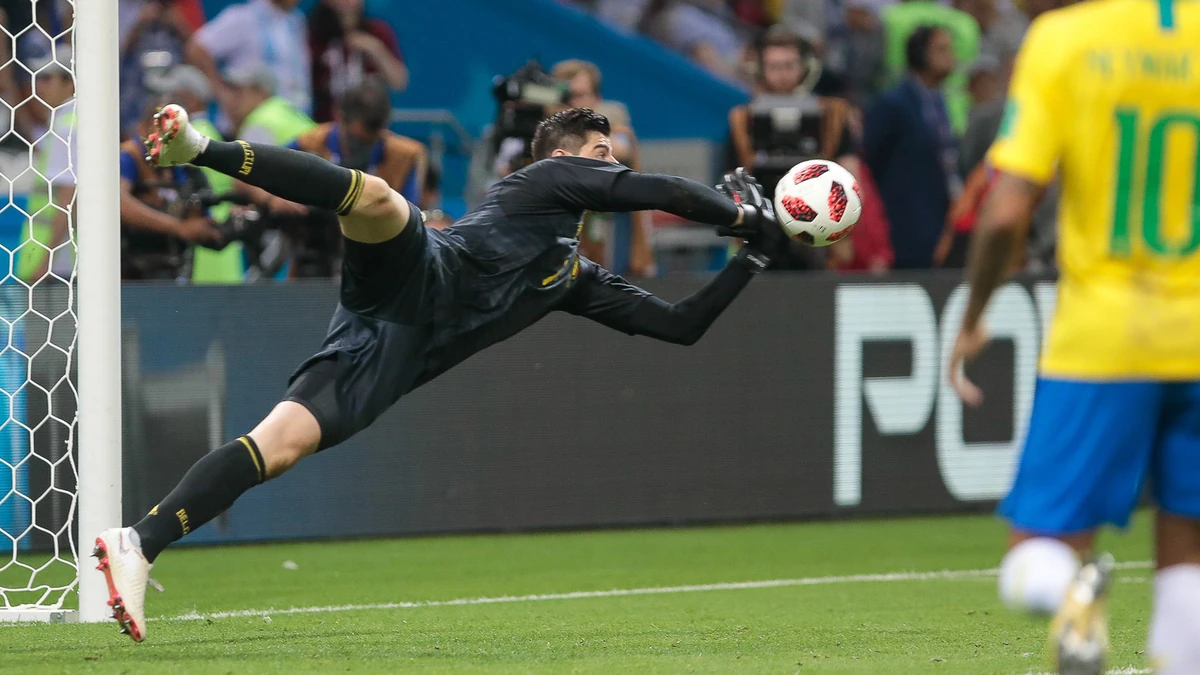
Anthropometric reach in a goalkeeper is best decomposed into a static envelope and a dynamic extension. The static envelope is governed by standing height, sitting height, arm span, and finger-tip-to-toe length — the geometric coverage available before any countermovement. Reilly, Bangsbo and Franks, in their canonical predisposition review, framed the goalkeeper as the position where anthropometric selection pressure is the strongest of any role on the pitch, with elite samples skewed toward the upper percentile of stature and limb length [1]. The dynamic extension layers jump height and dive trajectory onto that envelope, expanding the credible coverage area in three dimensions.
The static side of the envelope is anatomically fixed once growth completes. The dynamic side is not. Wisløff, Castagna, Helgerud, Jones and Hoff demonstrated in a sample of elite footballers that maximal squat strength correlates strongly with vertical-jump height and short-sprint performance — the same lower-body force-output that drives the goalkeeper’s vertical and lateral push-off when extending toward a high or wide ball [2]. The implication is that two goalkeepers of identical height can present very different effective reach envelopes if their lower-body strength differs by enough to shift their standing-jump reach by 5–10 cm.
Markovic and Mikulic’s review of plyometric adaptation refined the prescription. The neuromuscular qualities that drive an explosive lateral dive — rate of force development, stretch-shortening-cycle utilisation, ankle and knee stiffness during the loading phase — respond to short-contact plyometric work more than to heavy-strength work alone [3]. A goalkeeper who develops only maximal strength leaves the elastic component on the table; a goalkeeper who trains both pushes the dynamic-extension ceiling toward the geometric ceiling implied by his anthropometry.
The third layer is anticipatory — reach without correct timing covers nothing. Young and Farrow, in their applied review of agility, distinguished between change-of-direction (closed-skill, pre-planned) and reactive agility (open-skill, decision-coupled), arguing that reactive agility is the dominant constraint in invasion sports because the action must be initiated against an unstable cue [4]. For a goalkeeper, the cue is the shooter’s plant foot, hip angle and follow-through, and the time available is in the 200–400 ms window before ball flight is committed. The reach envelope is only as large as the timing of its deployment allows.
Stølen, Chamari, Castagna and Wisløff’s physiology-of-soccer review pulls the threads together at the position level: goalkeepers operate under a fundamentally different metabolic profile from outfield players — lower total distance, lower aerobic load, but a far higher density of explosive, high-force actions per minute of involvement [5]. The anthropometric envelope, the strength substrate, the elastic substrate and the perceptual substrate are all expressed in the same 0.5–1.0 second window in which a save is decided.
The Case — Courtois as anthropometric reach prototype
For a 1.99 m / 96 kg goalkeeper operating at the top of La Liga and the Champions League, the static reach envelope is consistent with the upper percentile of the position: a fingertip-to-fingertip span and a standing reach that already cover a significant proportion of the goal frame before any countermovement [1]. The case is not that height is sufficient — many tall goalkeepers do not reach this level — but that, when paired with adequate lower-body force output and well-trained dive mechanics, a height advantage compounds into an effective reach envelope that smaller goalkeepers cannot produce no matter how explosive they are.
The strength dimension matters in the opposite direction from outfield players. A 96 kg goalkeeper pays no penalty for absolute mass on the pitch — he does not have to repeatedly transport that mass over 10 km — but he does need force output proportional to that mass to convert his static envelope into a dynamic one. The Wisløff strength-jump correlation predicts that a tall goalkeeper with average lower-body force will look slow off the line, while one in the upper band of squat strength relative to body mass extends his reach by enough to defend the corners of the goal frame as well as the centre [2, 3].
The elastic-perceptual coupling is where the case becomes specific. Goalkeeping at the top level is dominated by reactive moments — deflections, second balls, point-blank reactions — where the dive must be initiated against a cue that resolves in the same 200–400 ms in which the limb is already loading [4]. A goalkeeper whose anticipation is sharp and whose ankle-knee stiffness is well-trained launches his dive earlier and from a more efficient foot-plant angle, with the consequence that his height advantage is expressed on more of the relevant shots rather than being wasted in the late-launch, late-arriving condition that nullifies the envelope.
Match-context note: Courtois’s clean-sheet and shot-stopping numbers in La Liga and the Champions League sit in the upper band for first-choice goalkeepers (Match data: SofaScore), with the discriminator being the proportion of saves made against high-xG shots in the corner zones of the goal frame rather than the central area where any goalkeeper can be expected to cover.
The repeatability dimension is structural rather than metabolic. A goalkeeper does not fatigue across 90 minutes the way a midfielder does, but he does need to deliver the same dive height and the same plant-foot timing on minute 88 as on minute 8, after standing in the cold for long stretches and producing one or two maximal actions per match [5]. The anthropometric envelope is the foundation; the extension is trained; the timing is read.
What This Means for the Reader
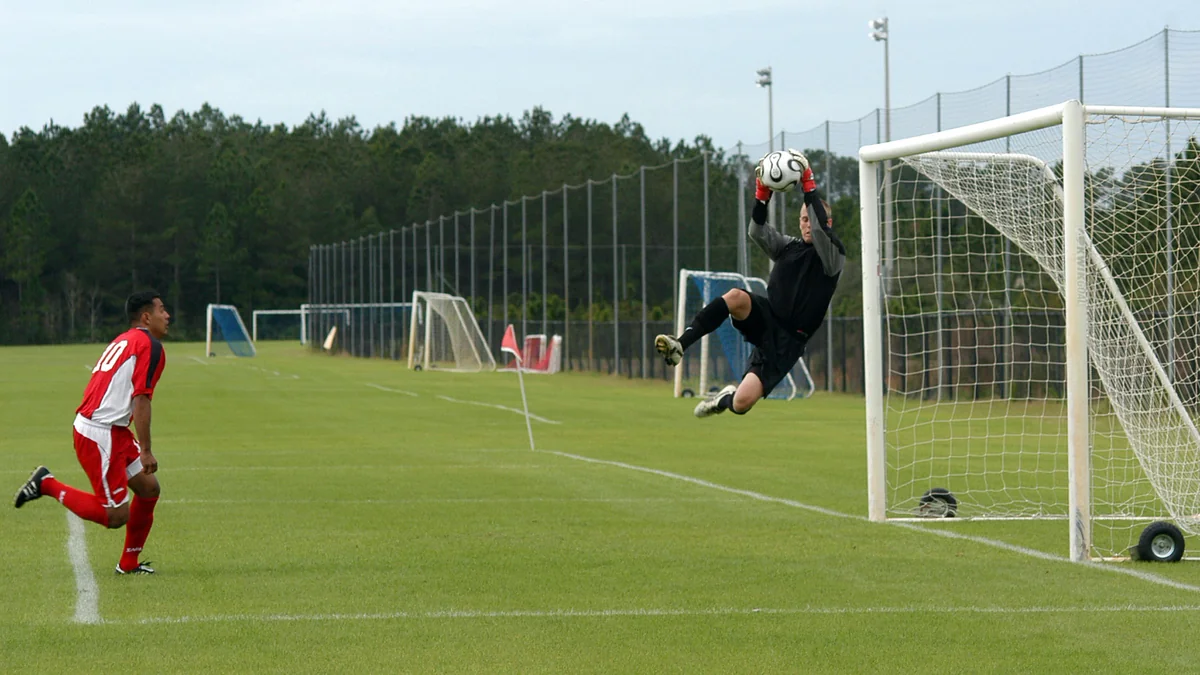
For a developing goalkeeper, the takeaway is that reach is a system of layers — static envelope, lower-body force, elastic stiffness, perceptual timing — and only the first layer is fixed. Three measurements diagnose where the limit lies: a standing-jump-reach test to estimate vertical extension, a standing broad jump as a horizontal-power proxy for dive distance, and a video-based reactive-agility task to estimate decision latency against a true open-skill cue [3, 4]. The goalkeeper who scores well on the first two but poorly on the third is leaving reach on the table because his timing is too late.
The training prescription targets the diagnostic finding: athletes with a strong static envelope but a weak vertical-extension score need short-contact plyometric work and unilateral lower-body strength; athletes with adequate jump but slow reactive timing need open-skill work — perception–action coupling drills against a live cue rather than pre-planned dives [3, 4]. The single diagnostic question for the developing goalkeeper: when a shot finds the corner I should have reached, did I run out of geometry, or did I run out of time?
References
- Reilly T, Bangsbo J, Franks A. (2000). Anthropometric and physiological predispositions for elite soccer. Journal of Sports Sciences, 18(9): 669–683. doi:10.1080/02640410050120050
- Wisløff U, Castagna C, Helgerud J, Jones R, Hoff J. (2004). Strong correlation of maximal squat strength with sprint performance and vertical jump height in elite soccer players. British Journal of Sports Medicine, 38(3): 285–288. doi:10.1136/bjsm.2002.002071
- Markovic G, Mikulic P. (2010). Neuro-musculoskeletal and performance adaptations to lower-extremity plyometric training. Sports Medicine, 40(10): 859–895. doi:10.2165/11318370-000000000-00000
- Young W, Farrow D. (2006). A review of agility: practical applications for strength and conditioning. Strength and Conditioning Journal, 28(5): 24–29. doi:10.1519/00126548-200610000-00004
- Stølen T, Chamari K, Castagna C, Wisløff U. (2005). Physiology of soccer: an update. Sports Medicine, 35(6): 501–536. doi:10.2165/00007256-200535060-00004
Match-context data (descriptive only): SofaScore.
Hüseyin Akbulut is the founder of Sporeus and author of THRESHOLD (EŞİK), a 540-page Turkish-language book on endurance science.
- 540pp THRESHOLD Book
- MSc Sport Sciences
- Marmara University
The Athlete in One Paragraph
Thibaut Nicolas Marc Courtois (b. 1992-05-11, Bree, Belgium) is, as of September 2026, the goalkeeper for Real Madrid and the Belgium national team. Listed at 1.99 m and ~96 kg, he is one of the tallest first-choice goalkeepers operating at the top of European football,…
The Physiology — what reach actually measures
Anthropometric reach in a goalkeeper is best decomposed into a static envelope and a dynamic extension. The static envelope is governed by standing height, sitting height, arm span, and finger-tip-to-toe length — the geometric coverage available before any countermovement. Reilly, Bangsbo and Franks, in their…
The Case — Courtois as anthropometric reach prototype
For a 1.99 m / 96 kg goalkeeper operating at the top of La Liga and the Champions League, the static reach envelope is consistent with the upper percentile of the position: a fingertip-to-fingertip span and a standing reach that already cover a significant proportion…
What This Means for the Reader
For a developing goalkeeper, the takeaway is that reach is a system of layers — static envelope, lower-body force, elastic stiffness, perceptual timing — and only the first layer is fixed. Three measurements diagnose where the limit lies: a standing-jump-reach test to estimate vertical extension,…