Preview
Hüseyin Akbulut, MSc (2026). Walter Tavares and the EuroLeague Rim-Protector Vertical-Reach Profile. Sporeus. Retrieved, November 9, 2026. https://sporeus.com/en/science/walter-tavares-euroleague-rim-protector-vertical-reach/
The Athlete in One Paragraph
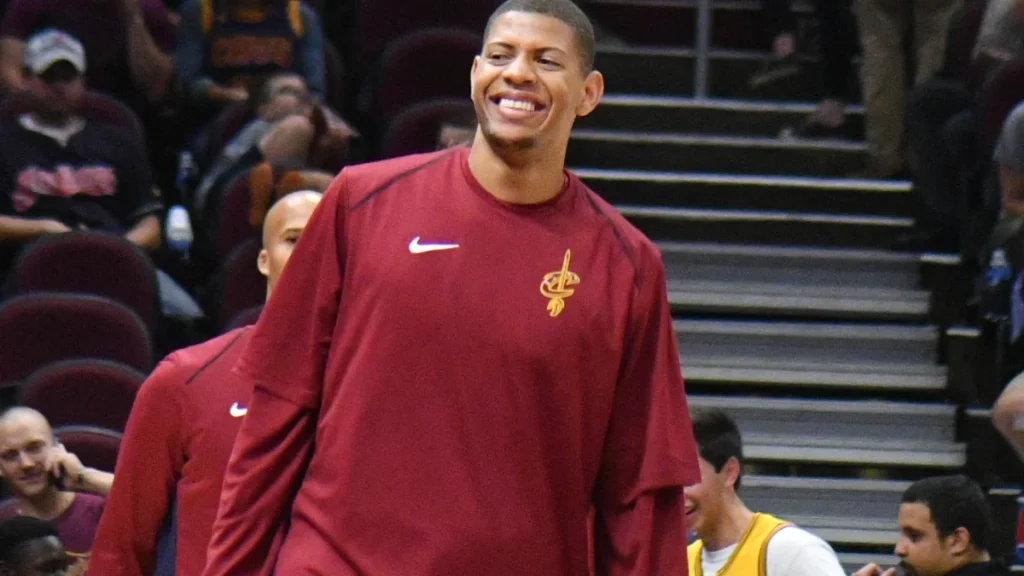
Walter Tavares (b. 1992-03-22) is a Cape Verdean center whose reputation across European basketball rests on rim protection built from standing reach and the timing of his shot blocks. Listed at 2.20 m and ~121 kg and as of September 2026 playing his EuroLeague campaign with Real Madrid, he embodies one of the league’s most scrutinised archetypes. Sport science is less interested in a single rejection than in the physiological and cognitive architecture that lets a player of his size repeat elite output across a 40-minute game, a regular season of 35-plus EuroLeague games and the playoffs. This profile names it Rim-protector vertical reach, the trainable determinants of rim-protection biomechanics and length advantages, and how they combine into the consistency the EuroLeague demands.
Table of Contents
The Physiology: what rim-protector vertical reach actually measures
A rim protector’s vertical reach has to be produced inside the stop-start rhythm of EuroLeague play. In their systematic review of basketball match-play demands, Stojanović and colleagues describe the game as repeated brief, high-intensity bouts separated by short active and passive recoveries, and the average intensity puts it squarely among high-intensity intermittent sports [1]. For a center anchoring the paint, the time-motion work of Ben Abdelkrim, El Fazaa and El Ati on elite young players shows what that load looks like up close: dozens of activity changes every minute, repeated jumps, shuffles, accelerations and decelerations, with heart rate hovering at or above the lactate threshold for long stretches of the game [2]. Every contest at the rim is launched from inside that fatigue.
Blocking shots is as perceptual as it is metabolic. Traffic in the paint limits decisions through perceptual narrowing under fatigue and through the reach of visual search; Abernethy’s work showed that search strategies, the location, timing and duration of an athlete’s gaze, set elite performers apart from sub-elite ones in racket and team sports [3]. Vickers’ quiet-eye paradigm goes further, tying a longer and more stable last fixation before a critical motor action to higher success rates in shooting and passing [4]. For a EuroLeague center, a good play versus a turnover is often decided by the eyes and the decision, not by athleticism.
Timing a block is a power event layered on top of length. Cormie, McGuigan and Newton identify strength, rate of force development and movement velocity as the trainable determinants of maximal neuromuscular power and show that heavy lifting combined with ballistic, velocity-biased work gives the best return [5]. For a center whose job is controlling the rim with reach and well-timed verticals, the reservoir is only wide enough when the strength, cognitive and energy-system bases rise together.
The Case: Walter Tavares as a rim-protector vertical reach archetype
At 2.20 m and ~121 kg, Tavares needs a shot-block profile built on length and clean jump timing that he can reproduce throughout a EuroLeague season. That requires a wide energy-system reservoir working alongside decision-making that fatigue has not eroded; otherwise a late-game collapse exposes a weak physiological foundation [1, 2]. His current role sits on exactly this crossing, since the skill, timing and judgement that define a rim protector must be carried by a very large body across the full EuroLeague season.
At 2.20 m, size is both Tavares’s weapon and his tax. His long levers expand the advantage that comes from controlling the rim with reach and well-timed verticals, and they also raise the absolute strength reservoir needed to move that body explosively across the floor [5]. In the longer EuroLeague playoff run, whose shorter, denser schedule punishes soft spots, the big with the best relative strength and the cleanest motor pattern for his frame keeps the most dependable profile [1, 2].
Walter Tavares’s archetype is defined as much by when he leaves the floor as by how high he reaches. At the elite level, the discriminator is not body speed but how cleanly the eyes and prefrontal cortex parse the play and choose the next action under time pressure [3, 4]. A rim protector who can hold a steady fixation, anticipate the pass or drive coming his way, and time his action while three players converge on the paint is the one whose numbers hold in the late games of a playoff series. EuroLeague rosters are deep in athletes; what separates a center like him is repeatable judgement across late-game minutes against Europe’s best [3, 4].
Tavares’s per-game EuroLeague contributions over his career, reported here as context rather than evidence, fall in the upper band among centers of his cohort (match data via EuroLeague.net and Basketball-Reference).

What This Means for the Reader
For a young big who wants to protect the rim, the lesson is that vertical reach on the court is not just length: it draws on three reservoirs, energy systems, neuromuscular power and decisional cognition and whichever is weakest sets the ceiling [1, 2, 3, 4, 5]. A center who only conditions, only lifts, or only drills blocking technique will hit that ceiling early against bigs who build all three together.
Three tests locate the weak link for a developing rim protector: a graded exercise test or an in-season heart-rate-recovery trend for the energy-system reservoir; a body-mass-relative strength benchmark plus a countermovement jump for the neuromuscular reservoir; and a video-based decision-accuracy task for the cognitive reservoir. When any of these drifts, it is an early warning that his presence at the rim is turning into late-game fade. The question the young center should ask: when I stop altering shots in the fourth quarter, is it a small engine, a jump that has lost its pop, or a late read on the driver?
References
- Stojanović E, Stojiljković N, Scanlan AT, Dalbo VJ, Berkelmans DM, Milanović Z. (2018). The activity demands and physiological responses encountered during basketball match-play: a systematic review. Sports Medicine, 48(1): 111–135. doi:10.1007/s40279-017-0794-z
- Ben Abdelkrim N, El Fazaa S, El Ati J. (2007). Time-motion analysis and physiological data of elite under-19-year-old basketball players during competition. British Journal of Sports Medicine, 41(2): 69–75. doi:10.1136/bjsm.2006.032318
- Abernethy B. (1991). Visual search strategies and decision-making in sport. International Journal of Sport Psychology, 22(3-4): 189–210.
- Vickers JN. (2007). Perception, Cognition, and Decision Training: The Quiet Eye in Action. Human Kinetics. doi:10.5040/9781492595519
- Cormie P, McGuigan MR, Newton RU. (2011). Developing maximal neuromuscular power: Part 1, biological basis of maximal power production. Sports Medicine, 41(1): 17–38. doi:10.2165/11537690-000000000-00000
Match-context data (descriptive only): EuroLeague.net / Basketball-Reference.

Hüseyin Akbulut is the founder of Sporeus and author of THRESHOLD (EŞİK), a 540-page Turkish-language book on endurance science.
- 540pp THRESHOLD Book
- MSc Sport Sciences
- Marmara University
The Athlete in One Paragraph
Walter Tavares (b. 1992-03-22) is a Cape Verdean center whose reputation across European basketball rests on rim protection built from standing reach and the timing of his shot blocks. Listed at 2.20 m and ~121 kg and as of September 2026 playing his EuroLeague campaign…
The Physiology: what rim-protector vertical reach actually measures
A rim protector's vertical reach has to be produced inside the stop-start rhythm of EuroLeague play. In their systematic review of basketball match-play demands, Stojanović and colleagues describe the game as repeated brief, high-intensity bouts separated by short active and passive recoveries, and the average…
The Case: Walter Tavares as a rim-protector vertical reach archetype
At 2.20 m and ~121 kg, Tavares needs a shot-block profile built on length and clean jump timing that he can reproduce throughout a EuroLeague season. That requires a wide energy-system reservoir working alongside decision-making that fatigue has not eroded; otherwise a late-game collapse exposes…
What This Means for the Reader
For a young big who wants to protect the rim, the lesson is that vertical reach on the court is not just length: it draws on three reservoirs, energy systems, neuromuscular power and decisional cognition and whichever is weakest sets the ceiling [1, 2, 3,…