Preview
Hüseyin Akbulut, MSc (2026). Kaylee McKeown and the Backstroke Stroke Mechanics and Economy of an Elite Backstroker. Sporeus. Retrieved, October 16, 2026. https://sporeus.com/en/science/kaylee-mckeown-backstroke-stroke-mechanics-economy/
The Athlete in One Paragraph
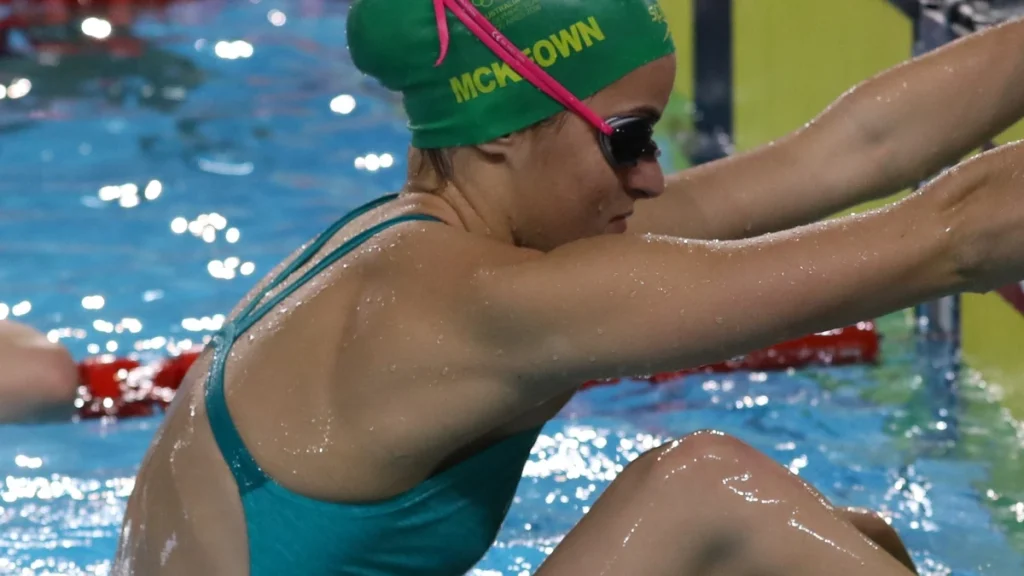
Kaylee Rochelle McKeown (b. 2001-07-12, Redcliffe, Queensland, Australia) is the defining backstroke specialist of her generation, a multiple-time Olympic champion across the 100 and 200 metres backstroke and a former world-record holder in the supine sprint. Listed at 1.78 m and roughly 65 kg, she carries the long-levered, narrow-trunk physique that backstroke disproportionately rewards — long arms for stroke-length leverage at the catch, a streamlined hip line that minimises the wave drag a face-up swimmer cannot avoid, and the trunk-rotation amplitude that turns each cycle into a coupled core-and-shoulder pulse rather than an isolated arm pull. The interesting case for sport science is not whether McKeown’s anaerobic ceiling looks sharp in isolation; it is how a swimmer holds technical economy across thousands of cycles in a stroke whose breathing is decoupled from arm action and whose body line is inverted relative to every other locomotor mode an elite endurance athlete trains. The variable underneath that pattern is backstroke stroke mechanics and economy — the same Joyner–Coyle three-factor model expressed through inverted swimming.
Table of Contents
The Physiology — what backstroke stroke economy actually is
Endurance performance in any locomotor mode is described by the same three-factor framework Joyner and Coyle articulated for running: a maximal aerobic ceiling (VO₂max), the fraction of that ceiling that can be sustained without runaway lactate accumulation, and the metabolic cost of moving at a given submaximal velocity [1]. In backstroke, that third term — stroke economy — is the oxygen cost per metre swum at a given supine velocity, and it is governed by stroke length, stroke rate, body alignment along the long axis, and the drag coefficient produced by a face-up posture that places the largest cross-sectional surface of the trunk on top of the water rather than beneath it [1, 2].
Saunders and colleagues catalogued the determinants of running economy — tendon stiffness, neuromuscular efficiency, body-mass distribution, accumulated training history — and the same logic translates almost intact to inverted swimming, with two specific substitutions: instead of vertical oscillation the backstroker minimises hip-yaw and prevents the hips from sinking below the water line, and instead of Achilles spring the propulsive economy is built on the elastic recoil of the trunk-and-shoulder kinetic chain through a continuous body roll [2]. The economy variable in backstroke is harder to measure than in other strokes because the medium itself fights back — drag rises with the square of velocity — and the supine head position fixes the airway just above the surface, which removes any option to “hide” the breath inside the stroke cycle [3].
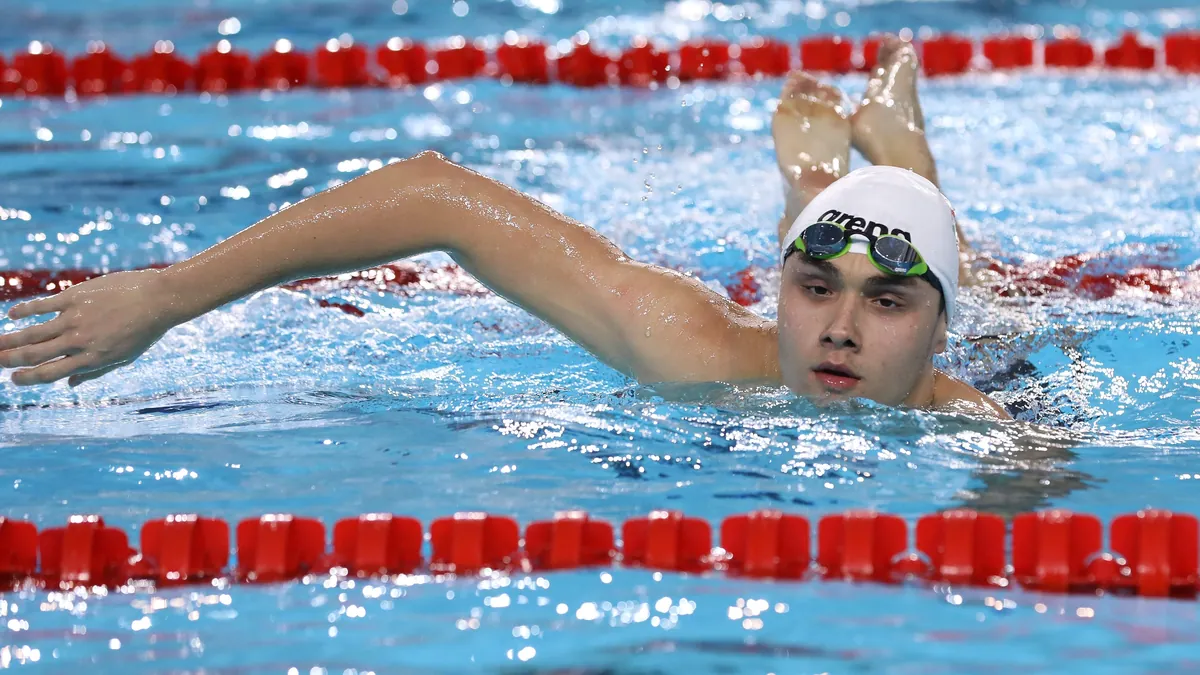
The breathing pattern itself is the cleanest mechanical difference. In freestyle, breaststroke and butterfly the breath is timed inside the propulsive phase; in backstroke the airway is permanently above water and breathing rate decouples from stroke rate, so the swimmer can sustain higher cycle frequencies without the ventilatory penalty that limits prone strokes — and the metabolic cost of high cycle rates depends entirely on how cleanly the swimmer’s body line tolerates the increase [3, 4]. Buchheit and Laursen’s HIIT framework formalised this idea across modes: the cost of high-intensity work is set by the recovery quality between bouts, and recovery quality in turn depends on submaximal economy [4].
Wisløff and colleagues showed that maximal lower-body strength correlates strongly with sprint and jump performance in elite athletes, and the same principle applies to the underwater dolphin-kick phase that opens every backstroke length — the 15-metre underwater segment is essentially a vertical-jump-like propulsive pulse executed through trunk-and-hip extension under load [5]. Stølen and colleagues, in the canonical physiology-of-soccer review, summarised what aerobic and stroke economy together buy any athlete: faster recovery between high-intensity bouts, higher sustainable velocity at submaximal effort, and a larger reserve at the back end of long efforts — which in a 200-metre backstroke is the difference between defending the lead and losing it in the final 50 metres [3].
The Case — McKeown as backstroke-economy lens
McKeown’s record across the 100 and 200 metres backstroke is the cleanest applied case study of the supine-economy phenotype. Her finishing margins in the 200 metres have repeatedly extended into multi-body-length leads against the rest of the global field; her split-pace consistency across the four 50-metre sections of a long-course final is unusually flat, with the late-race fade — the difference between the third 50 and the closing 50 — small enough that it implies a sustainable fraction held very near her personal aerobic ceiling for the full duration, on a stroke whose drag profile is unforgiving of any drift in body position [1, 2].
Her anthropometry is consistent with the profile. At 1.78 m she carries the stroke-length leverage that backstroke rewards at the catch and at the recovery; at roughly 65 kg her mass-specific oxygen demand at submaximal pace stays competitive even in the closing minutes when stroke rate inevitably drifts upward and head position becomes harder to defend. The Saunders determinants of locomotor economy — neuromuscular efficiency, accumulated training history, and the postural control that keeps the body line minimally drag-loaded — read like a description of her career trajectory in the event [2].
The strategic expression of the underlying physiology is the long-underwater-pulse-then-flat-pace tactic that has become her signature. A backstroker with high stroke economy does not need to surge mid-race; surges cost glycogen and oxygen disproportionately, and the body that holds a high steady fraction of VO₂max already operates with a small remaining margin for above-threshold spikes [4]. The visually demoralising 15-metre underwater she opens each length with is not stylistic — it is the only economical way to spend an aerobic budget that is already nearly fully committed, by displacing the most expensive surface-stroke metres with cheaper, less-drag dolphin-kick metres [5].
(Performance data: World Aquatics)
What This Means for the Reader
For the developing swimmer or any endurance athlete, the takeaway is that backstroke performance is a body-line problem before it is a fitness problem. Many recreational and age-group backstrokers chase short, high-intensity sets while their hips drift below the water line and their head position bobs through the cycle; the higher-yield block is usually a sustained period of body-line drill work that pushes the drag coefficient downward while stroke economy refines itself in the background [1, 2]. The 200-metre time falls because the per-metre oxygen cost falls, not because the ceiling rises.
The second implication is the underwater-kick investment. The 15-metre underwater segment is essentially a load-bearing vertical pulse; the strength and timing that produce it follow the same neuromuscular logic as a vertical jump, and the swimmer who develops the trunk-and-hip extension to hold a propulsive dolphin-kick frequency converts the cheap-displacement metres at the start of each length into a measurable race-pace advantage [4, 5]. Backstroke economy work is to inverted swimming what hill repeats are to running — slow, unglamorous, and decisive at the margin.
The diagnostic question for the swimmer: at my goal race pace, does my head position drift, my hips drop, or my stroke rate climb across the second half of the race — and which of those failure modes is costing me the most oxygen per metre?
References
- Joyner MJ, Coyle EF. (2008). Endurance exercise performance: the physiology of champions. The Journal of Physiology, 586(1): 35–44. doi:10.1113/jphysiol.2007.143834
- Saunders PU, Pyne DB, Telford RD, Hawley JA. (2004). Factors affecting running economy in trained distance runners. Sports Medicine, 34(7): 465–485. doi:10.2165/00007256-200434070-00005
- Stølen T, Chamari K, Castagna C, Wisløff U. (2005). Physiology of soccer: an update. Sports Medicine, 35(6): 501–536. doi:10.2165/00007256-200535060-00004
- Buchheit M, Laursen PB. (2013). High-intensity interval training, solutions to the programming puzzle. Sports Medicine, 43(5): 313–338. doi:10.1007/s40279-013-0029-x
- Wisløff U, Castagna C, Helgerud J, Jones R, Hoff J. (2004). Strong correlation of maximal squat strength with sprint performance and vertical jump height in elite soccer players. British Journal of Sports Medicine, 38(3): 285–288. doi:10.1136/bjsm.2002.002071
Performance data (descriptive only): World Aquatics.

Hüseyin Akbulut is the founder of Sporeus and author of THRESHOLD (EŞİK), a 540-page Turkish-language book on endurance science.
- 540pp THRESHOLD Book
- MSc Sport Sciences
- Marmara University
The Athlete in One Paragraph
Kaylee Rochelle McKeown (b. 2001-07-12, Redcliffe, Queensland, Australia) is the defining backstroke specialist of her generation, a multiple-time Olympic champion across the 100 and 200 metres backstroke and a former world-record holder in the supine sprint. Listed at 1.78 m and roughly 65 kg, she…
The Physiology — what backstroke stroke economy actually is
Endurance performance in any locomotor mode is described by the same three-factor framework Joyner and Coyle articulated for running: a maximal aerobic ceiling (VO₂max), the fraction of that ceiling that can be sustained without runaway lactate accumulation, and the metabolic cost of moving at a…
The Case — McKeown as backstroke-economy lens
McKeown's record across the 100 and 200 metres backstroke is the cleanest applied case study of the supine-economy phenotype. Her finishing margins in the 200 metres have repeatedly extended into multi-body-length leads against the rest of the global field; her split-pace consistency across the four…
What This Means for the Reader
For the developing swimmer or any endurance athlete, the takeaway is that backstroke performance is a body-line problem before it is a fitness problem. Many recreational and age-group backstrokers chase short, high-intensity sets while their hips drift below the water line and their head position…