Preview
Hüseyin Akbulut, MSc (2026). Tyrese Maxey and the Closed-Skill Shooting Development Curve of an Elite Guard. Sporeus. Retrieved, October 11, 2026. https://sporeus.com/en/science/tyrese-maxey-closed-skill-shooting-development-curve/
The Athlete in One Paragraph
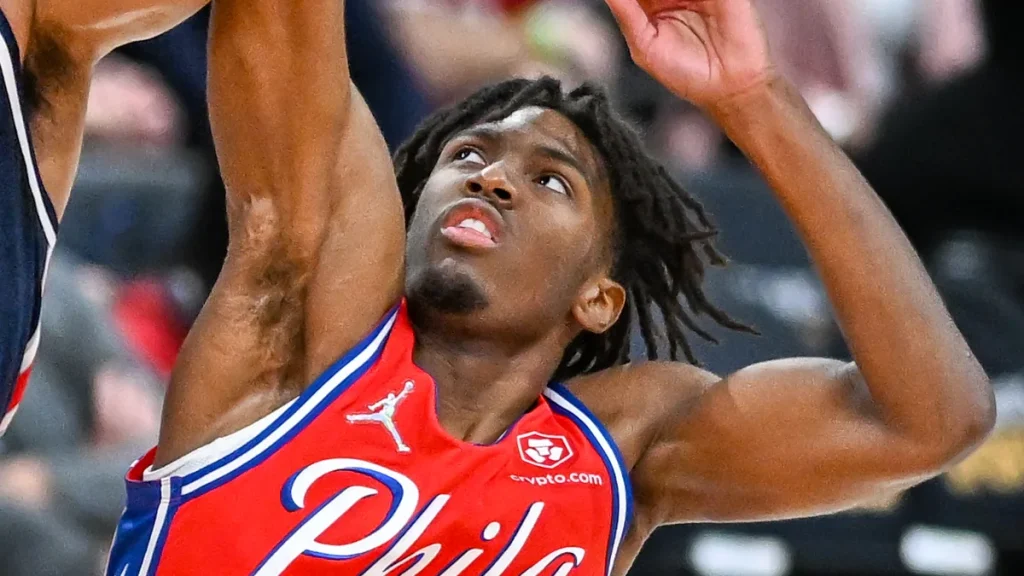
Tyrese Maxey (b. 2000-11-04, Garland, Texas, United States) is, as of September 2026, a guard for the Philadelphia 76ers and a recent member of the United States national-team programme. Listed at 1.88 m and ~91 kg, he carries the anthropometry of a quick, compact lead guard whose value lives in the half-second between a defender’s recovery step and the trigger of a perimeter shot. The 2024 Most Improved Player award marks him as the canonical recent NBA case of a guard whose perimeter-shooting trajectory across early-career seasons rose visibly faster than position-norm — the kind of jump that prompts the question of where the gain actually comes from. The variable underneath that story is the closed-skill shooting development curve — the trainable separation between cones-and-spots shooting (closed skill) and game-pace, defended shooting (open skill), and what changes for a guard between year-2 and year-4 in the NBA when the closed-skill base is mature and the open-skill demand is the new ceiling.
Table of Contents
The Physiology — what closed-skill vs open-skill development actually means
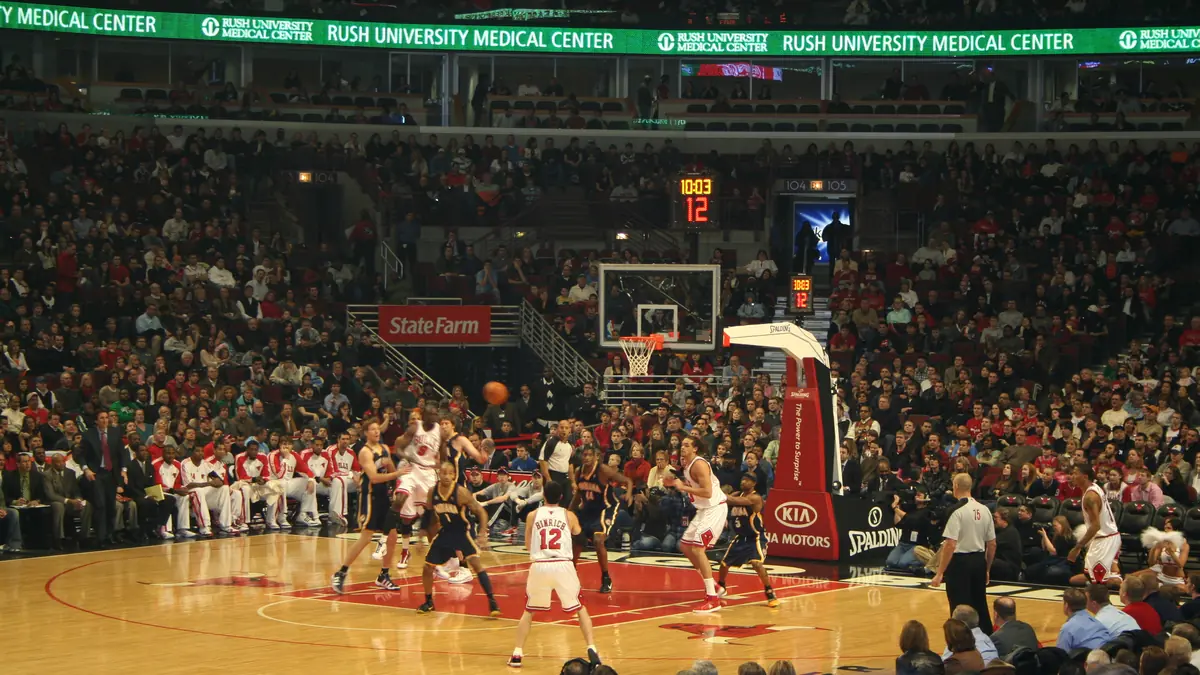
Sheppard and Young’s foundational review of agility — and by extension of any rapidly executed game-skill — drew the now-standard distinction between closed skills, performed in stable and predictable conditions, and open skills, performed under perceptual-cognitive load with uncertain timing and uncertain spatial cues [1]. A jump shot taken from a marked spot off a stationary pass is a closed-skill expression of the underlying motor pattern; the same shot taken in transition off a live screen with a recovering defender on the inside hip is an open-skill expression of the same pattern, and the literature is consistent that the two trainable channels do not transfer fully into one another [1, 2].
Young and Farrow’s practical-applications review extended the same logic into strength-and-conditioning programming: closed-skill rehearsal is necessary but not sufficient for performance under live conditions, and the open-skill component requires deliberate exposure to the perception-action coupling that closed drills explicitly remove [2]. For a developing shooter, the implication is that closed-skill shooting percentage — measured in cones-and-spots, off-the-rack, no-defender contexts — typically saturates earlier in the development curve than the open-skill expression does. A guard can already make a high percentage of clean catch-and-shoots before he is reliable off-the-dribble, in transition, or under late-rotation pressure.
Henry, Dawson, Lay and Young’s work on decision-making accuracy in reactive contexts brings the perceptual-cognitive layer into focus: skilled performers in open-skill conditions are not simply faster, they are reading the cues that allow them to initiate action sooner, with the perceptual lead time concealing the actual execution time [3]. For a shooter, the open-skill ceiling is not pressed by the release mechanics — those are usually mature by the second or third NBA season — but by the lead-up to the release: how quickly the body recognises a closeout pattern, a help-side rotation, or a switch, and prepares the shot before the catch.
Paul, Gabbett and Nassis, in their review of agility in team sports, framed the same point at the operational level: training that excludes the perceptual cues live competition presents tends to over-train the closed-skill expression and under-prepare the open-skill expression, and the fix is exposure with progressively realistic perception-action constraints [4]. A guard whose summer is built around catch-and-shoot reps but no live-defender exposure will return with a closed-skill peak that does not survive the first defended in-game possession.
Stølen, Chamari, Castagna and Wisløff’s update on team-sport physiology places this inside the broader match model: the integral of explosive output, recovery between bursts, and decision quality across a full game is what determines elite output, and the open-skill component of any shot is fatigue-sensitive in a way the closed-skill component is not [5]. A shooter who looks identical to himself at minute 5 and minute 35 in a closed setting may be a different shooter under defended, late-game open-skill demand.
The Case — Maxey as a year-by-year shooting development case study
For a 1.88 m / ~91 kg compact guard whose three-point shooting trajectory across his early NBA seasons rose at a steeper slope than the position median, the underlying physiology question is not whether the closed-skill mechanics improved — those are visible, well-coached, and converge across the first two seasons in any structured player-development environment. It is whether the open-skill expression rose at the same pace, and the closed-skill / open-skill framework gives a clean way to read the data: a guard who improves in transition pull-ups and off-the-dribble three-point conversion while his closed-skill spot-up percentage stays flat is a guard whose open-skill ceiling is moving, not just whose mechanics are tightening [1, 2].
Maxey’s 2024 Most Improved Player award placed him exactly inside that pattern at a public, scouting-visible level: an early-career guard whose mechanics were already credible by year-2 but whose live-game shot generation in transition, off-screen, and against late closeouts visibly stepped up between year-2 and year-4. The training implication is that the closed-skill base — the release height, the foot alignment, the rhythm of the catch — has to be in place before the open-skill development curve can compound, but once it is, the marginal returns on closed-skill volume drop sharply and the marginal returns on open-skill exposure rise [3, 4].
A second feature is fatigue tolerance for the perceptual-cognitive component. Late-game shot quality is, in part, a question of whether the lead-up — the recognition of the closeout pattern, the read of the help defender — survives the cumulative cognitive and physical load of an NBA rotation [5]. A guard whose late-game shooting splits track his early-game splits across a season is a guard whose open-skill conditioning is mature; one whose late-game splits collapse is a guard whose open-skill expression has not yet been trained against fatigue.
Match-context note: across his early career and especially through the 2023–24 season, Maxey’s perimeter-shooting volume and conversion rose into the upper band for guards of his role (Match data: NBA.com / Basketball-Reference). The discriminator is not the closed-skill catch-and-shoot but the open-skill pull-up, the off-screen, and the late-clock creation that compounds his open-skill ceiling year over year.
What This Means for the Reader
For developing guards, the lesson is sharper than the usual “shoot more reps” prescription: closed-skill shooting and open-skill shooting are partly separate trainable channels, and the time to switch the development emphasis from one to the other is when the closed-skill base saturates [1, 2, 3]. Guards who keep stacking closed-skill volume past that point are buying diminishing returns on a percentage they already own; the live-defender, decision-loaded, fatigue-tolerant exposures are what move the open-skill ceiling [4, 5].
Practical assessment: track three measurements across a season — closed-skill shooting percentage from a fixed spot-and-pass protocol, open-skill shooting percentage from a defended live-rep protocol, and the gap between them. A widening gap means the closed-skill base is moving but the open-skill expression is not following; a narrowing gap means the open-skill exposure is doing its job. The training prescription targets the diagnosed gap rather than adding undifferentiated volume.
The diagnostic question for the developing shooter: when my game-pace percentage drops, is it because the mechanics are off, or because the perception-action lead-up that selects the shot was not trained against the same load the game presents?
References
- Sheppard JM, Young WB. (2006). Agility literature review: classifications, training and testing. Journal of Sports Sciences, 24(9): 919–932. doi:10.1080/02640410500457109
- Young WB, Farrow D. (2006). A review of agility: practical applications for strength and conditioning. Strength and Conditioning Journal, 28(5): 24–29. doi:10.1519/00126548-200610000-00004
- Henry GJ, Dawson B, Lay BS, Young WB. (2013). Decision-making accuracy in reactive agility: quantifying the cost of poor decisions. Journal of Strength and Conditioning Research, 27(11): 3190–3196. doi:10.1519/JSC.0b013e31828b8da4
- Paul DJ, Gabbett TJ, Nassis GP. (2016). Agility in team sports: testing, training and factors affecting performance. Sports Medicine, 46(3): 421–442. doi:10.1007/s40279-015-0428-2
- Stølen T, Chamari K, Castagna C, Wisløff U. (2005). Physiology of soccer: an update. Sports Medicine, 35(6): 501–536. doi:10.2165/00007256-200535060-00004
Match-context data (descriptive only): NBA.com / Basketball-Reference.
Hüseyin Akbulut is the founder of Sporeus and author of THRESHOLD (EŞİK), a 540-page Turkish-language book on endurance science.
- 540pp THRESHOLD Book
- MSc Sport Sciences
- Marmara University
The Athlete in One Paragraph
Tyrese Maxey (b. 2000-11-04, Garland, Texas, United States) is, as of September 2026, a guard for the Philadelphia 76ers and a recent member of the United States national-team programme. Listed at 1.88 m and ~91 kg, he carries the anthropometry of a quick, compact lead…
The Physiology — what closed-skill vs open-skill development actually means
Sheppard and Young's foundational review of agility — and by extension of any rapidly executed game-skill — drew the now-standard distinction between closed skills, performed in stable and predictable conditions, and open skills, performed under perceptual-cognitive load with uncertain timing and uncertain spatial cues [1].…
The Case — Maxey as a year-by-year shooting development case study
For a 1.88 m / ~91 kg compact guard whose three-point shooting trajectory across his early NBA seasons rose at a steeper slope than the position median, the underlying physiology question is not whether the closed-skill mechanics improved — those are visible, well-coached, and converge…
What This Means for the Reader
For developing guards, the lesson is sharper than the usual "shoot more reps" prescription: closed-skill shooting and open-skill shooting are partly separate trainable channels, and the time to switch the development emphasis from one to the other is when the closed-skill base saturates [1, 2,…