Preview
Hüseyin Akbulut, MSc (2026). Tyrese Haliburton and the Transition Tempo, Pace and Decision Speed of an Elite Guard. Sporeus. Retrieved, October 5, 2026. https://sporeus.com/en/science/tyrese-haliburton-transition-tempo-pace-decision-speed/
The Athlete in One Paragraph
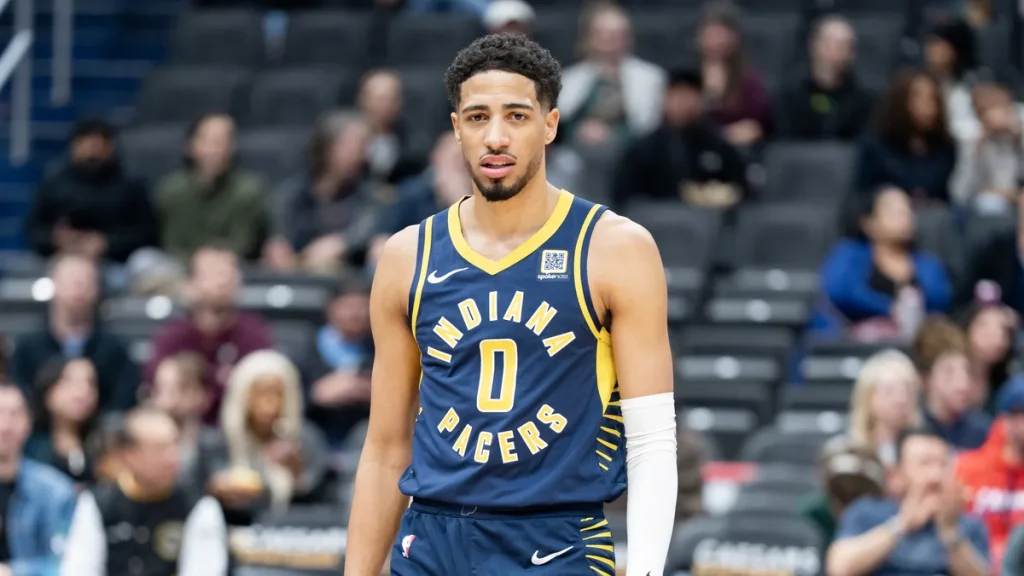
Tyrese Haliburton (b. 2000-02-29, Oshkosh, Wisconsin, United States) is, as of September 2026, a guard for the Indiana Pacers and a current contributor to the United States national team. Listed at 1.96 m and ~84 kg, he carries the anthropometry of a long, lean lead guard whose game lives at the seam between defensive rebound and the very first half-second of the next possession — the exact window in which a transition possession is either won as a quality look or surrendered as a stalled half-court reset. The interesting case for sport science is not a single highlight assist but the underlying control system that lets a 1.96 m guard run his team at near-maximum sprint pace while continuously updating who is open, who is trailing, and which pass is mechanically possible. The variable underneath that story is transition tempo, pace, and decision speed — how sprint mechanics, perceptual scanning, anticipatory cueing, and constrained decision-making interact to produce a high-tempo, low-turnover offensive attack.
Table of Contents

The Physiology — what transition decision speed actually measures
Transition basketball is a reactive-agility task layered on top of a maximum-effort sprint. Sheppard and Young’s classification work draws the line clearly: planned change-of-direction is a closed skill measurable in seconds; reactive agility, by contrast, is the ability to express that physical capacity in response to a stimulus that is itself unfolding in real time, and it is governed by perceptual-cognitive variables as much as by mechanical ones [1]. The fast-break ball-handler is operating in the reactive regime almost continuously — the lane he chooses, the angle at which he attacks, and the decision to pass or attack are all conditioned on what defenders and trailing teammates do over the next 200–400 milliseconds.
Young and Farrow’s review of agility for strength and conditioning practitioners adds the practical layer: the elite player does not just react faster; he reads earlier. Anticipatory scanning, pattern recognition and an internal model of where teammates and defenders will be a half-second from now compress the apparent reaction time and free the mechanical system to act without hesitation [2]. The training implication is that decision speed is itself trainable, and it sits in the same continuum as the physical end of agility rather than in a separate cognitive box.
Henry, Dawson, Lay and Young examined decision-making accuracy under reactive-agility constraints and showed that under time pressure, more skilled players preserved both speed and accuracy of decision, while less skilled players traded accuracy for speed once the time window contracted [3]. For a transition lead guard the operational read is direct: late, hurried decisions cost the team possessions; early, well-cued decisions buy the team open looks before the defence can re-set.
Paul, Gabbett and Nassis’s review of agility in team sports re-frames the picture as a multi-component system — a base of strength and power, a sprint-and-deceleration mechanical layer, a perceptual-cognitive layer, and the integration between them — and concludes that improvements in any one component without integration produce only modest match-context gains [4]. Stølen, Chamari, Castagna and Wisløff’s physiology-of-soccer review, although a football reference, captures the underlying energetic context that translates directly to elite basketball: the ability to repeat near-maximal efforts is gated by aerobic conditioning, repeated-sprint capacity, and recovery between bursts [5]. A transition lead guard who cannot recover between possessions will see his decision speed degrade in the late minutes regardless of how sharp it is when fresh.
The concise summary is that transition tempo is a system property — a sprint-mechanics layer underwriting the body, a perception-action loop running on top, and an aerobic-recovery layer keeping both available across a full game.
The Case — Tyrese Haliburton as transition-engine archetype
For a 1.96 m / ~84 kg lead guard, the long-levered build is a double-edged tool. The frame extends passing windows and forces defenders to commit at unusual distances; the same length, however, demands a clean sprint mechanic, because long levers loaded badly cost more time than they save [4, 5]. Haliburton’s transition role asks him to push pace from defensive rebound to attacking third while running the half-court look concurrently — the system is not in transition or in half-court, it is in transition and half-court at the same time for the first three seconds of every possession.
The cognitive layer is where his profile shows. The elite transition guard does not first sprint and then decide; he sprints with a constantly updating model of who is filling lanes and who is recovering, and that model is built by anticipatory scanning that begins before the defensive rebound is secured [1, 2]. The pass that surprises a defence has usually been telegraphed inside the player’s perceptual model two or three frames earlier; the mechanical window for actually delivering it is short, but the cognitive window has been open for much longer.
The decision-accuracy layer matters because turnovers and bad shot selections are the price of pace done badly. The player who preserves accuracy under time pressure is the player whose half-court team continues to trust the transition lookup — and the trust itself widens lanes, because trailing teammates run harder when they expect the ball to find them in rhythm [3]. Haliburton’s reputation for low-turnover, high-assist transition execution is consistent with the profile of an athlete whose perceptual-cognitive layer is operating ahead of, not behind, his sprint mechanics.
The recovery layer closes the loop. A 48-minute basketball game with playoff extensions cannot be won by a lead guard whose aerobic base collapses by the third quarter; the repeated-sprint demand of running the offence at tempo is real and physiologically expensive, and the discriminator at the elite level is the ability to keep producing the same quality of decision in the fourth quarter as in the first [4, 5].
Match-context note: across recent NBA seasons Haliburton’s per-game assist totals and on-court tempo have sat among the upper band for lead guards (Match data: NBA.com / Basketball-Reference), with the discriminator being the quality of decision under transition pressure rather than any single-game peak.

What This Means for the Reader
For a developing lead guard, the takeaway is that transition tempo is not a sprint test; it is an integration test [1, 2, 3, 4, 5]. Players who train sprint mechanics in isolation, agility cones in isolation, and film study in isolation, without ever forcing the three to operate against each other under time pressure, build three separate skills that do not compound in a real possession.
Three measurements diagnose the limiting variable in a developing transition guard’s profile: a short-acceleration sprint with mechanical assessment, a reactive-agility test with a live stimulus, and a small-sided decision-making drill scored on accuracy under a time cap. Drift in any of the three is the early signal that the transition engine is degrading at one of its three operating layers. The diagnostic question for the developing guard: when my late-game possessions go flat, is it my sprint, my read, or my recovery that has run out first?
References
- Sheppard JM, Young WB. (2006). Agility literature review: classifications, training and testing. Journal of Sports Sciences, 24(9): 919–932. doi:10.1080/02640410500457109
- Young W, Farrow D. (2006). A review of agility: practical applications for strength and conditioning. Strength and Conditioning Journal, 28(5): 24–29. doi:10.1519/00126548-200610000-00004
- Henry GJ, Dawson B, Lay BS, Young WB. (2013). Decision-making accuracy in reactive agility: quantifying the cost of poor decisions. Journal of Strength and Conditioning Research, 27(11): 3190–3196. doi:10.1519/JSC.0b013e31828b8da4
- Paul DJ, Gabbett TJ, Nassis GP. (2016). Agility in team sports: testing, training and factors affecting performance. Sports Medicine, 46(3): 421–442. doi:10.1007/s40279-015-0428-2
- Stølen T, Chamari K, Castagna C, Wisløff U. (2005). Physiology of soccer: an update. Sports Medicine, 35(6): 501–536. doi:10.2165/00007256-200535060-00004
Match-context data (descriptive only): NBA.com / Basketball-Reference.
The Athlete in One Paragraph
Tyrese Haliburton (b. 2000-02-29, Oshkosh, Wisconsin, United States) is, as of September 2026, a guard for the Indiana Pacers and a current contributor to the United States national team. Listed at 1.96 m and ~84 kg, he carries the anthropometry of a long, lean lead…
The Physiology — what transition decision speed actually measures
Transition basketball is a reactive-agility task layered on top of a maximum-effort sprint. Sheppard and Young's classification work draws the line clearly: planned change-of-direction is a closed skill measurable in seconds; reactive agility, by contrast, is the ability to express that physical capacity in response…
The Case — Tyrese Haliburton as transition-engine archetype
For a 1.96 m / ~84 kg lead guard, the long-levered build is a double-edged tool. The frame extends passing windows and forces defenders to commit at unusual distances; the same length, however, demands a clean sprint mechanic, because long levers loaded badly cost more…
What This Means for the Reader
For a developing lead guard, the takeaway is that transition tempo is not a sprint test; it is an integration test [1, 2, 3, 4, 5]. Players who train sprint mechanics in isolation, agility cones in isolation, and film study in isolation, without ever forcing…