Preview
Hüseyin Akbulut, MSc (2026). HIIT Essentials, Part I: Adaptation. Sporeus. Retrieved, November 17, 2026. https://sporeus.com/en/sport/hiit-essentials-adaptation/
To sustain life, our body responds to its environment with physiological reactions again and again, and it tries to adapt to every kind of stress it faces.
Temperature, humidity, pressure and many other factors act on the body constantly. Under all these influences, the body regulates its responses in order to survive. Otherwise these stresses could wear down its tissues, and tissues that fail to regenerate can lead to illness and disease.
When we look at adaptation in the context of exercise, the way loads are planned has to be adjusted for each individual. That is why individualisation is an important criterion when designing a training programme.
Progressive overload is one of the core loading principles in sport science. It should be used to understand physiological adaptation and to plan and individualise each training session.
Progressive overload is based on placing the body under more stress than normal during a session, and we can treat every load the body faces as a form of stress, for example training frequency, number of repetitions or weight lifted.
When the load is completed successfully, this extra stress usually results in the body improving. It then becomes necessary to place the body under a little more stress in later sessions in order to keep improving.
These loads, which you can think of as the sets and exercises within a session, are increased gradually from one session to the next, and the body is expected to adapt to them.
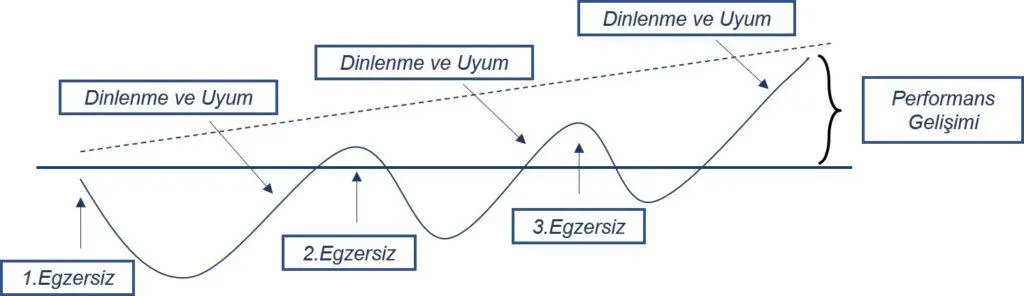
The figure shows, in simple form, how the body adapts to exercise. The dips after each session represent the loss of energy, and the rises represent recovery and improvement. In fact, the body improves through the sum of its physiological responses to each load.
Loads should be tailored to each athlete, because the stress a load creates and the response to that stress differ from person to person.
The simplest way to tailor a session to the individual is through duration and intensity. Loads should be increased with the limits of the human body in mind, which is a sound way to drive improvement.
Physiological data should be collected and evaluated to see the individual’s limits and progress. VO₂max and heart rate are good examples.
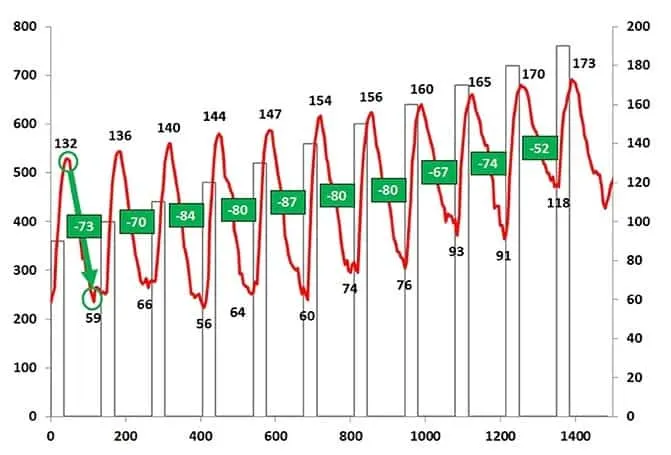
Heart rate can be used to set the intensity of a load. Although it is relatively easy to measure, it may not be as easy to use in HIIT as we might think, because the work periods in HIIT are very short.
Heart rate lags behind. The heart itself responds very quickly, but it takes a few seconds for the response to become large enough to show up in a heart-rate reading. With that in mind, using heart rate to guide HIIT becomes difficult.
Exercise intensity in HIIT is very high, so a great deal of energy is used in a short time. Recovery periods are needed to replace that energy and allow the body’s tissues to regenerate.
In HIIT, high-intensity work bouts are short and repeated many times. After each bout the body needs a recovery period before the next one. For the body to adapt, work and recovery periods have to be planned for the individual.
When we work with physiological data, our main aim is, put simply, to establish reference values. These data help us understand our body better, so we can set our loading limits and recovery periods more appropriately.
Adaptation and athlete development can be viewed from many angles. To understand the relationship between work and recovery better, see our article on periodisation.
Hüseyin AKBULUT
Coach. He graduated from the Faculty of Sport Sciences at Marmara University in 2017, wrote his master’s thesis in the university’s Information Technologies in Sport programme on the neural dynamics of performing and observing movement, and has worked on many research projects examining high-level exercise performance.
References
- Helgerud J, Høydal K, Wang E, et al. (2007). Aerobic high-intensity intervals improve VO2max more than moderate training. Medicine & Science in Sports & Exercise, 39(4): 665–671. doi:10.1249/mss.0b013e3180304570
- Buchheit M, Laursen PB. (2013). High-intensity interval training, solutions to the programming puzzle. Part I: cardiopulmonary emphasis. Sports Medicine, 43(5): 313–338. doi:10.1007/s40279-013-0029-x

Hüseyin Akbulut is the founder of Sporeus and author of THRESHOLD (EŞİK), a 540-page Turkish-language book on endurance science.
- 540pp THRESHOLD Book
- MSc Sport Sciences
- Marmara University