Preview
Hüseyin Akbulut, MSc (2026). How Many Calories Does Running Burn? The Factors That Matter. Sporeus. Retrieved, November 17, 2026. https://sporeus.com/en/sport/how-many-calories-does-running-burn/
How many calories does running burn? We all know running is good for us, but do we know how much energy we actually use when we run, or which factors affect calorie burn during exercise? We will focus on running, but you can apply the same factors to your own activities.
Table of Contents
Calorie: a unit expressing the heat and energy the body obtains when food is broken down in its tissues.
Different people doing the same activity for the same length of time can use very different amounts of energy. When running, the calories burned per kilometre can range from about 50 to 90.
A 30-minute run at 10 km pace can burn anywhere from 250 to 550 calories, depending on your body weight, your speed, the surface and the gradient.
5 km, 10 km, 15 km, 42.195 km: do these numbers mean anything to you? If you are a runner, you know exactly what they mean. They are distances in kilometres, but runners’ vocabulary goes much further: minutes per kilometre, the number of laps on a 400 m track, the distances and durations of work and recovery repeats, how often you need a drink, how many calories you burn, and so on.
Many people run to lose weight, get fit or for many other reasons. Because running is simple, and perhaps because the body adapts to it so readily, you can train in countless variations and burn a substantial number of calories.
But many factors affect calorie burn during exercise: body weight, fitness level, surface, gradient and more. To estimate accurately how many calories you burn in a session, your training plan needs to take these factors into account.
A Few Words About Calories
Your weight depends on many factors, but the basic equation is simple: take in more calories than you use and you gain weight; take in fewer and burn more through physical activity, and you lose weight.
Since roughly 7,500 calories correspond to about 1 kg of body fat, losing 1 kg requires a deficit of about that size. The deficit does not have to come from exercise alone. Adjusting what you eat and making small changes to your lifestyle can create it quite easily.
To maintain a healthy body weight, a man needs on average about 2,500 calories a day (10,500 kJ) and a woman about 2,000 calories a day (8,400 kJ). Besides sex, these values vary with age, physical activity and many other factors.
Energy Balance
The body needs energy to keep us alive and keep our organs working. When we eat and drink, we supply the substances from which it can produce energy, and it uses that energy for everything from breathing to running.
To keep body weight stable, the energy we take in must equal the energy we spend on normal body functions and physical activity.
Estimating the Calories You Burn Running
There are different ways to estimate how many calories you burn while running. Many runners use a rule of thumb of 65 calories per kilometre. It is the quickest and simplest way to estimate energy expenditure, but because it ignores important variables it is probably not the most accurate.
As a very general rule, a runner of average build burns about 65 calories per kilometre. So to burn 600 calories, they would need to run roughly 10 km.
Factors That Affect Calorie Expenditure
How many calories you burn on a run depends on many factors.
Body weight
A 65 kg athlete running at 10 km/h burns about 325 calories in 30 minutes. An 80 kg athlete running at the same speed burns about 410.
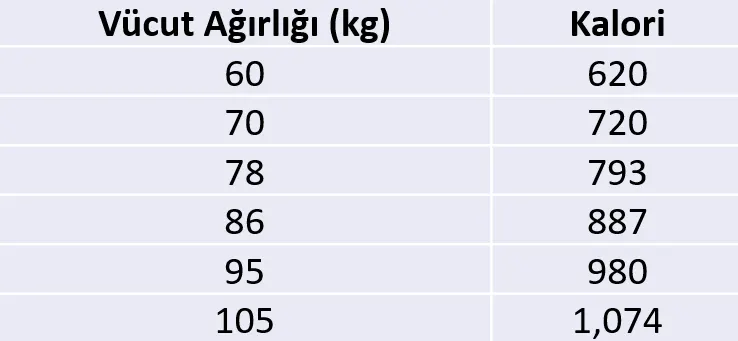
The reason for the increase is simple: a heavier body has to spend more energy to move.
Sex
Working out where the calorie difference comes from is difficult, and studies have reported different findings.
In studies where the same activities are performed for the same length of time, men generally burn more calories than women. Whether this is due to sex itself or to body composition is still unclear (on average, men carry more muscle mass than women).
Speed
A 70 kg athlete running at 10 km/h for 30 minutes burns on average about 350 calories. Running at 12 km/h for the same time, the same athlete burns about 420. Does the increase continue at the same rate at 14 km/h? Roughly, yes: the energy cost of running per kilometre is largely independent of speed (di Prampero, 1986), so the calories burned in a given time rise almost linearly with speed, and at very high speeds air resistance adds a little more. These figures are still only general averages.
Burning more calories at higher speeds simply reflects the greater energy demand.
Speed is a factor in estimating calorie burn, but calorie comparisons based on speed are often misleading, because a well-trained runner with good running economy uses less energy than an average runner at the same speed for the same time.
Gradient
Training on hilly roads or trails increases the calories you burn, mainly because running uphill forces you to work harder.
On a treadmill that estimates energy expenditure, you can run on the flat, then set the incline to 10% and compare the calories burned; your watch, your own calculations or another reference test can help here. You can then apply that difference to your runs on hilly roads or trails. Of course, you need to know the gradient of your route, but if you train regularly in the same area, that should not be hard to find out.
Remember that just as you burn more calories running uphill, at certain speeds you will burn fewer running downhill.
Hill and trail running are very useful for athletes because, even when the session stays aerobic, your heart rate rises and falls repeatedly on the climbs and descents. Adapting to these changes can feel hard in your first sessions and raises calorie burn considerably. With training, though, your heart adapts, and that adaptation contributes significantly to your performance on flat ground.
Running surface
Whether you run on the road, a treadmill, a trail or sand, the surface also affects how many calories you burn. Treadmill running is generally thought to burn the fewest.
Running on sand, mud or trails demands more energy, because you have to recruit more muscles and muscle groups to keep your balance and stay upright on uneven ground.
Weather
Running in strong wind can increase the intensity of a session, and if you hold your pace, you will burn more calories. Whether more calories are burned in the heat or in the cold is still debated.
How Many Calories Do Different Activities Burn?
The image below, based on figures from the Mayo Clinic, shows the average calories a 73 kg (160 lb) person burns in one hour of different activities. As this article has explained, these figures vary with many factors, so keep that in mind, but they are useful for getting a rough idea.
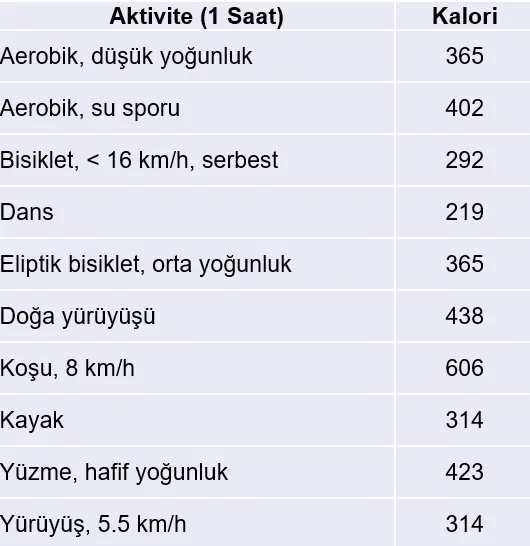
In this article we have tried to answer the question “How many calories does running burn?” by taking several factors into account. Many scientific papers estimate energy expenditure using more sophisticated methods; here we have covered general average values and the factors that affect calorie burn while running. It is a useful place to start.
If you have questions, you can leave a comment or write to us at info@sporeus.com.
References
- Ainsworth, B. E., Haskell, W. L., Herrmann, S. D., et al. (2011). 2011 Compendium of Physical Activities: a second update of codes and MET values. Medicine & Science in Sports & Exercise, 43(8), 1575-1581. https://doi.org/10.1249/MSS.0b013e31821ece12
- di Prampero, P. E. (1986). The energy cost of human locomotion on land and in water. International Journal of Sports Medicine, 7(2), 55-72. https://doi.org/10.1055/s-2008-1025736

Hüseyin Akbulut is the founder of Sporeus and author of THRESHOLD (EŞİK), a 540-page Turkish-language book on endurance science.
- 540pp THRESHOLD Book
- MSc Sport Sciences
- Marmara University
A Few Words About Calories
Your weight depends on many factors, but the basic equation is simple: take in more calories than you use and you gain weight; take in fewer and burn more through physical activity, and you lose weight.
Energy Balance
The body needs energy to keep us alive and keep our organs working. When we eat and drink, we supply the substances from which it can produce energy, and it uses that energy for everything from breathing to running.
Estimating the Calories You Burn Running
There are different ways to estimate how many calories you burn while running. Many runners use a rule of thumb of 65 calories per kilometre. It is the quickest and simplest way to estimate energy expenditure, but because it ignores important variables it is probably…
Factors That Affect Calorie Expenditure
How many calories you burn on a run depends on many factors.
Body weight
A 65 kg athlete running at 10 km/h burns about 325 calories in 30 minutes. An 80 kg athlete running at the same speed burns about 410.