Preview
Hüseyin Akbulut, MSc (2026). Types of Muscle: How Skeletal, Smooth and Cardiac Muscle Differ. Sporeus. Retrieved, November 17, 2026. https://sporeus.com/en/sport/muscle-types-skeletal-smooth-cardiac/
The types of muscle in the human body are striated skeletal muscle, smooth muscle and cardiac muscle. So what differences are there in their structure?
Table of Contents
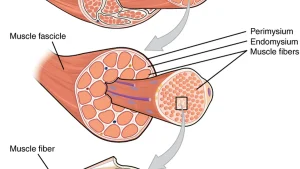
With some exceptions, skeletal muscles attach to at least two different bones. That attachment to bone tissue happens through tendons. When the muscle contracts, force is transmitted to the bones as the tendons are put under tension, and movement takes place.
Smooth muscle and cardiac muscle are built differently. To examine and compare them, start with what needs to be known first.
Striated and Smooth Muscle
The first thing to establish is what we mean by striated and smooth muscle.
The difference between them is the set of lines observed in their anatomical structure under a microscope. Those lines are called striations.
Striated skeletal muscle is also directed by the nervous system through voluntary contraction, and that property separates it from the other two muscle types.
Cardiac muscle resembles striated skeletal muscle structurally but, as its function demands, is under autonomic control.
For a further difference, we need to determine whether a muscle is myogenic or neurogenic in its organisation.
Note that in these terms the suffix -genic refers to origin or production, myo- means muscle and neuro- means neuron.
How Movement Is Initiated
Consider how a muscular movement begins, or how muscle contraction is triggered.
Does the neuron trigger it, or the muscle?
Look closely at a neurogenic muscle and you see the motor neuron axon reaching all the way to the muscle fibres. Through those axons the motor neurons transmit the command to contract.
Such a muscle is neurogenic because there is a neuron telling the muscle to contract. Striated skeletal muscle therefore has neurogenic properties.
There are also types of smooth muscle that can be called neurogenic. To repeat: neurogenic muscles are those in which contraction is triggered through a neuron.
Myo- means muscle, and what is meant here is really the muscle cells. In these structures we see that if one of the cells contracts, that is, depolarises, the signal spreads to the other muscle fibres and the muscle contracts.
We call this myogenic rather than neurogenic, because there is no neuron telling the muscle to contract or transmitting a command. Contraction is triggered by spontaneous activity in the cell.
Thinking in these terms, we can see that cardiac muscle is myogenic. For more detail on cardiac muscle, see Cardiac Muscle: From Structure to Effects.
Single-unit, myogenic organisation can also be found in smooth muscle. And if you have cells capable of spontaneous activity, you want to know how that activity propagates.
To understand how depolarisation spreads, we need to know about the special connections in muscle tissue called gap junctions. In cardiac muscle those connections are part of the intercalated discs. The other component of the intercalated disc is the desmosome.
In this way the process that begins with depolarisation spreads through the muscle via the gap junctions.
The reason cardiac muscle additionally has desmosomes is to prevent tearing and wear.
So the intercalated disc in cardiac muscle contains both gap junctions and desmosomes. And the contraction that spreads through the gap junctions allows all the muscle cells to contract together.
The muscle types and the differences in their structure can be compared and examined in this way. Knowing the details and functions behind those differences makes the body’s movements and responses easier to understand.
You may also like: Muscle Fibre Types: Oxygen, Glycogen, Myoglobin and Fatigue
References
- Severs NJ. (2000). The cardiac muscle cell. BioEssays, 22(2): 188–199. doi:10.1002/(SICI)1521-1878(200002)22:2<188::AID-BIES10>3.0.CO;2-T
- Webb RC. (2003). Smooth muscle contraction and relaxation. Advances in Physiology Education, 27(4): 201–206. doi:10.1152/advan.00025.2003
- Hall JE. (2016). Contraction of Skeletal Muscle; Contraction and Excitation of Smooth Muscle. In Guyton and Hall Textbook of Medical Physiology (13th ed.). Elsevier. ISBN 978-1455770052

Hüseyin Akbulut is the founder of Sporeus and author of THRESHOLD (EŞİK), a 540-page Turkish-language book on endurance science.
- 540pp THRESHOLD Book
- MSc Sport Sciences
- Marmara University
Striated and Smooth Muscle
The first thing to establish is what we mean by striated and smooth muscle.
How Movement Is Initiated
Consider how a muscular movement begins, or how muscle contraction is triggered.