Preview
Emre Köse (2026). Modern Forehand: Open Stance and the Rotational Engine. Sporeus. Retrieved, October 23, 2026. https://sporeus.com/en/tennis/modern-forehand-open-stance-rotational/
Watch a 1985 ATP match and a 2025 ATP match back to back. Many things look different, racquets, strings, court speeds, ball trajectories. But the single most dramatic visible change is the forehand. The 1985 forehand is a sideways, square-stance, linear-weight-transfer stroke. The 2025 forehand is an open-stance, rotational, ground-driven stroke. They look like different shots produced by different bodies in different sports.
Table of Contents
The shift from closed-stance to open-stance forehand is the defining stroke evolution of modern tennis. Understanding why it happened, what makes it work, and where it still misfires is essential for any coach trying to teach the modern game.
What Open Stance Actually Means
In a closed-stance forehand, the player steps forward with the lead foot (left foot for a right-hander) toward the ball, planting it perpendicular to the baseline. Weight transfers forward, hips and shoulders rotate in a relatively linear way, and the stroke ends with the player’s body facing the net.
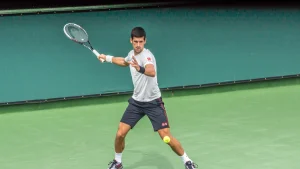
In an open-stance forehand, the player stays sideways-on or even slightly opens toward the net throughout the swing. The lead foot does not step forward into the ball. Both feet remain roughly parallel to the baseline. Weight transfers from the back leg to the front leg through rotation rather than translation. The trunk’s primary motion is angular, not linear.
The difference is not aesthetic. It is mechanical. A closed-stance forehand produces force primarily through linear momentum (mass moving forward). An open-stance forehand produces force primarily through rotational momentum (mass spinning around a vertical axis). Modern racquet technology and ball physics reward the rotational engine over the linear one.
Why Open Stance Became Dominant
Several factors converged in the 1990s and 2000s to shift forehand technique:
1. Topspin physics. Modern polyester strings and graphite frames allow far more topspin generation than older equipment. The open stance positions the body to generate vertical brush, the racquet path can move more steeply upward through contact, because the body’s rotation is around a vertical axis instead of through a horizontal weight transfer. Open stance and heavy topspin co-evolved.
2. Faster game pace. Closed-stance footwork takes longer to execute, the step, the plant, the weight transfer. As ground stroke pace rose in the 1990s and 2000s, players found that they could not afford the time to set up closed stances on every ball. Open stance became the default for time-pressured shots, and then for all shots.
3. Recovery economics. After hitting a closed-stance forehand, the player’s body is committed forward and toward the ball. Recovery to the center requires reversing that momentum. After hitting an open-stance forehand, the player is already rotating back toward neutral. Recovery is faster. Across thousands of rallies, the seconds saved compound.
4. Power output. With modern equipment, the rotational engine produces more racquet head speed than the linear engine. The biggest forehands in the game, Nadal, Alcaraz, Sabalenka, are predominantly open-stance. There is no top-ten player today whose forehand is primarily closed-stance.
The combined effect: the open-stance forehand is the high-leverage stroke for modern tennis. Coaching that ignores this evolution produces players whose forehand caps out below what their bodies could produce.
The Mechanics of the Open-Stance Forehand
A well-executed open-stance forehand has a specific sequence:
Phase 1: Unit turn. The player turns the trunk (shoulders and hips together) toward the side of the incoming ball. The racquet goes back as a function of the trunk rotation, not a separate arm movement. The back foot loads, for a right-hander, the right leg coils as the trunk turns right.
Phase 2: Load. The back leg accepts the weight transfer through rotation, not by stepping back. The hips coil slightly more than the shoulders, creating the hip-shoulder separation angle that will release power later. The trunk is fully loaded; the arm is still in a passive trailing position.
Phase 3: Initiation. The back leg drives. Ground reaction force pushes the hips into rotation. The hips begin to open toward the net, leading the shoulders. The arm is still passive, it has not yet started its forward motion.
Phase 4: Sequential release. Hips rotate, shoulders catch up and overtake, then the arm whips through. The trunk’s angular velocity peaks before the arm’s. This is the kinetic chain expressing through rotation.
Phase 5: Contact and follow-through. The racquet meets the ball with the body still rotating. Pronation occurs through contact. The follow-through finishes with the racquet over the opposite shoulder and the chest facing the net, the rotation has been fully expressed.
Throughout the sequence, the feet stay relatively planted in their starting positions. There is no big step forward. Power comes from rotation, not from forward linear motion.
Where Amateurs Get Open Stance Wrong
In coaching practice, four errors recur in players trying to learn the modern forehand.
Error 1: Open stance without rotation. The player adopts the open foot position but doesn’t actually rotate the trunk fully. They look open-stance but the engine is dead. The result is a weak stroke that has the cosmetics of modern tennis without the mechanics. The fix is to focus on trunk rotation explicitly, the feet matter less than what the trunk does.
Error 2: Arm-led swing. The player rotates the trunk slightly, then leads the swing with the arm. The arm reaches the ball before the trunk has finished rotating. The result is an arm-only stroke that produces neither the pace nor the topspin of a true open-stance forehand. The fix is the same coaching cue I use for the kinetic chain: “Trunk first, arm last.”
Error 3: Insufficient back-leg load. The player doesn’t load the back leg fully before initiating the swing. Without ground reaction force from the back leg, the trunk has nothing to rotate against. The hips rotate weakly, the trunk follows weakly, the arm finishes a weak stroke. The fix is to exaggerate the back-leg load in drills, feel the right leg (for a right-hander) accept the weight before the swing starts.
Error 4: Excessive contact-point distance. Players new to open stance often try to hit balls further from the body than they should. The closed-stance forehand’s geometry allows for reaching contact points that are 1-1.2 meters from the body. The open-stance forehand’s geometry favors contact 0.6-0.9 meters from the body, in front of the lead hip. Balls further away should be played with a step out (semi-open stance) or recovered later with adjustments, not forced into open-stance geometry that doesn’t accommodate them.
When Closed Stance Still Matters
The open-stance forehand is the modern default, but closed stance is not extinct. There are specific situations where closed stance is the right choice:
Situation 1: Approach shots. When the player is moving forward into the ball on an offensive approach, the linear momentum of a closed stance can be helpful, both for the stroke and for the transition to the net.
Situation 2: Wide balls deep on the forehand side. A ball pulled far wide may require a semi-closed or closed stance simply because the geometry doesn’t allow time to set up an open stance. The player runs, plants, and hits with whatever stance the situation permits.
Situation 3: Slice forehand. Defensive slice forehands often use closed stance because the stroke mechanics differ, less rotation, more linear cutting motion under the ball.
Situation 4: Some neutral-pace floaters. A slow, high-bouncing ball at moderate pace can be played comfortably with closed stance. The geometry is forgiving and the linear motion can produce a clean strike.
In practice, modern professionals use roughly 70-85% open stance, 15-30% closed or semi-open. The mix shifts toward more open stance as pace and time pressure rise.
Building the Open-Stance Forehand
The transition from closed to open stance, for a player who learned closed stance first, is one of the harder technical adjustments in tennis. It involves rewiring footwork, weight transfer, and trunk rotation simultaneously. The progression I use:
Stage 1: Static rotation drills (1-2 weeks). Off the court, the player practices the rotation motion without a ball or racquet. Hands on shoulders, feet planted, rotate the trunk through full range. Build the body memory of trunk-led rotation before adding equipment.
Stage 2: Shadow forehands (2-3 weeks). With a racquet, the player practices the open-stance swing without a ball. Focus on the back-leg load, hip-shoulder separation, and trunk-led sequence. Twenty shadow swings per side at the start of every practice.
Stage 3: Short-court forehands (3-4 weeks). From inside the service line, the player hits open-stance forehands at 50-60% pace. The slower pace allows attention to be on mechanics rather than ball-tracking. Volume matters here, 100+ open-stance forehands per session for several weeks.
Stage 4: Full-court forehands (ongoing). The player moves back to the baseline and integrates open stance into normal play. Errors will rise initially as the body negotiates new mechanics under pressure. After 6-10 weeks, the open-stance forehand becomes default.
Total transition time: 3-6 months for committed adults. Faster for juniors, who have less to unlearn.
One Thing to Do on Court Tomorrow
For ten minutes, hit only open-stance forehands. Stay sideways. Do not step forward with your lead foot. Let the trunk do all the work, rotate hard, feel the back leg pushing the ground, let the arm follow last. Hit with 50-60% pace.
Most players, doing this for the first time, are surprised at how unfamiliar the motion feels. The body wants to step forward; the trunk doesn’t want to rotate that hard; the arm wants to lead. Resist all three impulses for ten minutes. After ten minutes, hit five normal forehands. Notice the difference.
The modern forehand is rotational. The body produces the stroke; the arm finishes it. Once that sequence is in place, the rest of the technical layer, wrist lag, pronation, topspin generation, emerges. The open stance is the chassis on which the modern forehand is built.
Related in this series: The kinetic chain · Wrist lag and pronation on the forehand · Trunk rotation and separation angle
Selected reading:
- Reid, M., Elliott, B., & Crespo, M. (2013). Mechanics and learning practices associated with the tennis forehand. Journal of Sports Science & Medicine.
- Landlinger, J., Lindinger, S. J., Stöggl, T., et al. (2010). Key factors and timing patterns in the tennis forehand. Journal of Sports Sciences.
- Bahamonde, R. E., & Knudson, D. (2003). Kinematics of the open and square stance tennis forehand. Journal of Science and Medicine in Sport.

Tennis coach at Istanbul Beykoz Tennis Club for over 12 years. Graduate of the Coaching Education programme at Marmara University Faculty of Sport Sciences.
- 12+ Years on Court
- Graduate of Marmara University Faculty of Sport Sciences
What Open Stance Actually Means
In a closed-stance forehand, the player steps forward with the lead foot (left foot for a right-hander) toward the ball, planting it perpendicular to the baseline. Weight transfers forward, hips and shoulders rotate in a relatively linear way, and the stroke ends with the player's…
Why Open Stance Became Dominant
Several factors converged in the 1990s and 2000s to shift forehand technique:
The Mechanics of the Open-Stance Forehand
A well-executed open-stance forehand has a specific sequence:
Where Amateurs Get Open Stance Wrong
In coaching practice, four errors recur in players trying to learn the modern forehand.
When Closed Stance Still Matters
The open-stance forehand is the modern default, but closed stance is not extinct. There are specific situations where closed stance is the right choice: