Preview
Hüseyin Akbulut, MSc (2026). Bruce Treadmill Protocol — Protocol, Norms and Application. Sporeus. Retrieved, October 8, 2026. https://sporeus.com/en/egzersiz-testleri-en/bruce-treadmill-protocol/
Measures: Maximal aerobic capacity (VO₂max), cardiovascular function
Table of Contents
Difficulty: Hard | Category: Aerobic
Protocol
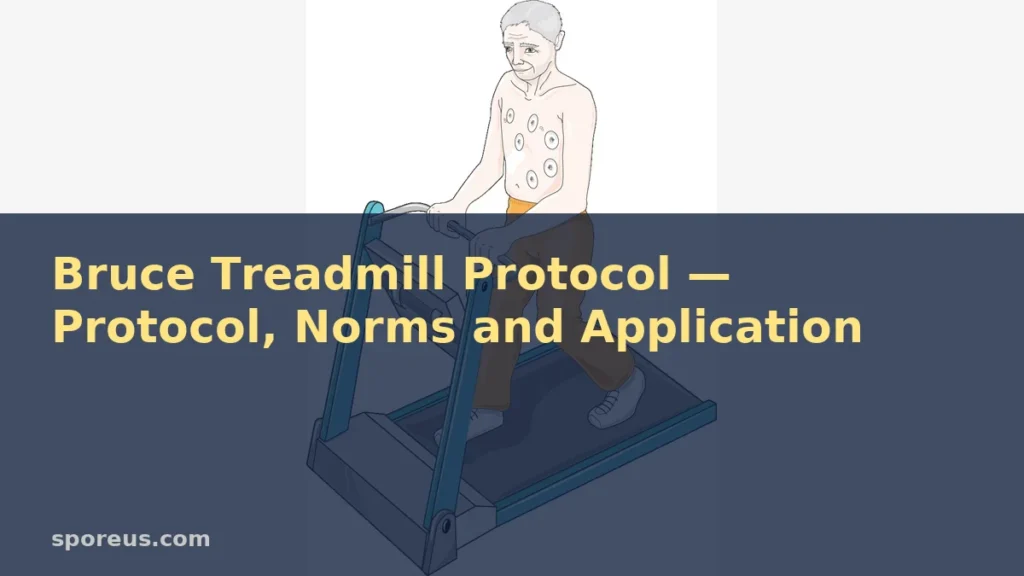
The Bruce Treadmill Protocol, developed by Dr. Robert Bruce in 1963, is considered the gold standard for cardiac exercise testing. It is widely used in clinical settings and increases both speed and incline every 3 minutes. Preparation: Participants should have eaten a light meal at least 3 hours before and avoided strenuous exercise for 24 hours. In clinical settings, ECG electrodes and blood pressure cuff are fitted. Emergency equipment (defibrillator, oxygen) must be available. Protocol Stages: – Stage 1: 1.7 mph (2.7 km/h), 10% grade, 3 minutes – Stage 2: 2.5 mph (4.0 km/h), 12% grade, 3 minutes – Stage 3: 3.4 mph (5.5 km/h), 14% grade, 3 minutes – Stage 4: 4.2 mph (6.8 km/h), 16% grade, 3 minutes – Stage 5: 5.0 mph (8.0 km/h), 18% grade, 3 minutes – Stage 6: 5.5 mph (8.9 km/h), 20% grade, 3 minutes – Stage 7: 6.0 mph (9.7 km/h), 22% grade, 3 minutes Data Collection: Heart rate, blood pressure, and RPE are recorded at each stage. ECG is continuously monitored if available. Termination criteria include chest pain, ECG changes, blood pressure drop, pallor, and loss of coordination. Calculation: VO₂max is estimated using test duration (minutes). Male: VO₂max = 14.8 − (1.379 × T) + (0.451 × T²) − (0.012 × T³); Female: VO₂max = 4.38 × T − 3.9. T = total test time in minutes. Post-Test: Active cool-down is performed by gradually slowing the treadmill over 3–5 minutes. Vital signs are re-recorded at 5 and 10 minutes post-test. Abnormal responses are reported to the clinician.Formula
VO₂max (male) = 14.8 - (1.379×T) + (0.451×T²) - (0.012×T³); VO₂max (female) = 4.38×T - 3.9; T = minutes
Equipment Required
treadmill (adjustable grade and speed), ECG monitor (clinical), blood pressure cuff, heart rate monitor
Normative Values (Age: 40-49)
| Classification | Male | Female |
|---|---|---|
| Excellent | >10 min (>34 ml/kg/min) | >8 min |
| Good | 8-10 min | 6-8 min |
| Average | 6-8 min | 4-6 min |
| Below Average | 4-6 min | 3-4 min |
| Poor | <4 min | <3 min |
Practical Applications
The Bruce protocol is widely used as a stress test in cardiology clinics. It is suitable for diagnosis of coronary artery disease, cardiac risk assessment, and pre-surgical functional capacity measurement.Limitations
Grade increases may be too rapid for sedentary individuals; Modified Bruce is recommended in such cases. Not appropriate for individuals with orthopedic limitations. Requires clinical supervision.Related Tests: Balke Treadmill Protocol, Modified Balke Protocol, Naughton Protocol
Sources: Bruce RA, 1971, Am J Cardiol; ACSM Guidelines for Exercise Testing, 2021
References
- Bruce RA, Kusumi F, Hosmer D. (1973). Maximal oxygen intake and nomographic assessment of functional aerobic impairment in cardiovascular disease. American Heart Journal, 85(4): 546-562. doi:10.1016/0002-8703(73)90502-4
- Foster C, Jackson AS, Pollock ML, Taylor MM, Hare J, Sennett SM, Rod JL, Sarwar M, Schmidt DH. (1984). Generalized equations for predicting functional capacity from treadmill performance. American Heart Journal, 107(6): 1229-1234. doi:10.1016/0002-8703(84)90282-5
- Pollock ML, Bohannon RL, Cooper KH, Ayres JJ, Ward A, White SR, Linnerud AC. (1976). A comparative analysis of four protocols for maximal treadmill stress testing. American Heart Journal, 92(1): 39-46. doi:10.1016/S0002-8703(76)80401-2
Hüseyin Akbulut is the founder of Sporeus and author of THRESHOLD (EŞİK), a 540-page Turkish-language book on endurance science.
- 540pp THRESHOLD Book
- MSc Sport Sciences
- Marmara University
Protocol The Bruce Treadmill Protocol, developed by Dr. Robert Bruce in 1963, is considered the gold standard for cardiac exercise testing. It is widely used in clinical settings and increases both speed and incline every 3 minutes. Preparation: Participants should have eaten a light meal at least 3 hours before and avoided strenuous exercise for 24 hours. In clinical settings, ECG electrodes and blood pressure cuff are fitted. Emergency equipment (defibrillator, oxygen) must be available. Protocol Stages: - Stage 1: 1.7 mph (2.7 km/h), 10% grade, 3 minutes - Stage 2: 2.5 mph (4.0 km/h), 12% grade, 3 minutes - Stage 3: 3.4 mph (5.5 km/h), 14% grade, 3 minutes - Stage 4: 4.2 mph (6.8 km/h), 16% grade, 3 minutes - Stage 5: 5.0 mph (8.0 km/h), 18% grade, 3 minutes - Stage 6: 5.5 mph (8.9 km/h), 20% grade, 3 minutes - Stage 7: 6.0 mph (9.7 km/h), 22% grade, 3 minutes Data Collection: Heart rate, blood pressure, and RPE are recorded at each stage. ECG is continuously monitored if available. Termination criteria include chest pain, ECG changes, blood pressure drop, pallor, and loss of coordination. Calculation: VO₂max is estimated using test duration (minutes). Male: VO₂max = 14.8 − (1.379 × T) + (0.451 × T²) − (0.012 × T³); Female: VO₂max = 4.38 × T − 3.9. T = total test time in minutes. Post-Test: Active cool-down is performed by gradually slowing the treadmill over 3–5 minutes. Vital signs are re-recorded at 5 and 10 minutes post-test. Abnormal responses are reported to the clinician. Formula
VO₂max (male) = 14.8 - (1.379×T) + (0.451×T²) - (0.012×T³); VO₂max (female) = 4.38×T - 3.9; T = minutes
Equipment Required
treadmill (adjustable grade and speed), ECG monitor (clinical), blood pressure cuff, heart rate monitor