Preview
Hüseyin Akbulut, MSc (2026). Alperen Şengün and the Young European Big-Man Skill Density of an Elite Centre. Sporeus. Retrieved, October 5, 2026. https://sporeus.com/en/science/alperen-sengun-young-european-big-man-skill-density/
The Athlete in One Paragraph
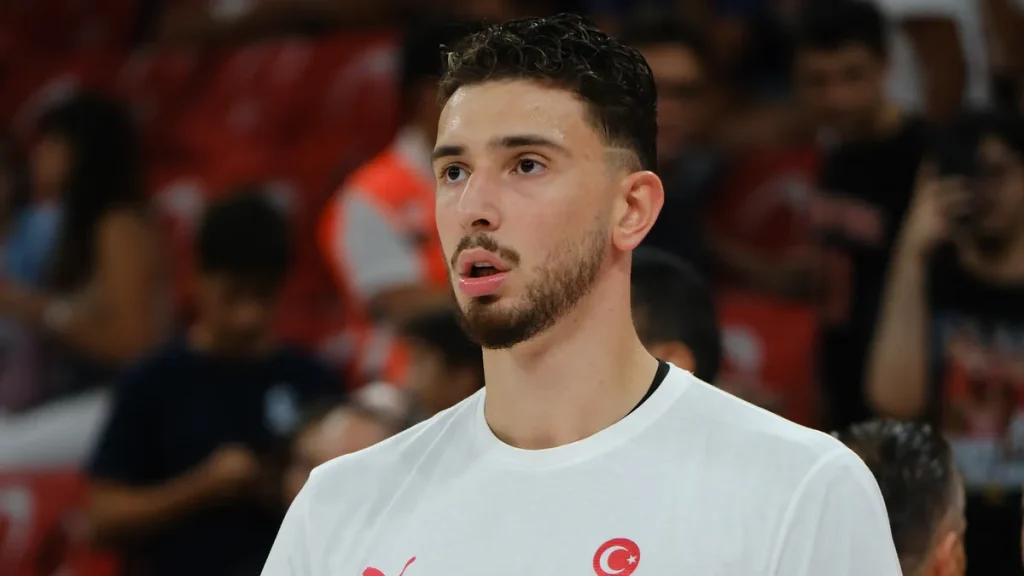
Alperen Şengün (b. 2002-07-25, Giresun, Türkiye) is, as of September 2026, a centre for the Houston Rockets and the Türkiye national team. Listed at 2.11 m and ~109 kg, he arrived in the NBA carrying the imprint of a European basketball upbringing — Bandırma, Beşiktaş, then a Houston rookie season at nineteen — and almost immediately drew comparisons that had less to do with raw athleticism and more to do with how much basketball he packed into every touch. He is not the highest-vertical centre in the league, not the longest-armed, not the fastest down the floor; what distinguishes him is an unusual ratio between technical-tactical density and physical ceiling. The interesting case for sport science is the variable that lies beneath that ratio: young European big-man skill density, the per-touch skill capital — passing reads, footwork rotations, contact balance, finishing angles — that European-trained centres tend to bring into the NBA before their bodies finish maturing.
Table of Contents
The Physiology — what skill density actually is
Skill density, in the sense relevant to a young centre, is the ratio of decision-loaded actions per unit of physical exposure. A high-density possession includes a screen angle adjusted to the defender’s hip, a re-screen, a short-roll catch, a passing read off two defenders, then a finish through contact — all within the same possession that a vertically-biased big might resolve with a single dunk attempt. The biological question is what supports that density physiologically without burning the athlete out across an 82-game NBA season layered on top of national-team summers.
The aerobic floor matters more than it appears. Stølen, Chamari, Castagna and Wisløff’s review of soccer physiology, while not basketball-specific, established the principle that intermittent team-sport athletes need a robust aerobic base because it is what permits repeated short-duration anaerobic efforts to recover within seconds rather than minutes [1]. A centre playing 30+ minutes of high-screen, short-roll, post-up basketball is doing repeated short bursts at high intensity; the aerobic floor is what keeps the fifth post-up of the third quarter as crisp as the first. Bangsbo, Mohr and Krustrup add the operational point that elite intermittent athletes spend a disproportionate fraction of their training year defending the aerobic floor, not chasing a peak [2].
Wisløff and colleagues then connect lower-body strength to the explosive output that any contested rim attempt requires: maximal squat strength correlates strongly with vertical jump and short sprint output in elite team-sport athletes [3]. For a centre, the implication is direct — every contested finish, every box-out, every screen-and-roll re-screen draws from the same strength-power well. The strength reserve is not flashy; it is what lets a young big do twelve high-effort actions in a row without the twelfth one collapsing.
The agility literature adds the third leg. Sheppard and Young’s review distinguished pre-planned change-of-direction from reactive agility, with reactive agility — responding to a moving stimulus — relying on perceptual-cognitive processing as much as on mechanical capacity [4]. A European-trained big tends to score high on the perceptual-cognitive side; the question is whether the mechanical side keeps up as defenses crowd him with quicker, longer NBA athletes. Joyner and Coyle’s framing of endurance physiology completes the picture: champion-level performance is the integration of multiple physiological subsystems, none of which alone explains output [5].
The Case — Şengün as a skill-density exemplar
For a 2.11 m / ~109 kg centre still in his early twenties, the story underneath the highlight reels is one of a body still adapting to the NBA’s mass-distance-collision profile while the brain already operates at a veteran’s read-and-react pace. The European development pipeline — fewer games, more practice repetitions, more decision-loaded skill work — front-loads the cognitive-technical side of the athlete’s development; the NBA season then asks the body to keep up with a brain that arrived early [4, 5].
The aerobic floor is the quiet enabler. A centre who passes well is asked, by good coaching, to handle the ball more — short rolls, dribble hand-offs, post entries against doubles. Each of those touches is a decision-loaded event; the cost of running them at high quality late in games is paid in aerobic capacity, because the alternative is a centre who is brilliant in the first quarter and ordinary in the fourth [1, 2]. The training implication is unflashy: maintain the aerobic floor through the season even as strength, power and rehab work compete for the same recovery budget.
The strength-power side is the maturation edge. Şengün entered the league with a body that, by NBA centre norms, was still adding force-production capacity. The literature on heavy-strength training in young athletes is consistent: the squat-strength-to-output relationship is dose-responsive across the early career, and the athletes who arrive with a usable strength base are the ones who convert their skill density into reliable production against bigger, longer defenders [3]. The implication for skill-density preservation is that strength work is not a competing demand against skill — it is the substrate that keeps skill executable under contact.
Match-context note: across his Houston seasons, Şengün’s per-touch productivity at the centre position has tracked at the upper end of his age cohort (Match data: NBA.com / Basketball-Reference). The discriminator is not any single metric but the breadth of decision-loaded actions per touch sustained across long minutes.

What This Means for the Reader
For a developing big — at any level, not just NBA-bound — the lesson is that skill density is a learnable signature, not a gift. Three diagnostics tell the story: the per-touch event count under standardised drills (passing reads + footwork rotations + finish under contact), the aerobic floor (a sub-maximal heart-rate response to a fixed running protocol), and the lower-body strength-power baseline (a back-squat or trap-bar reference relative to body mass) [1, 2, 3].
The training prescription follows the diagnostic gap: cognitively-rich athletes whose physical floor is the limiter should treat aerobic-base work and heavy strength training as non-negotiables; physically-imposing athletes whose decision-density is the limiter should restructure practice around decision-loaded reps rather than mechanical repetitions. Both pathways converge on the same product — a big man whose touches generate more outcomes per minute than the league average.
The diagnostic question for the developing centre: am I being scored down because of what I do with the ball, or because of how my body holds up between the moments I have it? The answer determines training emphasis.
References
- Stølen T, Chamari K, Castagna C, Wisløff U. (2005). Physiology of soccer: an update. Sports Medicine, 35(6): 501–536. doi:10.2165/00007256-200535060-00004
- Bangsbo J, Mohr M, Krustrup P. (2006). Physical and metabolic demands of training and match-play in the elite football player. Journal of Sports Sciences, 24(7): 665–674. doi:10.1080/02640410500482529
- Wisløff U, Castagna C, Helgerud J, Jones R, Hoff J. (2004). Strong correlation of maximal squat strength with sprint performance and vertical jump height in elite soccer players. British Journal of Sports Medicine, 38(3): 285–288. doi:10.1136/bjsm.2002.002071
- Sheppard JM, Young WB. (2006). Agility literature review: classifications, training and testing. Journal of Sports Sciences, 24(9): 919–932. doi:10.1080/02640410500457109
- Joyner MJ, Coyle EF. (2008). Endurance exercise performance: the physiology of champions. Journal of Physiology, 586(1): 35–44. doi:10.1113/jphysiol.2007.143834
Match-context data (descriptive only): NBA.com / Basketball-Reference.
The Athlete in One Paragraph
Alperen Şengün (b. 2002-07-25, Giresun, Türkiye) is, as of September 2026, a centre for the Houston Rockets and the Türkiye national team. Listed at 2.11 m and ~109 kg, he arrived in the NBA carrying the imprint of a European basketball upbringing — Bandırma, Beşiktaş,…
The Physiology — what skill density actually is
Skill density, in the sense relevant to a young centre, is the ratio of decision-loaded actions per unit of physical exposure. A high-density possession includes a screen angle adjusted to the defender's hip, a re-screen, a short-roll catch, a passing read off two defenders, then…
The Case — Şengün as a skill-density exemplar
For a 2.11 m / ~109 kg centre still in his early twenties, the story underneath the highlight reels is one of a body still adapting to the NBA's mass-distance-collision profile while the brain already operates at a veteran's read-and-react pace. The European development pipeline…
What This Means for the Reader
For a developing big — at any level, not just NBA-bound — the lesson is that skill density is a learnable signature, not a gift. Three diagnostics tell the story: the per-touch event count under standardised drills (passing reads + footwork rotations + finish under…