
Preview
Hüseyin Akbulut, MSc (2026). Tatyana McFadden and the Wheelchair Racing Upper-Body Power Economy of an Elite Para Athlete. Sporeus. Retrieved, October 5, 2026. https://sporeus.com/en/science/tatyana-mcfadden-wheelchair-racing-upper-body-power-economy/
The Athlete in One Paragraph
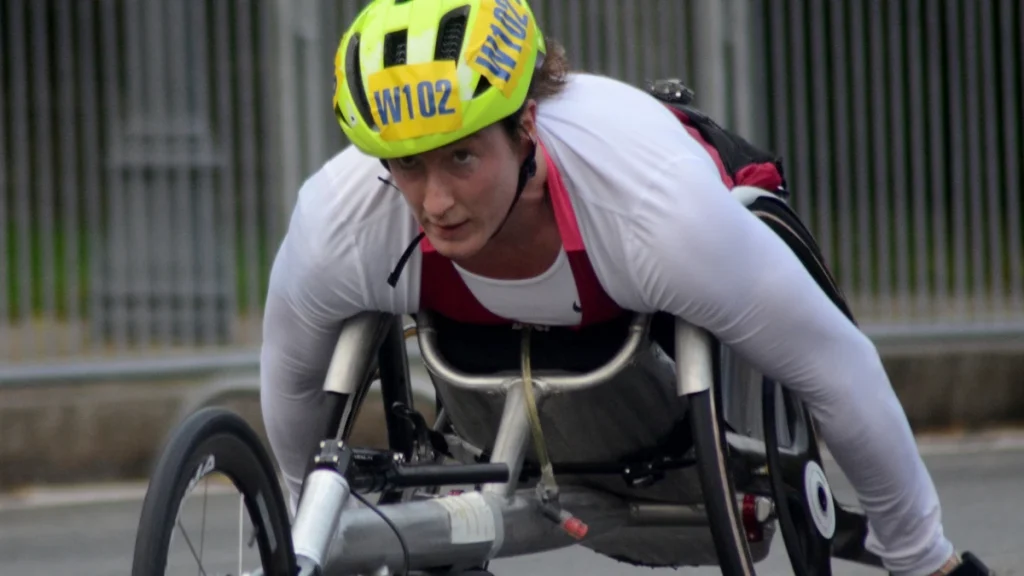
Tatyana McFadden (b. 1989-04-21, Saint Petersburg, Russia, raised in the United States) is an American Para wheelchair racer with multiple Paralympic gold medals across distances ranging from sprint to marathon, and a long roll-call of major-marathon wins on the women’s wheelchair circuit. Listed at approximately 1.55 m and ~50 kg, she carries the anthropometry of a small-framed but high-output racer whose game lives in push-rim mechanics, sustained upper-body work, and the kind of metabolic capacity that supports an hour-plus of repeated near-maximal pushes over a marathon course. The interesting case for sport science is not any single Paralympic gold or major-marathon kick but the underlying engine — a wheelchair racer’s performance still gates on aerobic capacity, repeated-effort economy and recovery between bursts, but the work is expressed through deltoid, triceps, and trunk musculature loading the push-rim rather than through a running gait. The variable underneath that story is wheelchair racing upper-body power economy — how aerobic capacity, push-mechanics economy, and high-intensity-interval programming combine to deliver elite Para racing inside an upper-body-driven physiological template.
Table of Contents
The Physiology — what wheelchair racing upper-body power economy actually measures
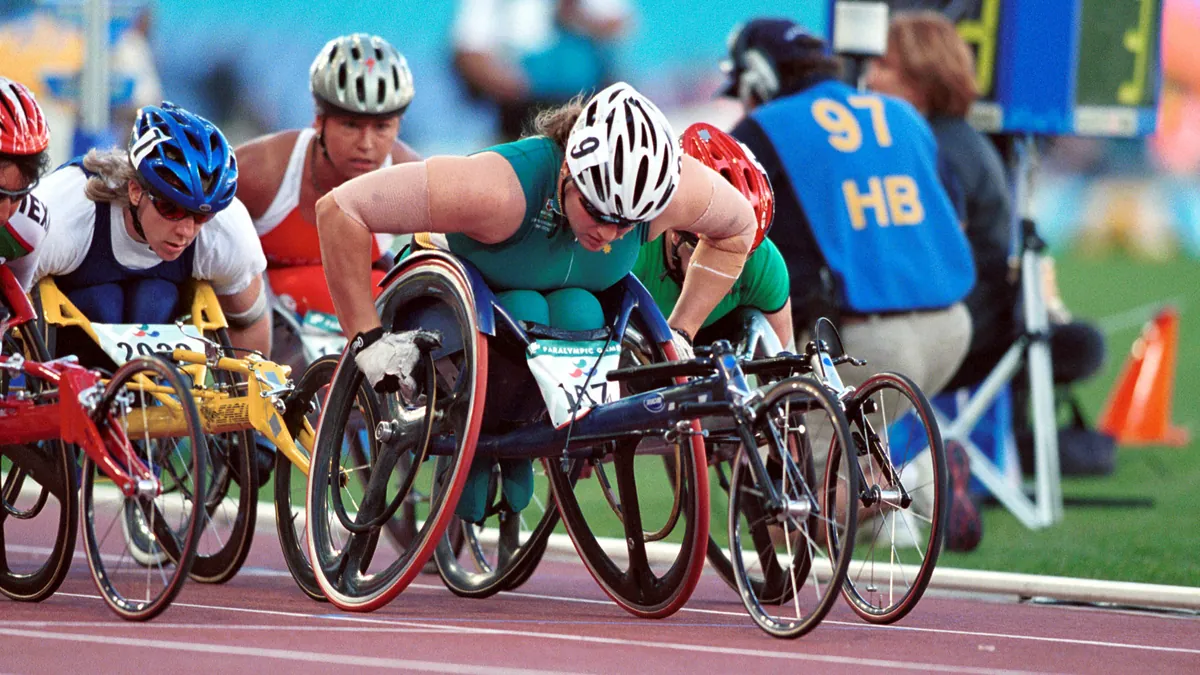
Endurance performance, regardless of the limb that drives it, sits on three pillars: maximal oxygen uptake, the lactate threshold (or comparable submaximal sustainable intensity), and the economy with which the chosen mode of locomotion converts metabolic cost into propulsive output. Joyner and Coyle’s framework for endurance performance in champions is the canonical statement: VO₂max, fractional utilisation, and economy interact, and an athlete with a modest VO₂max and exceptional economy can outperform an athlete with the reverse profile [1]. For a wheelchair racer the framework remains intact; only the propulsive mode changes.
Saunders, Pyne, Telford and Hawley’s review of factors affecting running economy in trained distance runners is conceptually transferable to the push-rim case [2]. Economy in running is the metabolic cost per unit distance at a sub-maximal velocity, governed by elastic energy storage, neuromuscular coordination, body composition, and movement-pattern efficiency. In wheelchair racing the homologue is push economy — the metabolic cost per unit distance at a sub-maximal velocity, governed by push-rim contact mechanics, the timing of the push-and-recovery cycle, the angle of force application to the rim, and the trunk and shoulder coordination that delivers the impulse without leaking it into non-propulsive motion. Athletes who reduce the metabolic cost per kilometre at race pace can either go faster at the same cost or longer at the same speed — exactly the trade-off Para wheelchair racing rewards over marathon distance.
Wisløff, Castagna, Helgerud, Jones and Hoff demonstrated that maximal strength correlates with explosive performance outputs [3]; while their original cohort was footballers, the underlying physiology — that a larger maximal-strength reservoir underwrites higher-rate-of-force-development efforts — applies directly to the upper-body case in wheelchair racing, where deltoid, triceps and trunk strength reserves underwrite the push impulse generated against the rim. The racer with a heavy upper-body strength base owns a larger reservoir from which to draw a sustained push at race pace.
Buchheit and Laursen’s high-intensity-interval-training framework provides the programming layer [4]. The HIIT puzzle — long intervals, short intervals, repeated sprints, and supra-maximal work — is solved differently for upper-body sport, but the principles are the same: stress the cardiovascular and metabolic systems above the lactate threshold for a meaningful cumulative duration, recover sufficiently between sets to repeat quality work, and dose the load against the calendar of competitions. For the elite Para racer the HIIT prescription targets the same VO₂max and threshold variables that drive running performance, expressed through arm-cranking and on-track wheelchair work.
Stølen, Chamari, Castagna and Wisløff’s physiology-of-soccer review captures the energetic context shared across all repeated-effort sports — the ability to repeat near-maximal efforts is gated by aerobic conditioning, repeated-sprint capacity, and recovery between bursts [5]. A wheelchair racer cannot sustain near-maximal pushes for the kick at the end of a marathon if her upper-body aerobic base has collapsed in the middle third of the race; the physiology is sport-agnostic, the expression is not.
The concise summary is that upper-body power economy in wheelchair racing is the same three-layer engine — VO₂max, threshold, and economy — that drives running endurance, simply re-expressed through deltoid, triceps and trunk work against the push-rim.
The Case — Tatyana McFadden as upper-body-economy archetype
For a small-framed Para wheelchair racer at approximately 1.55 m and ~50 kg, the lever arms of the upper body are short and the force-time integral required to push the racing chair at sub-maximal sustainable velocity must be solved through cycle frequency, push-rim contact angle, and the metabolic economy of repeated near-maximal efforts rather than through brute mass [1, 2]. McFadden’s range across sprint, middle-distance and marathon Paralympic events implies an engine that can be tuned across the speed-endurance spectrum — a base sufficient for the marathon and a power head sufficient for sprint finals.
The economy layer is where the elite profile shows. The racer who delivers a clean push, with force applied to the rim across the angles where the mechanical advantage is highest, and who returns the arm cleanly to the recovery phase without wasted motion, leaks fewer joules per kilometre than the racer with the same VO₂max and a noisier push pattern [2]. The advantage compounds across a marathon — a small per-stroke economy gain becomes a meaningful late-race velocity advantage when the push count runs into the tens of thousands.
The strength-reservoir layer matters because the push impulse cannot be cheaply replaced. A larger maximal-strength base in the deltoid, triceps and trunk lets the racer spend a smaller fraction of her maximum on each push, which protects fatigue resistance across the race [3]; the racer who is closer to her ceiling on every stroke loses the late-race kick that the elite Para field is contested on. Combined with a HIIT prescription tuned to upper-body aerobic capacity, this is the engine that separates a Paralympic finalist from a Paralympic gold medallist [4].
The recovery layer closes the loop. The marathon-and-sprint dual profile cannot be sustained without an aerobic base that supports repeated near-maximal efforts and the inter-effort recovery that makes them repeatable [4, 5]. McFadden’s record across multiple Paralympic Games and major-marathon wins is consistent with all three layers — economy, strength reserve, and aerobic base — having been maintained at elite level concurrently.
Match-context note: across her career McFadden has accumulated multi-Paralympic gold and multiple wins across the women’s wheelchair major-marathon circuit (Performance data: World Para Athletics / IPC), with the discriminator being her dual capability across speed and endurance distances rather than any single race.
What This Means for the Reader
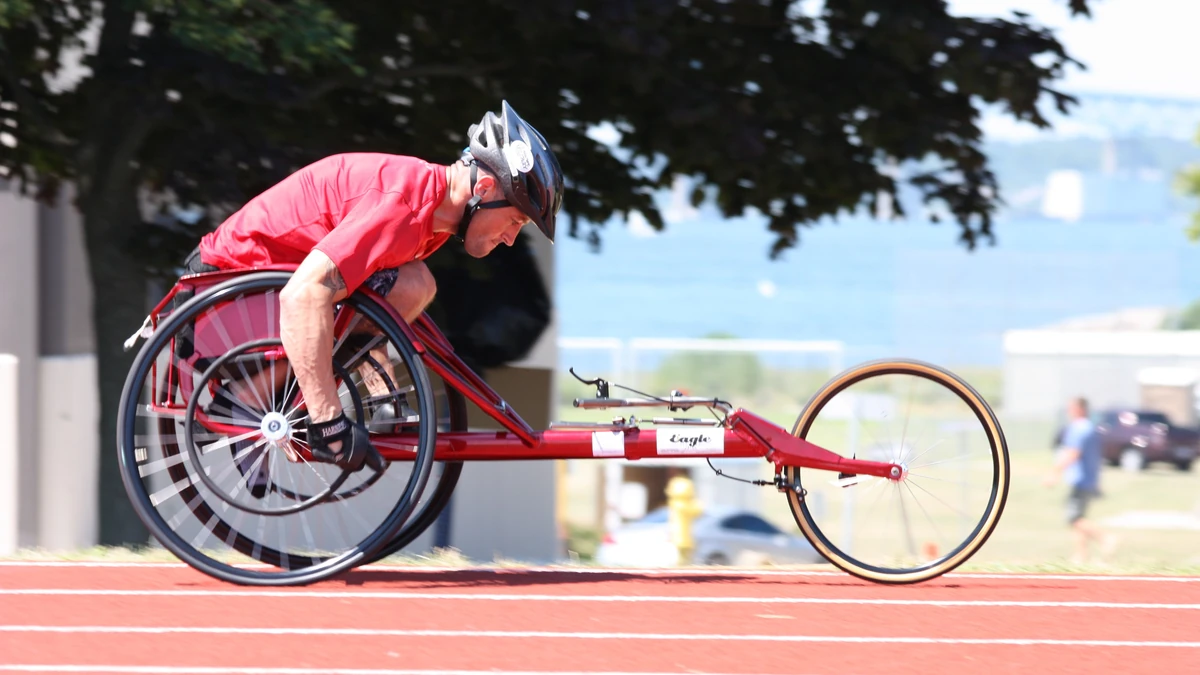
For an aspiring Para racer or any upper-body-driven endurance athlete, the takeaway is that the engine is the same three-layer engine that drives running endurance — only the limb is different [1, 2, 3, 4, 5]. The athlete who trains volume without economy plateaus at a metabolic cost per kilometre that no fitness gain can reduce; the athlete who trains intensity without an upper-body strength reservoir bleeds the late-race kick.
Three measurements diagnose the limiting variable in a developing wheelchair racer’s profile: an upper-body VO₂max test or a comparable arm-cranking maximal-aerobic-output test, a sub-maximal push-economy assessment at controlled velocity, and an upper-body maximal-strength reference relative to body mass. Drift in any of the three is the early signal that the engine is degrading at one of its three operating layers. The diagnostic question for the developing wheelchair racer: when my late-race velocity drops, is it my aerobic base, my push economy, or my strength reservoir that has run out first?
References
- Joyner MJ, Coyle EF. (2008). Endurance exercise performance: the physiology of champions. Journal of Physiology, 586(1): 35–44. doi:10.1113/jphysiol.2007.143834
- Saunders PU, Pyne DB, Telford RD, Hawley JA. (2004). Factors affecting running economy in trained distance runners. Sports Medicine, 34(7): 465–485. doi:10.2165/00007256-200434070-00005
- Wisløff U, Castagna C, Helgerud J, Jones R, Hoff J. (2004). Strong correlation of maximal squat strength with sprint performance and vertical jump height in elite soccer players. British Journal of Sports Medicine, 38(3): 285–288. doi:10.1136/bjsm.2002.002071
- Buchheit M, Laursen PB. (2013). High-intensity interval training, solutions to the programming puzzle. Sports Medicine, 43(5): 313–338. doi:10.1007/s40279-013-0029-x
- Stølen T, Chamari K, Castagna C, Wisløff U. (2005). Physiology of soccer: an update. Sports Medicine, 35(6): 501–536. doi:10.2165/00007256-200535060-00004
Match-context data (descriptive only): World Para Athletics / IPC.
The Athlete in One Paragraph
Tatyana McFadden (b. 1989-04-21, Saint Petersburg, Russia, raised in the United States) is an American Para wheelchair racer with multiple Paralympic gold medals across distances ranging from sprint to marathon, and a long roll-call of major-marathon wins on the women's wheelchair circuit. Listed at approximately…
The Physiology — what wheelchair racing upper-body power economy actually measures
Endurance performance, regardless of the limb that drives it, sits on three pillars: maximal oxygen uptake, the lactate threshold (or comparable submaximal sustainable intensity), and the economy with which the chosen mode of locomotion converts metabolic cost into propulsive output. Joyner and Coyle's framework for…
The Case — Tatyana McFadden as upper-body-economy archetype
For a small-framed Para wheelchair racer at approximately 1.55 m and ~50 kg, the lever arms of the upper body are short and the force-time integral required to push the racing chair at sub-maximal sustainable velocity must be solved through cycle frequency, push-rim contact angle,…
What This Means for the Reader
For an aspiring Para racer or any upper-body-driven endurance athlete, the takeaway is that the engine is the same three-layer engine that drives running endurance — only the limb is different [1, 2, 3, 4, 5]. The athlete who trains volume without economy plateaus at…