Preview
Hüseyin Akbulut, MSc (2026). Beatrice Chebet and the Women’s Track Distance Double-Gold Physiology of an Elite Distance Runner. Sporeus. Retrieved, October 9, 2026. https://sporeus.com/en/science/beatrice-chebet-women-track-distance-double-gold-physiology/
The Athlete in One Paragraph
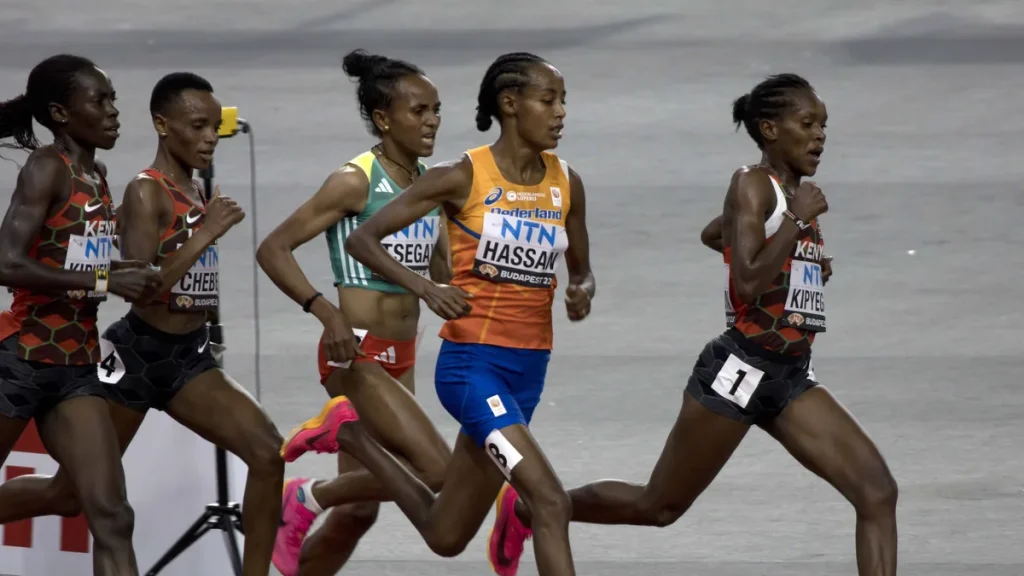
Beatrice Chebet (b. 2000-03-05, Kericho, Kenya) is the Paris 2024 Olympic 5000 m and 10000 m double champion and the women’s 10000 m world-record holder, having become the first woman to break the 29-minute barrier on the track. Listed at 1.65 m and approximately 47 kg, she carries the canonical East-African distance physique — low body mass, narrow hips, long limbs relative to torso — into a discipline whose championship calendar demands a specific kind of physiological versatility: the ability to deliver two near-maximal efforts on the same track, separated by days rather than weeks. The marathoner solves a fractional-utilisation problem over two-plus hours; the single-event track-distance specialist solves a ceiling-and-fraction problem over fourteen to thirty minutes; the double-gold athlete solves both of those problems at championship intensity and then has to recover the central system in time to do the second one. Chebet is the contemporary case study for women’s track distance double-gold physiology.
Table of Contents
The Physiology — what changes when two near-maximal efforts must coexist
Endurance performance in the 5000 m and 10000 m is governed by the same three Joyner–Coyle factors as in any aerobic event: VO₂max, lactate threshold and running economy combine multiplicatively to determine sustainable race velocity [1]. The 5000 m is run at a fractional utilisation that approaches the velocity at VO₂max itself; the 10000 m sits marginally lower in fraction but extends across more than twice the distance; both are, by marathon standards, ceiling-and-fraction problems whose limiting bottleneck sits much closer to the central oxygen-delivery system than to substrate efficiency.
Saunders and colleagues’ synthesis of running-economy determinants — stride mechanics, tendon stiffness, neuromuscular efficiency, body-mass distribution, accumulated training history — establishes that economy still multiplies the equation at track-distance velocities, but the relative payoff of an economy gain decreases as race intensity rises [2]. Faude and colleagues’ lactate-threshold catalogue applies, but at the higher race intensities of the 5000 m the threshold sits below race velocity and the rate of lactate accumulation across the race becomes the operational constraint [3]. The training that prepares the system to operate above threshold for the bulk of the race is therefore the structural counterpart of the demand.
The double-gold scenario adds a second-order constraint: recovery between events. Buchheit and Laursen’s framework for high-intensity interval training is the structural counterpart not only to the ceiling-training stimulus that anchors track-distance preparation but also to the recovery-management problem that championship double-gold execution imposes [4]. Their analytical synthesis identifies the variables that determine both training adaptation and acute-recovery dynamics — work intensity, work duration, recovery duration, recovery intensity — and the same parameters that govern interval programming govern between-event recovery during a championship week. The athlete who has trained the central system to tolerate repeated near-maximal efforts is the athlete who can produce two of them inside seven days.
Helgerud and colleagues’ demonstration that targeted aerobic interval training raises VO₂max in already-trained athletes [5] anchors the trainability of the ceiling. The double-gold athlete needs that ceiling raised, defended through HIIT-anchored stimulus, and supported by a recovery infrastructure — sleep, nutrition, controlled training load, monitoring — that allows the system to re-prime within the championship window.
The Case — Chebet as double-gold lens
Chebet’s Paris 2024 5000 m and 10000 m gold-medal pair, together with her sub-29-minute 10000 m world record on the track, implies an athlete whose three Joyner–Coyle inputs are simultaneously elite and whose central oxygen-delivery system has been trained to tolerate the cycle of near-maximal effort followed by re-priming and a second near-maximal effort within the same championship [1, 4]. The performance is not a single race; it is a within-week cycle of stress-and-recovery executed at championship intensity.
Her anthropometry — 1.65 m, ~47 kg — sits in the range that minimises mass-specific oxygen cost while preserving the limb-length geometry that supports high running velocity at submaximal effort. Saunders’ determinants of running economy are still expressed at elite level [2]; the contribution of economy to the equation is real but, as the race intensity rises, less limiting than the central ceiling itself. The 10000 m world-record performance, in particular, implies an economy-fraction-ceiling product that sits at the apex of contemporary women’s track-distance physiology.
The double-gold race shape is also distinctive. The 10000 m is typically run with an early phase that holds at a high fraction of VO₂max, a tactical mid-race that responds to surges, and a finishing phase that taps the residual anaerobic and neuromuscular contribution above threshold; the 5000 m, run later in the same championship, is shorter, faster, and more dependent on the velocity at VO₂max itself with a sharper finishing kick [1, 3]. The training system that produces both performances is — in Buchheit and Laursen’s framework — a portfolio that combines threshold work for the 10000 m sustainable fraction, HIIT-anchored work for the VO₂max ceiling, and managed-load recovery for the within-championship cycle [4, 5].
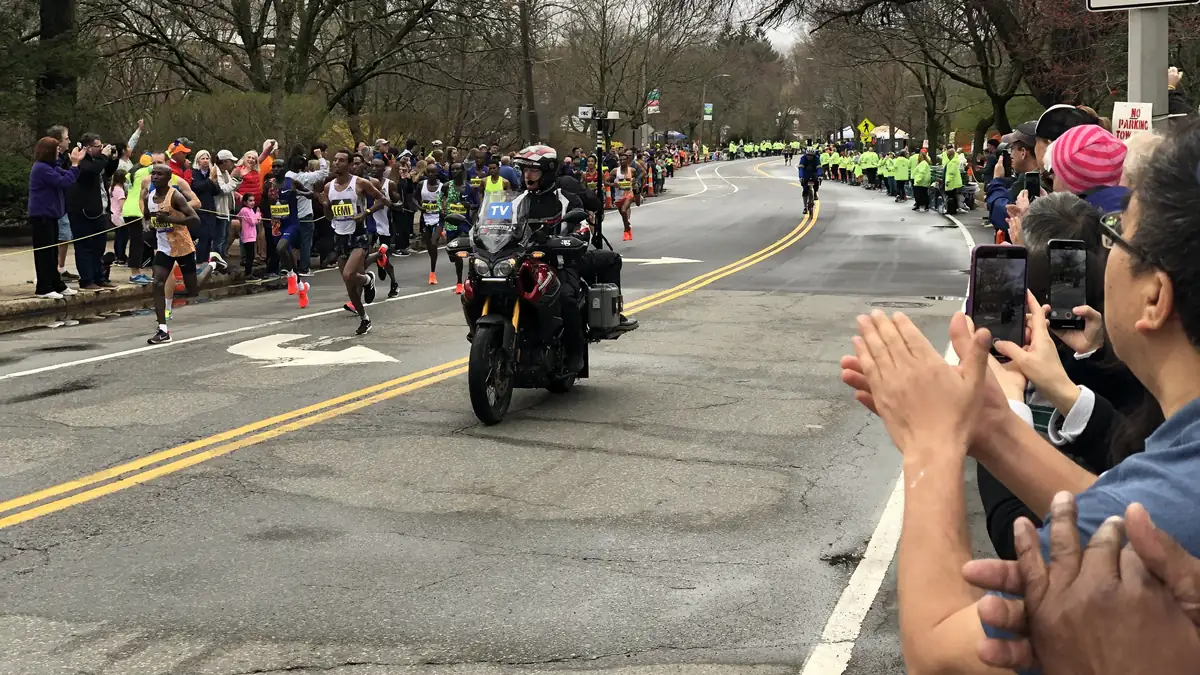
(Performance data: World Athletics)
What This Means for the Reader
For the developing women’s track-distance athlete, the takeaway is portfolio composition. Single-event preparation already requires balancing threshold and HIIT-anchored work; double-event preparation adds the recovery-management dimension and shifts the weighting toward training that does not over-deplete the system between sessions [1, 4]. The reader’s task is not to imitate a championship double-gold weekly load but to identify which of the three inputs — economy, fraction, ceiling — is currently the rate-limiter in their own profile, and to programme accordingly while preserving recovery margin.
The second implication is the recovery infrastructure that double-gold execution depends on. Sleep, nutrition, training-load monitoring and inter-session intensity discipline are not peripheral comforts; they are the scaffolding that allows the central system to re-prime between near-maximal efforts [4, 5]. The athlete who treats recovery as optional cannot hold two championship-quality performances inside one week; the athlete who builds it as a structural input can. The diagnostic question for the athlete: how does my system actually behave in the 24–72 hours after a near-maximal effort, and is my training programmed around the answer?
References
- Joyner MJ, Coyle EF. (2008). Endurance exercise performance: the physiology of champions. The Journal of Physiology, 586(1): 35–44. doi:10.1113/jphysiol.2007.143834
- Saunders PU, Pyne DB, Telford RD, Hawley JA. (2004). Factors affecting running economy in trained distance runners. Sports Medicine, 34(7): 465–485. doi:10.2165/00007256-200434070-00005
- Faude O, Kindermann W, Meyer T. (2009). Lactate threshold concepts: how valid are they? Sports Medicine, 39(6): 469–490. doi:10.2165/00007256-200939060-00003
- Buchheit M, Laursen PB. (2013). High-intensity interval training, solutions to the programming puzzle. Sports Medicine, 43(5): 313–338. doi:10.1007/s40279-013-0029-x
- Helgerud J, Engen LC, Wisløff U, Hoff J. (2001). Aerobic endurance training improves soccer performance. Medicine & Science in Sports & Exercise, 33(11): 1925–1931. doi:10.1097/00005768-200111000-00019
Performance data (descriptive only): World Athletics.
Hüseyin Akbulut is the founder of Sporeus and author of THRESHOLD (EŞİK), a 540-page Turkish-language book on endurance science.
- 540pp THRESHOLD Book
- MSc Sport Sciences
- Marmara University
The Athlete in One Paragraph
Beatrice Chebet (b. 2000-03-05, Kericho, Kenya) is the Paris 2024 Olympic 5000 m and 10000 m double champion and the women's 10000 m world-record holder, having become the first woman to break the 29-minute barrier on the track. Listed at 1.65 m and approximately 47…
The Physiology — what changes when two near-maximal efforts must coexist
Endurance performance in the 5000 m and 10000 m is governed by the same three Joyner–Coyle factors as in any aerobic event: VO₂max, lactate threshold and running economy combine multiplicatively to determine sustainable race velocity [1]. The 5000 m is run at a fractional utilisation…
The Case — Chebet as double-gold lens
Chebet's Paris 2024 5000 m and 10000 m gold-medal pair, together with her sub-29-minute 10000 m world record on the track, implies an athlete whose three Joyner–Coyle inputs are simultaneously elite and whose central oxygen-delivery system has been trained to tolerate the cycle of near-maximal…
What This Means for the Reader
For the developing women's track-distance athlete, the takeaway is portfolio composition. Single-event preparation already requires balancing threshold and HIIT-anchored work; double-event preparation adds the recovery-management dimension and shifts the weighting toward training that does not over-deplete the system between sessions [1, 4]. The reader's task…