Preview
Hüseyin Akbulut, MSc (2026). Joshua Cheptegei and the Track Distance Aerobic VO2max Ceiling of an Elite Distance Runner. Sporeus. Retrieved, October 3, 2026. https://sporeus.com/en/science/joshua-cheptegei-track-distance-aerobic-vo2max-ceiling/
The Athlete in One Paragraph
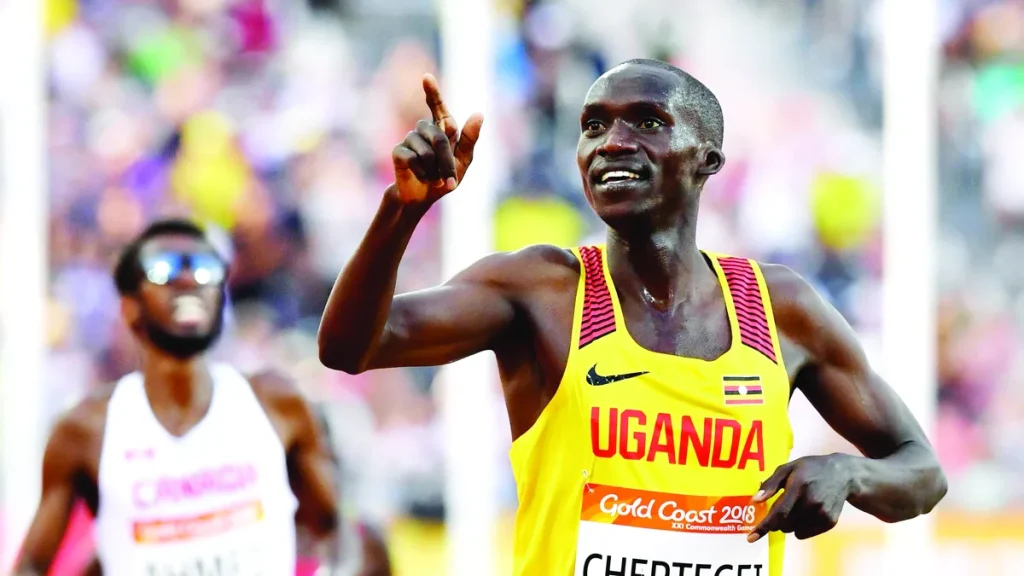
Joshua Cheptegei (b. 1996-09-12, Kapchorwa, Uganda) is the world-record holder in both the men’s 5000 m (12:35.36) and the men’s 10000 m, the Tokyo 2020 Olympic 5000 m champion and one of the defining track-distance runners of his generation. Listed at 1.78 m and approximately 54 kg, he carries a slightly taller East-African distance physique than the canonical marathon profile — long limbs, low body mass, narrow hips — into a discipline whose physiological demands diverge from the marathon in a specific and instructive direction. The marathon is a fractional-utilisation problem held over two-plus hours; the 5000 m and 10000 m are higher-intensity events whose ceilings are gated more tightly by the absolute aerobic capacity itself. Cheptegei is the contemporary case study for what happens when an elite system is optimised for track distance aerobic VO₂max ceiling rather than for the prolonged-substrate efficiency that the marathon rewards.
Table of Contents
The Physiology — what changes when the distance shortens
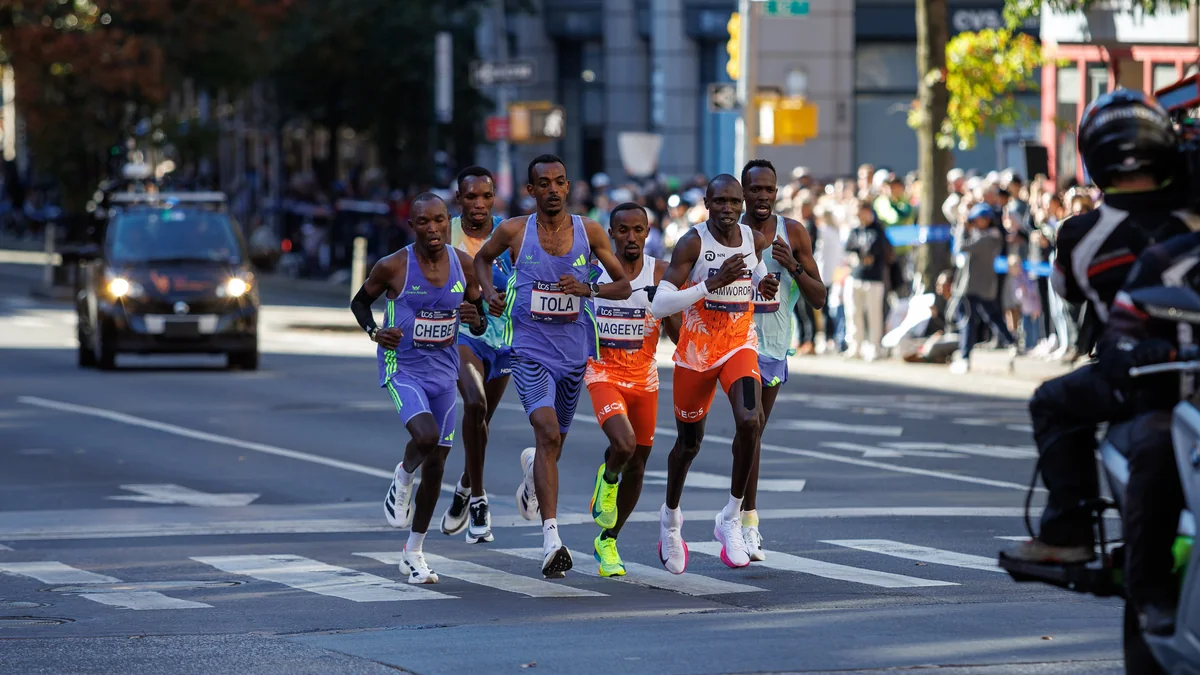
Endurance performance is governed by the same three Joyner–Coyle factors regardless of distance, but the relative weighting shifts substantially as the event shortens. VO₂max sets the absolute aerobic ceiling; lactate threshold sets the sustainable fraction of that ceiling; running economy sets the oxygen cost per unit distance at submaximal velocities — and the multiplicative product of the three determines the speed an athlete can hold for the duration of the race [1]. In the marathon, race velocity sits at roughly 80–88% of VO₂max in elites; in the 10000 m, the equivalent figure climbs into the low-90s; in the 5000 m, it approaches and at times exceeds the velocity at VO₂max itself. The weighting therefore shifts from “fraction” toward “ceiling” as the distance falls.
This shift makes the 5000 m and 10000 m fundamentally different training problems from the marathon. Saunders and colleagues’ synthesis of running-economy determinants is still relevant — economy still multiplies the equation — but the relative payoff of a percentage-point gain in economy decreases as the distance shortens, while the relative payoff of a percentage-point gain in VO₂max ceiling and in peak running velocity at VO₂max increases [2]. Faude and colleagues’ lactate-threshold catalogue applies to both, but the position of the threshold relative to VO₂max becomes less of a constraint at the higher race intensities of the 5000 m, where the limiting bottleneck shifts upstream toward the central oxygen-delivery system itself [3].
Buchheit and Laursen’s framework for high-intensity interval training is the structural counterpart to this shift. Their analytical synthesis identified the variables that an HIIT prescription manipulates — work-interval intensity, work-interval duration, recovery duration, recovery intensity, exercise modality, total session volume, training frequency — and showed that the prescription that maximises time at or near VO₂max is the prescription that most directly trains the central ceiling [4]. The 5000 m / 10000 m specialist’s training portfolio is therefore tilted, relative to the marathoner’s, toward longer, faster intervals run at velocities at or near VO₂max — supplemented with threshold work, but with the central-system overload as the highest-priority adaptation.
Helgerud and colleagues’ demonstration that targeted aerobic interval training raises VO₂max in already-trained athletes [5] anchors the trainability of the ceiling itself; the ceiling is not a fixed number but a long-term consequence of consistent overload. The implication for the track-distance specialist is that the ceiling has to be defended and upgraded continuously through HIIT-anchored stimulus while threshold and economy refine themselves alongside.
The Case — Cheptegei as ceiling lens
Cheptegei’s 5000 m world record of 12:35.36 implies a sustained running velocity that, for any plausible economy estimate consistent with elite East-African distance physique [2], maps onto a fractional utilisation in the very high-90s relative to peak aerobic capacity — substantially higher than the marathon equivalent and pressing against the velocity at VO₂max itself. The 10000 m is run at a marginally lower fraction but over twice the distance, and the equivalence of the two world-record performances implies an athlete whose central oxygen-delivery system, peripheral utilisation, and economy are all simultaneously operating near the upper end of what the contemporary distribution permits [1, 4].
His anthropometry — 1.78 m, ~54 kg, long-limbed — is consistent with a profile that minimises mass-specific oxygen cost while preserving the limb-length geometry that supports high running velocity at submaximal effort. Saunders’ determinants of running economy — stride mechanics, tendon stiffness, neuromuscular efficiency, body-mass distribution, accumulated training volume — are still expressed at elite level [2]; what differentiates the track-distance profile from the marathon profile is not that economy is unimportant but that the ceiling sits absolutely higher and is more directly stressed in race conditions.
The pacing signature of an elite 5000 m or 10000 m record attempt is also distinctive. Where the marathon record demands an even split close to threshold for two hours, a track-distance record typically demands a more aggressive distribution — early laps at a high fraction of VO₂max with a finishing kick that taps the residual anaerobic and neuromuscular contribution above threshold. Buchheit and Laursen’s HIIT framework anticipates this race shape; the training that prepares the athlete to operate at high VO₂max fractions for the bulk of the race and to switch into the above-threshold finishing kick is exactly the structured-interval architecture they describe [4, 5].
(Performance data: World Athletics)
What This Means for the Reader
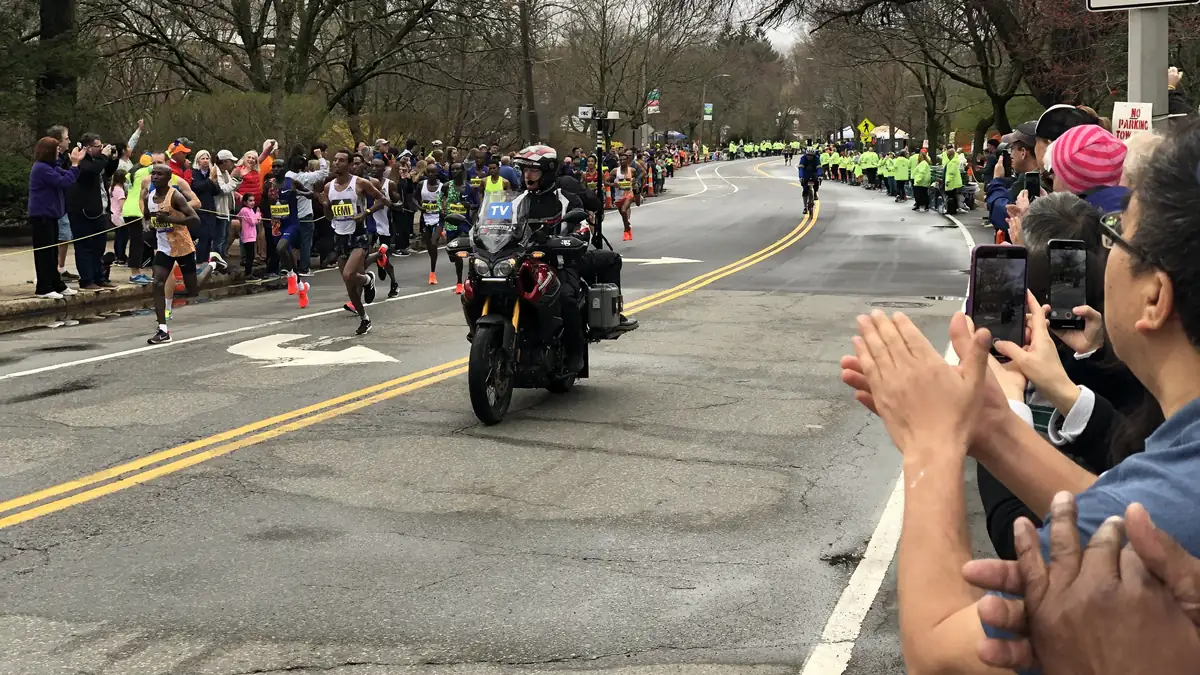
For the developing track-distance athlete, the takeaway is event-specificity. The marathon training literature emphasises sustained-pace and threshold work because the marathon is a fraction problem; the 5000 m and 10000 m are ceiling-and-fraction problems whose training portfolio has to include a substantially higher proportion of HIIT-anchored work performed at velocities at or near VO₂max [1, 4, 5]. Substituting marathon-style training for track-distance preparation under-trains the ceiling that the shorter event demands. The reader’s task is to identify whether their current training is appropriately weighted toward the demands of the event they actually race.
The second implication is pacing. The race shape of a 5000 m or 10000 m differs from the marathon’s even-split discipline; the distribution of intensity, the placement of surges, and the timing of the finishing kick are all expressions of the underlying ceiling-and-fraction profile [2, 3]. The diagnostic question for the athlete: what is my velocity at VO₂max, and how does the velocity I attempt to hold in race conditions compare to it?
References
- Joyner MJ, Coyle EF. (2008). Endurance exercise performance: the physiology of champions. The Journal of Physiology, 586(1): 35–44. doi:10.1113/jphysiol.2007.143834
- Saunders PU, Pyne DB, Telford RD, Hawley JA. (2004). Factors affecting running economy in trained distance runners. Sports Medicine, 34(7): 465–485. doi:10.2165/00007256-200434070-00005
- Faude O, Kindermann W, Meyer T. (2009). Lactate threshold concepts: how valid are they? Sports Medicine, 39(6): 469–490. doi:10.2165/00007256-200939060-00003
- Buchheit M, Laursen PB. (2013). High-intensity interval training, solutions to the programming puzzle. Sports Medicine, 43(5): 313–338. doi:10.1007/s40279-013-0029-x
- Helgerud J, Engen LC, Wisløff U, Hoff J. (2001). Aerobic endurance training improves soccer performance. Medicine & Science in Sports & Exercise, 33(11): 1925–1931. doi:10.1097/00005768-200111000-00019
Performance data (descriptive only): World Athletics.
The Athlete in One Paragraph
Joshua Cheptegei (b. 1996-09-12, Kapchorwa, Uganda) is the world-record holder in both the men's 5000 m (12:35.36) and the men's 10000 m, the Tokyo 2020 Olympic 5000 m champion and one of the defining track-distance runners of his generation. Listed at 1.78 m and approximately…
The Physiology — what changes when the distance shortens
Endurance performance is governed by the same three Joyner–Coyle factors regardless of distance, but the relative weighting shifts substantially as the event shortens. VO₂max sets the absolute aerobic ceiling; lactate threshold sets the sustainable fraction of that ceiling; running economy sets the oxygen cost per…
The Case — Cheptegei as ceiling lens
Cheptegei's 5000 m world record of 12:35.36 implies a sustained running velocity that, for any plausible economy estimate consistent with elite East-African distance physique [2], maps onto a fractional utilisation in the very high-90s relative to peak aerobic capacity — substantially higher than the marathon…
What This Means for the Reader
For the developing track-distance athlete, the takeaway is event-specificity. The marathon training literature emphasises sustained-pace and threshold work because the marathon is a fraction problem; the 5000 m and 10000 m are ceiling-and-fraction problems whose training portfolio has to include a substantially higher proportion of…