Preview
Hüseyin Akbulut, MSc (2026). Faith Kipyegon and the Female Middle-distance Running Economy of an Elite Middle-distance Runner. Sporeus. Retrieved, October 8, 2026. https://sporeus.com/en/science/faith-kipyegon-female-middle-distance-running-economy/
The Athlete in One Paragraph
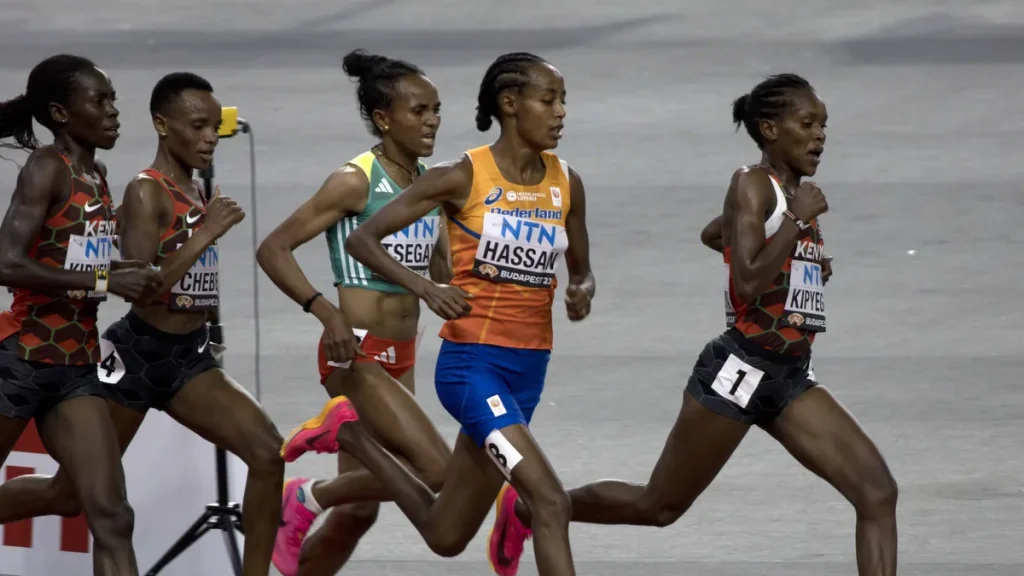
Faith Chepngetich Kipyegon (b. 1994-01-10, Bomet County, Kenya) is the defining women’s middle-distance runner of her generation, multiple-time Olympic 1500 m champion and the world-record holder at 1500 m, 5000 m, and the road mile across recent seasons. Listed at 1.57 m and roughly 42 kg, she carries an exceptionally low absolute mass into a discipline where mass-specific oxygen cost is the dominant marathon-mile-spectrum equation. The interesting case for sport science is the way the female middle-distance physiology arrives at world-record pace by a slightly different route from the men’s archetype: the women’s lactate-threshold-to-VO₂max ratio sits, on average, at a slightly different point on the spectrum, and the multiplicative product of VO₂max, threshold fraction, and running economy expresses itself differently across the field. The variable underneath that pattern is running economy — the oxygen cost per unit submaximal velocity, expressed against a background of sex-specific aerobic physiology.
Table of Contents
The Physiology — what running economy actually is, in the women’s context
Running economy (RE) is the steady-state oxygen consumption at a given submaximal velocity, usually expressed as ml O₂ · kg⁻¹ · km⁻¹ [1]. Saunders and colleagues identified the determinants in trained runners: stride mechanics (vertical oscillation, ground contact pattern), tendon stiffness (especially Achilles), neuromuscular efficiency, body-mass distribution, and accumulated training history [1]. RE is not fixed at maturity; it improves over years of consistent stimulus, and at world-class level it is often the variable that discriminates within otherwise homogeneous groups of high-VO₂max athletes.
Joyner and Coyle’s three-factor framework — VO₂max, lactate threshold, and RE — applies to women as it does to men, but the populations differ in average expression of each variable [2]. Mean female VO₂max in elite distance populations sits below the male equivalent in absolute terms; mean RE sits broadly comparable when properly mass-corrected; and the lactate-threshold fraction (the percentage of VO₂max that the threshold velocity corresponds to) sits, in some studies, at a marginally different point on the curve. The applied consequence is that the equation that produces a world-class women’s 1500 m time relies, on average, slightly more heavily on threshold and economy than on the absolute oxygen ceiling.
Faude and colleagues’ review of lactate-threshold concepts emphasises that the underlying biology — a non-linear deflection in lactate accumulation, a sustainable steady state of clearance balancing production — is the same in both sexes; only the fitted velocity differs [3]. Billat’s earlier diagnostic work showed that submaximal lactate measurements predict race performance more tightly than VO₂max in homogeneous elite groups, regardless of sex [4]; among elite women, threshold velocity and economy together discriminate between athletes who all have similar ceilings.
Helgerud and colleagues demonstrated that targeted aerobic interval training raises VO₂max and improves both threshold velocity and maximal aerobic speed in trained athletes [5]. The trainability of all three Joyner–Coyle factors is preserved in women, and the long career arcs of elite women’s middle-distance runners — Kipyegon’s continued progression into her thirties — illustrate it.
The Case — Kipyegon as women’s-RE lens
Kipyegon’s world-record pace at 1500 m, sustained across multiple seasons, expresses a profile in which all three Joyner–Coyle factors must sit very near the personal limit simultaneously. At 1.57 m and ~42 kg, the absolute oxygen cost per stride is low; the mass-specific cost — the variable that actually appears in the energy equation — is competitive with anyone in the women’s field [1, 2]. Saunders’ determinants read like a description of an athlete shaped by the East-African terrain and training culture: long Achilles moment-arms, efficient ground contact, and a long accumulated stimulus history.
The 1500 m women’s race is metabolically a hybrid event in the same sense as the men’s — front-end pace at or above VO₂max, with a closing kick that overshoots the ceiling — but the pace structure is set by the women’s-specific physiology. The athlete who can hold the highest fraction of her ceiling longest, with the lowest oxygen cost per kilometre, dictates the race [2, 3]. Kipyegon’s even-paced front-running races and her negative-split closing kicks are both expressions of this underlying multiplicative product.
The framing matters because women’s middle-distance physiology is sometimes treated, incorrectly, as a scaled-down version of the men’s. The biology is the same; the population means differ on each axis; and an athlete who optimises within the women’s-specific physiological context can produce performances that are world-class on the discipline’s terms — not on a percentage-of-male reference frame. Billat’s diagnostic logic and Faude’s threshold catalogue both apply directly [3, 4].
(Performance data: World Athletics)
What This Means for the Reader
For the developing women’s middle-distance athlete, the takeaway is the same as for any well-trained endurance population: the high-leverage variable is rarely an additional VO₂max interval. The higher-yield blocks are usually a sustained period of threshold and tempo work — pushing the lactate-deflection velocity upward — alongside the long-term economy refinement that comes from years of consistent submaximal volume [1, 3]. The race time falls because both the fraction and the per-kilometre cost shift; the ceiling alone is a small contributor among elites who already sit near it.
For coaches, the practical implication is that female athletes should be programmed against the same Joyner–Coyle framework as men, with the same trainability for each component [2, 5]. Sex-specific considerations exist — menstrual-cycle phase effects, energy availability, mass-specific calibration — but the underlying endurance physiology is shared. The framework predicts; the population means simply parameterise it.
The diagnostic question for the athlete: at what fraction of my VO₂max does my blood lactate begin to rise non-linearly, and what is the oxygen cost per kilometre at that velocity?
References
- Saunders PU, Pyne DB, Telford RD, Hawley JA. (2004). Factors affecting running economy in trained distance runners. Sports Medicine, 34(7): 465–485. doi:10.2165/00007256-200434070-00005
- Joyner MJ, Coyle EF. (2008). Endurance exercise performance: the physiology of champions. The Journal of Physiology, 586(1): 35–44. doi:10.1113/jphysiol.2007.143834
- Faude O, Kindermann W, Meyer T. (2009). Lactate threshold concepts: how valid are they? Sports Medicine, 39(6): 469–490. doi:10.2165/00007256-200939060-00003
- Billat LV. (1996). Use of blood lactate measurements for prediction of exercise performance. Sports Medicine, 22(3): 157–175. doi:10.2165/00007256-199622030-00003
- Helgerud J, Engen LC, Wisløff U, Hoff J. (2001). Aerobic endurance training improves soccer performance. Medicine & Science in Sports & Exercise, 33(11): 1925–1931. doi:10.1097/00005768-200111000-00019
Performance data (descriptive only): World Athletics.

Hüseyin Akbulut is the founder of Sporeus and author of THRESHOLD (EŞİK), a 540-page Turkish-language book on endurance science.
- 540pp THRESHOLD Book
- MSc Sport Sciences
- Marmara University
The Athlete in One Paragraph
Faith Chepngetich Kipyegon (b. 1994-01-10, Bomet County, Kenya) is the defining women's middle-distance runner of her generation, multiple-time Olympic 1500 m champion and the world-record holder at 1500 m, 5000 m, and the road mile across recent seasons. Listed at 1.57 m and roughly 42…
The Physiology — what running economy actually is, in the women's context
Running economy (RE) is the steady-state oxygen consumption at a given submaximal velocity, usually expressed as ml O₂ · kg⁻¹ · km⁻¹ [1]. Saunders and colleagues identified the determinants in trained runners: stride mechanics (vertical oscillation, ground contact pattern), tendon stiffness (especially Achilles), neuromuscular efficiency,…
The Case — Kipyegon as women's-RE lens
Kipyegon's world-record pace at 1500 m, sustained across multiple seasons, expresses a profile in which all three Joyner–Coyle factors must sit very near the personal limit simultaneously. At 1.57 m and ~42 kg, the absolute oxygen cost per stride is low; the mass-specific cost —…
What This Means for the Reader
For the developing women's middle-distance athlete, the takeaway is the same as for any well-trained endurance population: the high-leverage variable is rarely an additional VO₂max interval. The higher-yield blocks are usually a sustained period of threshold and tempo work — pushing the lactate-deflection velocity upward…