Preview
Hüseyin Akbulut, MSc (2026). Buse Tosun Çavuşoğlu and the Women’s Freestyle Wrestling Power-Conditioning of an Elite 68 kg Wrestler. Sporeus. Retrieved, October 7, 2026. https://sporeus.com/en/science/buse-tosun-cavusoglu-women-freestyle-wrestling-power-conditioning/
The Athlete in One Paragraph
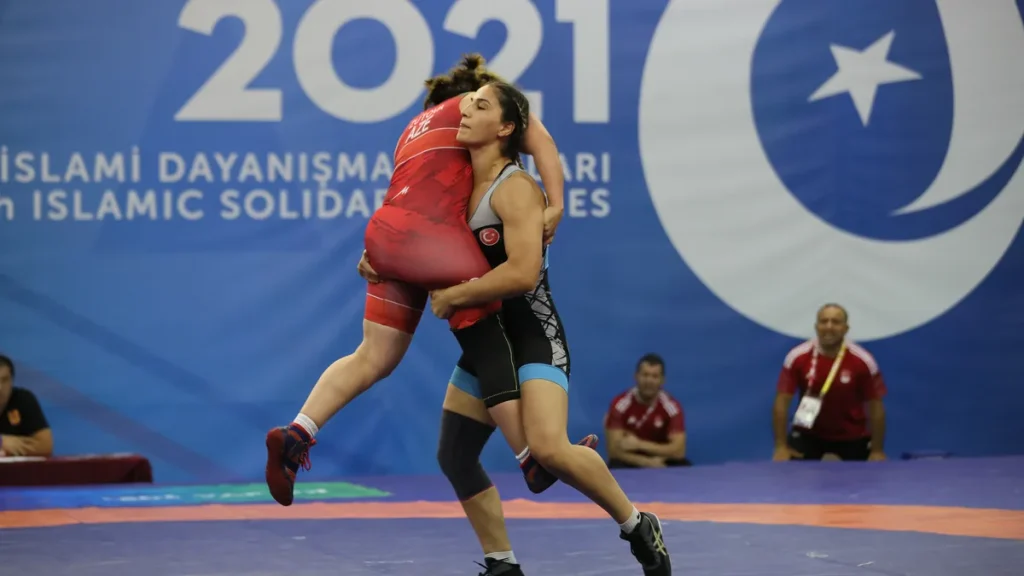
Buse Tosun Çavuşoğlu (b. 1995-12-05, İzmir, Türkiye) is a freestyle wrestler in the women’s 68 kg category for Türkiye, the Olympic bronze medallist at Paris 2024 and 2023 world champion, and a multi-time medallist at the World and European levels. Listed at 1.73 m and roughly 68 kg, she carries the proportionate build of an elite middle-weight female wrestler whose performance hinges not on absolute mass but on the ratio of strength and power to body mass, expressed across a six-minute bout. The interesting case for sport science is not any single takedown; it is the structural question of how a women’s freestyle wrestler at the top of the 68 kg division produces sustained grip, push, and repeat-takedown effort across two three-minute periods, then recovers between matches across an Olympic-day load. The variable underneath that pattern is women’s freestyle wrestling power-conditioning — the integration of maximal strength, expressed power, and aerobic-anaerobic recovery on a female-physiology frame that the literature is only recently formalising for combat sports.
Table of Contents
The Physiology — what women’s freestyle wrestling power-conditioning actually is
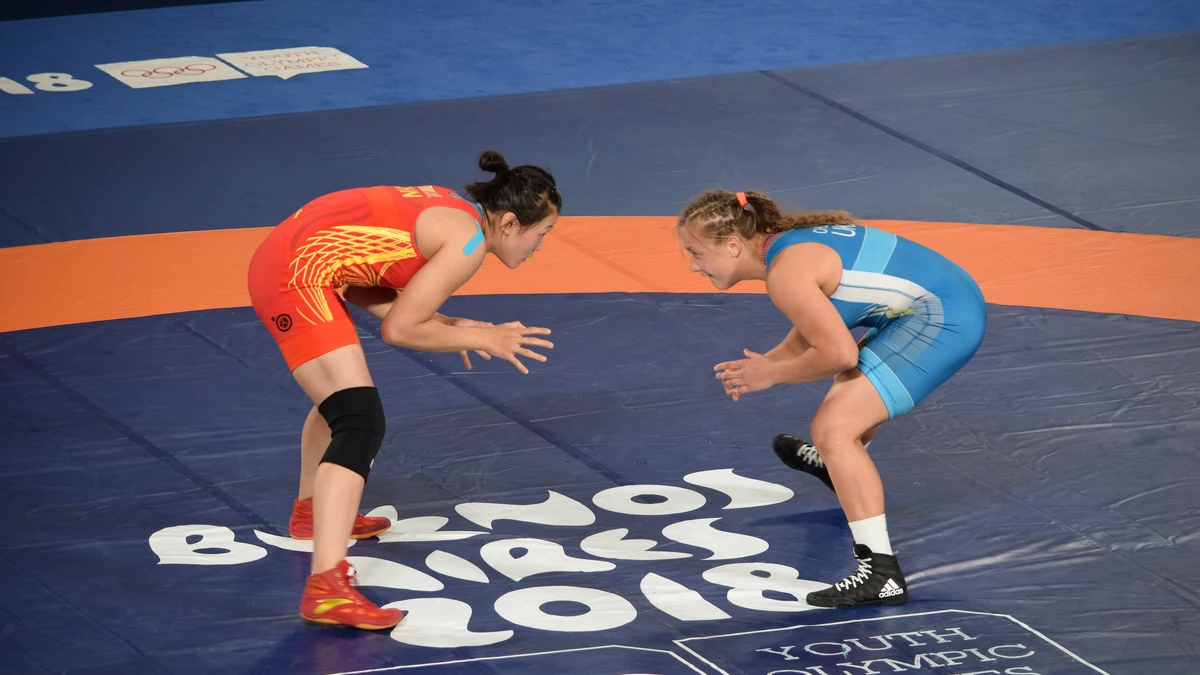
Wrestling at 68 kg is not the same physiological event as wrestling at 50 kg, nor is it the same event as wrestling at 76 kg. The absolute forces, the inertia of contact, the metabolic cost of moving the athlete’s own mass, and the recovery between explosive efforts all scale with body mass — but the structure of the determinants is invariant: a six-minute bout, two three-minute periods with a brief pause between, is a coordination problem between three subsystems. There is the maximal-strength reserve that produces decisive offensive actions — gripping, pulling, lifting, finishing under load. There is the velocity component — strength expressed at speed, the difference between a strong wrestler and a strong-and-fast one. And there is the aerobic-anaerobic recovery floor that determines whether the second period is wrestled at first-period intensity or at a fatigue-discounted intensity [1, 2, 5].
Wisløff and colleagues established that maximal lower-body strength is strongly correlated with explosive output in elite athletes, and the same principle applies — at the appropriate body-mass scale — to combat athletes whose foundational actions are loaded squat-pattern movements against another body [1]. The strength-power floor for a women’s freestyle wrestler is therefore not an optional add-on; it is the substrate that every offensive turn draws from, and the underlying force–velocity profile is what determines whether that strength becomes a takedown or stalls into a held position.
Cormie, McGuigan and Newton’s review of maximal neuromuscular power adds the dose-response dimension: power output is a product of force and velocity, and elite-level power production requires both heavy strength training (raising the force ceiling) and explosive work (raising the velocity ceiling) [2]. For the 68 kg wrestler whose finishing actions occur under load — driving from an underhook, finishing a leg attack against resistance — the velocity component is what separates a positionally strong athlete from a positionally strong and finishing one.
Stølen and colleagues’ broader endurance review, alongside Bangsbo and colleagues’ work on metabolic demands of intermittent high-intensity work, frames the recovery side: high-intensity efforts are produced on top of an aerobic base, and the larger that base, the more efforts the athlete produces per bout [3, 4]. Buchheit and Laursen’s HIIT framework formalises how that base, and the threshold position that sits inside it, is built on intermittent stimuli at or above VO₂max-eliciting intensity — exactly the prescription required by an athlete whose competition is a sequence of high-intensity bursts separated by partial recoveries [5].
The Case — Çavuşoğlu as a women’s freestyle 68 kg case
For a 1.73 m / ~68 kg freestyle wrestler operating at the top of an Olympic women’s category, the signature feat is not any single decisive turn but the ability to produce decisive turns repeatedly — within a single bout, across multiple bouts in a tournament day, and across the multi-year cycle that culminated in the Paris bronze. The mechanical bill at this body mass, summed across sustained grip exchanges, takedown attempts, defensive scrambles, and the loaded position transitions that fill a championship calendar, is paid through the integration of all three legs of the power-conditioning triangle [1, 2, 3].
The strength reserve question is the cleanest place to start. The literature on heavy resistance training is consistent: maximal-strength preservation through the competitive season requires continuous heavy stimulus, not a single peaking phase followed by detraining [1]. For a women’s freestyle wrestler whose offensive actions are loaded squat-pattern, hip-hinge, and pull-pattern movements, dropping the heavy strength stimulus mid-season is dropping the very substrate that makes the technique work. The training implication is unflashy: heavy work continues through the competitive calendar, with the dose adjusted but not withdrawn.
The power side — strength expressed at speed — is where wrestling diverges from pure strength sport. Cormie, McGuigan and Newton’s framing is directly applicable: the wrestler who can produce force quickly under load wins the position; the wrestler who can produce force only slowly loses it before the action can finish [2]. The training implication is that high-velocity-low-load work and low-velocity-high-load work are complementary, not interchangeable, and a women’s freestyle programme that drops either leg leaves the athlete exposed where it matters.
The endurance side defines the second period and the multi-bout day. A wrestler whose lactate threshold sits high enough to keep the second period at first-period intensity holds a profound advantage against an opponent who merely matched her in the first period [3, 4, 5]. The training implication is that aerobic-anaerobic intervals at competition intensity, programmed alongside the heavy strength work, are not optional — they are what lets the athlete arrive at the closing exchanges with finishing power intact and to wrestle the third match of the day with the same authority as the first.
(Performance data: UWW / Türkiye Güreş Federasyonu)
What This Means for the Reader
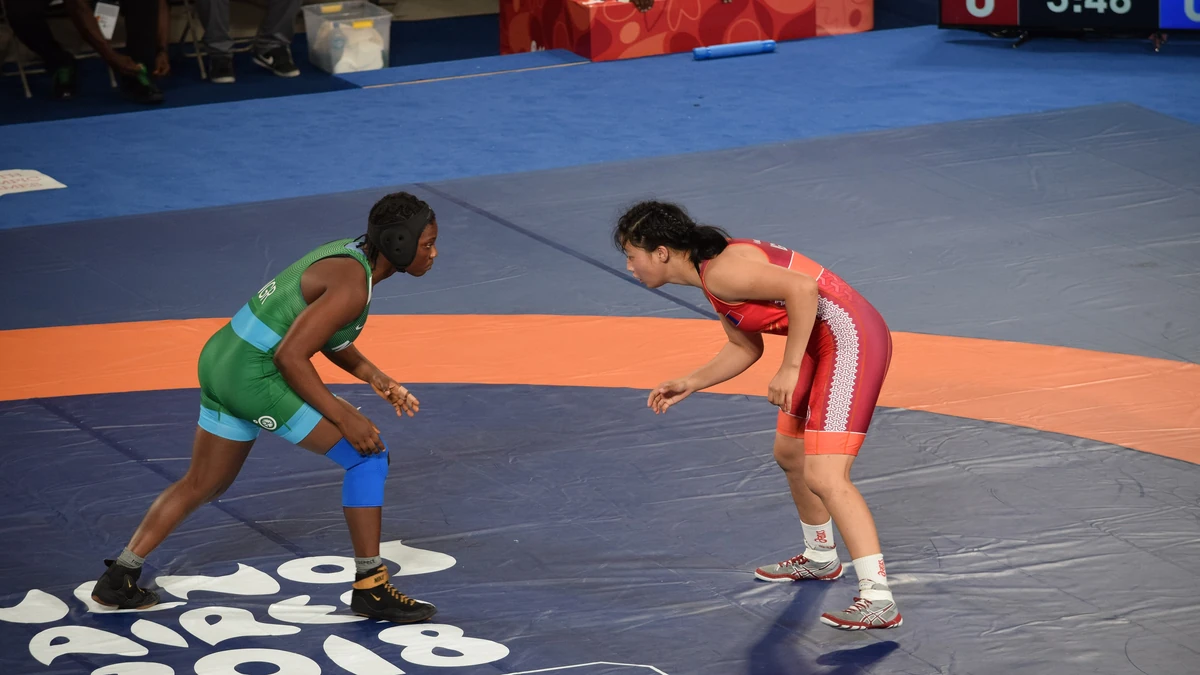
For a developing women’s wrestler — and for any female combat athlete operating in the middle-weight categories — the lesson is that power-conditioning is not a single quality but a coordination problem between three legs: maximal strength, expressed power, and aerobic-anaerobic recovery. Three diagnostics tell the story: a heavy lower-body reference lift relative to bodyweight (back squat or trap-bar), a force-velocity profile under loaded jump or throw, and a sub-maximal heart-rate response to a fixed grip-and-push protocol [1, 2, 4].
The training prescription depends on the gap. Strength-floor-limited athletes need continuous heavy work through the competitive season; velocity-limited athletes need explicit ballistic and high-velocity contrast work programmed alongside that heavy stimulus; recovery-floor-limited athletes need aerobic-anaerobic intervals at competition intensity, not generic conditioning [3, 5]. The three legs reinforce each other; collapsing one exposes the other two.
The diagnostic question for the developing women’s wrestler: when I lose the second period, is it because I ran out of force, ran out of speed at force, or ran out of recovery between exchanges? The answer determines training emphasis.
References
- Wisløff U, Castagna C, Helgerud J, Jones R, Hoff J. (2004). Strong correlation of maximal squat strength with sprint performance and vertical jump height in elite soccer players. British Journal of Sports Medicine, 38(3): 285–288. doi:10.1136/bjsm.2002.002071
- Cormie P, McGuigan MR, Newton RU. (2011). Developing maximal neuromuscular power: Part 1 — biological basis of maximal power production. Sports Medicine, 41(1): 17–38. doi:10.2165/11537690-000000000-00000
- Stølen T, Chamari K, Castagna C, Wisløff U. (2005). Physiology of soccer: an update. Sports Medicine, 35(6): 501–536. doi:10.2165/00007256-200535060-00004
- Bangsbo J, Mohr M, Krustrup P. (2006). Physical and metabolic demands of training and match-play in the elite football player. Journal of Sports Sciences, 24(7): 665–674. doi:10.1080/02640410500482529
- Buchheit M, Laursen PB. (2013). High-intensity interval training, solutions to the programming puzzle. Sports Medicine, 43(5): 313–338. doi:10.1007/s40279-013-0029-x
Performance data (descriptive only): UWW / Türkiye Güreş Federasyonu.
Hüseyin Akbulut is the founder of Sporeus and author of THRESHOLD (EŞİK), a 540-page Turkish-language book on endurance science.
- 540pp THRESHOLD Book
- MSc Sport Sciences
- Marmara University
The Athlete in One Paragraph
Buse Tosun Çavuşoğlu (b. 1995-12-05, İzmir, Türkiye) is a freestyle wrestler in the women's 68 kg category for Türkiye, the Olympic bronze medallist at Paris 2024 and 2023 world champion, and a multi-time medallist at the World and European levels. Listed at 1.73 m and…
The Physiology — what women's freestyle wrestling power-conditioning actually is
Wrestling at 68 kg is not the same physiological event as wrestling at 50 kg, nor is it the same event as wrestling at 76 kg. The absolute forces, the inertia of contact, the metabolic cost of moving the athlete's own mass, and the recovery…
The Case — Çavuşoğlu as a women's freestyle 68 kg case
For a 1.73 m / ~68 kg freestyle wrestler operating at the top of an Olympic women's category, the signature feat is not any single decisive turn but the ability to produce decisive turns repeatedly — within a single bout, across multiple bouts in a…
What This Means for the Reader
For a developing women's wrestler — and for any female combat athlete operating in the middle-weight categories — the lesson is that power-conditioning is not a single quality but a coordination problem between three legs: maximal strength, expressed power, and aerobic-anaerobic recovery. Three diagnostics tell…