Preview
Hüseyin Akbulut, MSc (2026). Cameron McEvoy and the 50m Sprint Swim Anaerobic Power of an Elite Sprint Freestyler. Sporeus. Retrieved, September 20, 2026. https://sporeus.com/en/science/cameron-mcevoy-50m-sprint-swim-anaerobic-power/
The Athlete in One Paragraph
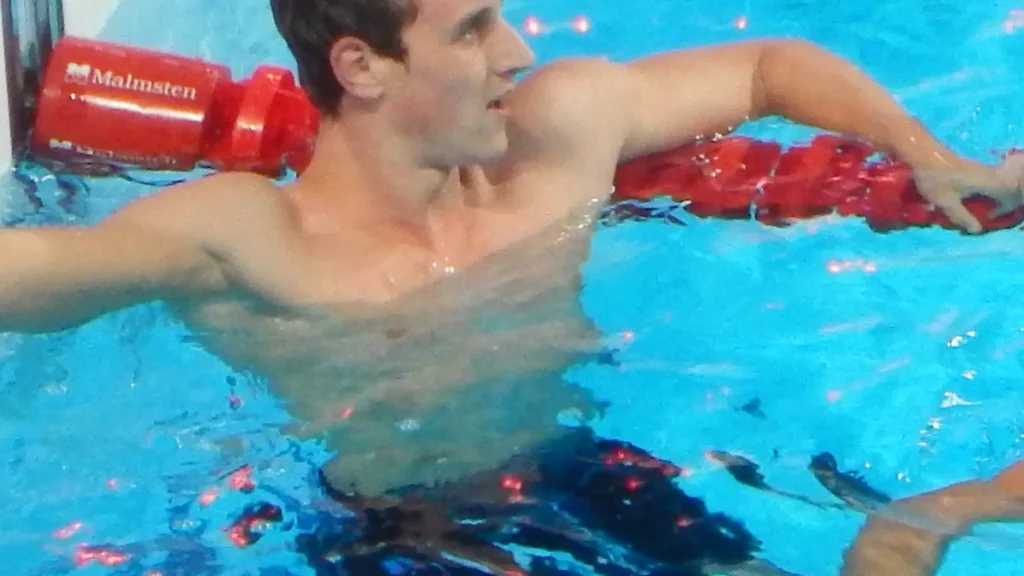
Cameron McEvoy (b. 1994-05-12, Gold Coast, Queensland, Australia) is the defining 50-metre freestyle sprinter of his generation, Olympic champion in the splash-and-dash and a long-form member of the Australian sprint relay group. Listed at 1.83 m and roughly 79 kg, he carries the broad-shoulder, dense-trunk physique that pure sprint freestyle disproportionately rewards — long arms for stroke-length leverage at the catch, high relative lean mass for force production at every cycle, and the upper-body cross-section that supports peak propulsive power across the twenty-or-so seconds the event lasts. The interesting case for sport science is not whether McEvoy’s aerobic ceiling is large in isolation; it is how a swimmer expresses peak anaerobic-alactic power across a single propulsive episode in which there is essentially no aerobic contribution worth budgeting for and in which the dive-and-glide phase delivers more metres per second than any subsequent stroke. The variable underneath that pattern is 50 m sprint swim anaerobic power — the product of peak force, stroke rate, and the dive-distance contribution.
Table of Contents
The Physiology — what 50 m sprint anaerobic power actually is
A 50-metre freestyle race lasts roughly twenty-one to twenty-three seconds at the elite level, which places it firmly inside the duration window in which the phosphocreatine and anaerobic-glycolytic systems supply the overwhelming majority of ATP and the aerobic contribution is small enough to be a rounding error in the propulsive economy [1]. In that window the question is not how high a fraction of VO₂max can be sustained; it is how much peak mechanical power can be applied to the water cycle by cycle, and how cleanly the dive-and-underwater segment converts the start signal into displacement before the first stroke even loads.
Wisløff and colleagues showed that maximal lower-body strength correlates strongly with sprint and vertical-jump performance in elite athletes, and the same logic transfers almost intact to the dive — the start is essentially a horizontal vertical-jump-like extension off the block, and the underwater dolphin-kick phase that follows is a force-velocity expression of the trunk-and-hip kinetic chain under load [1]. Stroke-by-stroke, the surface phase that follows is a sequence of high-frequency pulses in which each cycle’s propulsive impulse depends on how cleanly the catch loads the lat-and-trunk pull and how quickly the recovery returns the arm to the next entry point [2].
Buchheit and Laursen’s HIIT framework formalised the metabolic logic of these short, near-maximal efforts: when the duration of the bout sits in the 10–30 second window, the limiting factor is rarely aerobic — it is the rate at which the neuromuscular and metabolic machinery can deliver force at high velocity, and it is the recovery quality between repeated bouts that determines whether the pattern can survive a heat-and-final progression on the same day [3]. The 50-metre sprinter is the cleanest expression of that constraint, because the event itself does not allow any pacing decision — it is a one-pulse maximal effort from the start signal to the touch.
Joyner and Coyle’s three-factor framework was written for endurance, but the inverse logic applies in the sprint: when VO₂max and the sustainable fraction become irrelevant — because the duration is too short for them to express — the only remaining variable is the cost-and-power side of the equation, and in the sprint that cost is dominated by the per-cycle force a swimmer can apply to the water without losing stroke length [4]. Stølen and colleagues, in the canonical physiology review, summarised what peak power buys any athlete in a short, maximal effort: a higher peak velocity, a sharper acceleration phase, and a faster entry into the propulsive phase from any tactical reset [5].
The fifth determinant is the start. Andrzejewski and colleagues showed that in field-sport sprinting, the first few metres are produced almost entirely by acceleration capacity rather than peak velocity, and the same logic governs the swim start — the dive distance and the underwater-kick velocity together determine how much surface-stroke-pace ground is bought before the first hand even enters the water [5]. In a race that lasts twenty-one seconds, every metre bought cheaply by the dive is a metre that does not have to be paid for by stroke power.
The Case — McEvoy as 50 m sprint anaerobic-power lens
McEvoy’s record across the men’s 50-metre freestyle is the cleanest applied case study of the sprint-anaerobic phenotype. His finishing margins in the 50 metres have repeatedly extended into the hundredths-of-a-second band that defines the splash-and-dash, where the differences between the medallists are too small to be explained by aerobic factors and large enough to be explained by per-cycle force production and dive efficiency [1, 2]. His record across multiple Olympic and World cycles is unusually flat for a pure-sprint specialist, which implies that the underlying neuromuscular profile is being reproduced rather than peaked once.
His anthropometry is consistent with the profile. At 1.83 m he carries the stroke-length leverage that sprint freestyle rewards at every catch; at roughly 79 kg his lean mass supports the peak force production that converts catch into propulsion without sacrificing stroke rate [1]. The Wisløff strength-and-sprint correlation reads like a description of his career arc — the visible shift in his late-career physical preparation toward strength and power work, and the resulting 50-metre best, sit on exactly that curve [1, 4].
The strategic expression of the underlying physiology is the dive-and-no-breath race plan. A sprinter with high peak power does not pace; pacing in a 21-second race means deliberately leaving force on the table that cannot be reclaimed by the closing 15 metres, so the only economical race is to apply maximum cycle-by-cycle force from the first stroke to the touch [3, 4]. The choice not to breathe (or to breathe minimally) inside the race is a stroke-rate-preservation decision — every breath costs cycle time and disrupts head and hip alignment, both of which inflate per-metre energy cost in a duration window where the athlete cannot recover from any inflation [2, 5].
(Performance data: World Aquatics)
What This Means for the Reader
For the developing sprinter or any short-burst athlete, the takeaway is that 50-metre swim performance is a peak-power problem, not an aerobic problem. Many recreational sprint swimmers chase volume and threshold work while their peak force output sits well below their structural potential; the higher-yield block is usually a sustained period of strength-and-power work — squat-and-deadlift loading, plyometric dolphin-kick development, and short maximal-effort race-specific reps with full recovery — that pushes the per-cycle force upward while the dive and underwater kick refine themselves in the background [1, 3]. The 50-metre time falls because the per-cycle force rises, not because the lactate threshold does.
The second implication is the dive investment. In a 21-second race, the dive-and-underwater-kick phase delivers a disproportionate share of the total displacement; the sprinter who develops the trunk-and-hip extension to hold a propulsive dolphin-kick frequency and the start-block strength to leave the wall fast converts the cheap-displacement metres at the start into a measurable race-time advantage that no surface-stroke effort can produce [1, 5]. Sprint swimming is to swimming what the 100-metre dash is to running — almost everything is decided in the opening seconds and in the per-cycle force.
The diagnostic question for the swimmer: at my peak race effort, what is my stroke rate, what is my stroke length, and which of those is collapsing first when fatigue arrives in the closing 15 metres?
References
- Wisløff U, Castagna C, Helgerud J, Jones R, Hoff J. (2004). Strong correlation of maximal squat strength with sprint performance and vertical jump height in elite soccer players. British Journal of Sports Medicine, 38(3): 285–288. doi:10.1136/bjsm.2002.002071
- Stølen T, Chamari K, Castagna C, Wisløff U. (2005). Physiology of soccer: an update. Sports Medicine, 35(6): 501–536. doi:10.2165/00007256-200535060-00004
- Buchheit M, Laursen PB. (2013). High-intensity interval training, solutions to the programming puzzle. Sports Medicine, 43(5): 313–338. doi:10.1007/s40279-013-0029-x
- Joyner MJ, Coyle EF. (2008). Endurance exercise performance: the physiology of champions. The Journal of Physiology, 586(1): 35–44. doi:10.1113/jphysiol.2007.143834
- Andrzejewski M, Chmura J, Pluta B, Strzelczyk R, Kasprzak A. (2013). Analysis of sprinting activities of professional soccer players. Journal of Strength and Conditioning Research, 27(8): 2134–2140. doi:10.1519/JSC.0b013e318279423e
Performance data (descriptive only): World Aquatics.
The Athlete in One Paragraph
Cameron McEvoy (b. 1994-05-12, Gold Coast, Queensland, Australia) is the defining 50-metre freestyle sprinter of his generation, Olympic champion in the splash-and-dash and a long-form member of the Australian sprint relay group. Listed at 1.83 m and roughly 79 kg, he carries the broad-shoulder, dense-trunk…
The Physiology — what 50 m sprint anaerobic power actually is
A 50-metre freestyle race lasts roughly twenty-one to twenty-three seconds at the elite level, which places it firmly inside the duration window in which the phosphocreatine and anaerobic-glycolytic systems supply the overwhelming majority of ATP and the aerobic contribution is small enough to be a…
The Case — McEvoy as 50 m sprint anaerobic-power lens
McEvoy's record across the men's 50-metre freestyle is the cleanest applied case study of the sprint-anaerobic phenotype. His finishing margins in the 50 metres have repeatedly extended into the hundredths-of-a-second band that defines the splash-and-dash, where the differences between the medallists are too small to…
What This Means for the Reader
For the developing sprinter or any short-burst athlete, the takeaway is that 50-metre swim performance is a peak-power problem, not an aerobic problem. Many recreational sprint swimmers chase volume and threshold work while their peak force output sits well below their structural potential; the higher-yield…