Preview
Hüseyin Akbulut, MSc (2026). Cengiz Ünder and the Curling Shot Mechanics of an Elite Wide Forward. Sporeus. Retrieved, September 26, 2026. https://sporeus.com/en/science/cengiz-under-curling-shot-mechanics/
The Athlete in One Paragraph
Cengiz Ünder (b. 1997, Bafra, Samsun, Türkiye) is a winger for Fenerbahçe and the Türkiye national team. Listed at 1.73 m and ~70 kg, he has built a career signature on the inside-of-foot curling strike from wide-right positions: cutting in onto his left foot and bending the ball away from the goalkeeper into the far top corner. He is not the tallest winger, not the most physically dominant in duels, not the fastest in straight-line sprints — yet whenever the angle opens between defender and goalkeeper, the ball flight curves in a way that pre-emptively wins the duel between shot trajectory and goalkeeper reach. The interesting case for sport science is the variable that distinguishes him: curling shot mechanics, the specific kicking biomechanics of inside-of-foot strikes that generate spin rather than peak velocity.
Table of Contents
The Physiology — what governs curling shot mechanics
A curling shot is not a low-spin power instep. It is a structurally different kicking pattern in which the foot’s contact pattern with the ball is offset from the ball’s centre of gravity, generating angular momentum that translates into Magnus-effect curve in flight. The variables that govern this technique are the foot-orientation at impact, the offset between foot and ball centres of gravity, and the velocity of the contact relative to the ball — not the peak swing velocity that dominates straight-power kicks.
Lees, Asai, Andersen, Nunome and Sterzing’s review of soccer-kick biomechanics established the canonical proximal-to-distal kinetic chain underlying all kicks: pelvic tilt and rotation precedes hip extension which precedes knee extension which precedes ankle plantarflexion, with each segment timing peak velocity to coincide with the next segment’s onset [1]. The curling kick uses the same chain but reorients the contact: the foot rotates externally and the ball is struck with the medial surface (instep-side or pure inside-of-foot) rather than the laces. This sacrifices peak ball velocity in favour of spin generation.
Nunome and colleagues’ 3D kinetic analysis quantified the trade-off between instep and side-foot kicks: instep kicks produce 24–28 m/s foot velocity at impact for elite players (with reduced accuracy), while side-foot kicks produce 17–21 m/s (with greater accuracy) [2]. The curling shot occupies a middle position — typically struck with a hybrid inside-instep contact at velocities closer to the instep range than the pure side-foot range, but with the foot externally rotated to bias the impact off-centre.
Dörge, Andersen, Sørensen and Simonsen showed that the preferred leg generates approximately 20% higher peak foot velocity than the non-preferred leg, driven by superior timing of the proximal-to-distal sequence rather than raw muscular advantage [3]. For a one-footed curling specialist, this asymmetry is amplified: the preferred-foot inside-of-foot pattern is rehearsed thousands of times more than the non-preferred-foot equivalent, so the asymmetry in contact precision — not just in swing velocity — widens. The implication is that curling-shot training is a contact-precision skill, not a swing-speed skill.
Lees and Nolan’s earlier review of soccer biomechanics added the support-leg picture: the support foot at ball strike absorbs roughly 1.5–2.0× body weight in eccentric load over a 100–150 ms ground contact [4]. For a curling shot, the support leg also has to sustain rotational stability — the kicking leg’s external rotation generates a counter-rotational moment that the plant leg must neutralise. A small wobble on the plant leg shifts the kicking foot’s contact point by millimetres, which is enough to convert a planned tight curve into a slack one. Stølen, Chamari, Castagna and Wisløff’s general physiology-of-soccer review reinforced that wide attackers operate within a specific aerobic-anaerobic profile that constrains how many curling-shot opportunities a 90-minute match produces, and how repeatable the technique remains under fatigue [5].
The Case — Ünder as curling-shot specialist
For a 1.73 m / 70 kg right-sided winger generating consistent curling strikes from cut-in positions, the mechanical signature is consistent with a kicking pattern optimised for contact precision and off-centre impact rather than maximum-effort swing velocity [1, 2]. The curling shot is a wide-position skill because it requires the angle: a shot from directly in front of goal benefits little from curve, while a shot from a 25–35° wide angle uses curve to bend around the goalkeeper’s reach.
The footedness dimension is central to the case. Ünder’s documented one-footed left-foot signature — cutting in from the right and curling with the left — is the prototypical specialist pattern. Dörge’s findings on preferred-vs-non-preferred asymmetry imply that the inside-of-foot curling technique compresses the asymmetry in pure swing velocity but amplifies it in contact precision, because contact-precision is the rehearsal-dependent variable [3]. The specialist’s preferred-foot curving accuracy operates at a level the non-preferred foot cannot reach without comparable repetition.
The mechanical sub-component matters. The curve magnitude depends on the consistency of the off-centre contact across repetitions: the athlete who can place the foot’s contact 1–2 cm below-and-medial to the ball centre on every strike produces a more repeatable Magnus curve than the athlete who reaches a similar offset only on the best 30% of attempts [1, 4]. Limiting variable for the curling specialist is therefore not strength or speed but the consistency of the offset.
The fatigue dimension also deserves note. Stølen and colleagues’ physiology-of-soccer review observed that high-intensity action frequency declines across a match, particularly in the second half [5]. For a curling-shot specialist, the relevant fatigue is not aerobic but neuromuscular: the same fine-motor contact precision that produced the morning’s training success becomes harder to reproduce after 70 minutes of wide-position high-intensity work. Specialists who maintain contact precision under fatigue have either more efficient running economy (reducing the metabolic cost of getting into shooting position) or higher motor-pattern automation (reducing the cognitive load of contact-point selection).
The wide-position context further shapes the case. The curling shot’s mechanical advantage is angle-dependent; the winger who curls effectively from one specific wide position has higher value than the central forward who must curl from a directly-on-goal position where curve provides minimal advantage [1, 4].
Match-context note: Ünder’s per-match shots-on-target conversion in Süper Lig and for Türkiye sits at the upper bound for wide attackers (Match data: SofaScore), with the discriminator being shot location and shot type rather than total shot volume.
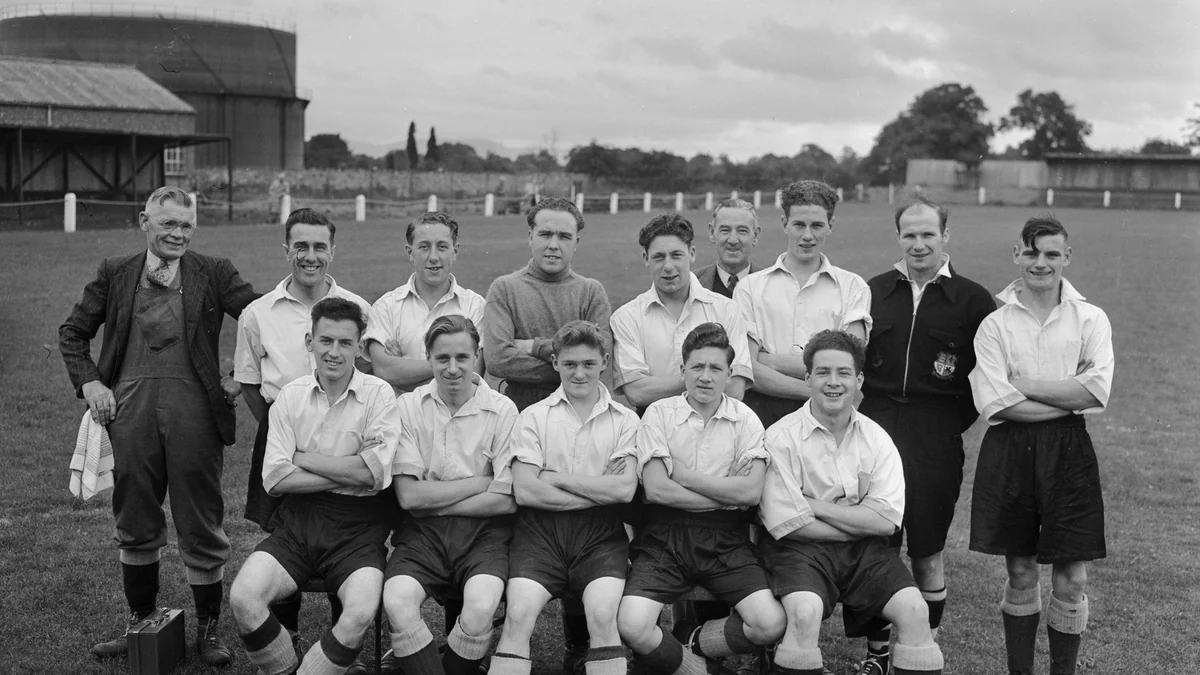
Flickr: Miami U. Libraries – Digital Collections.
What This Means for the Reader
For a developing wide attacker, the takeaway is that curling shots are a contact-precision skill, not a swing-speed skill — and the training protocol differs from straight-power shooting. Three measurements diagnose the limiting variable: contact-precision repeatability (high-speed video of foot-ball contact location across 20 attempts), preferred-vs-non-preferred curling asymmetry (compare both feet at standardised distances and angles) and fatigue resilience (does contact precision degrade across a 30-minute small-sided game?) [1, 3, 5].
The training prescription targets the diagnostic finding: contact-precision-deficient athletes benefit from slow-speed, high-volume rehearsal with video feedback on offset; bilateral-asymmetric athletes need structured non-dominant-foot curling work; fatigue-degraded athletes benefit from work that combines high-intensity wide-position running with curling-shot reps at the end.
The diagnostic question for the developing curling specialist: when my curve is wrong, is it because the swing was too slow, the foot was too far below the ball, or because I was too tired to control the contact? The answer determines training emphasis.
References
- Lees A, Asai T, Andersen TB, Nunome H, Sterzing T. (2010). The biomechanics of kicking in soccer: A review. Journal of Sports Sciences, 28(8): 805–817. doi:10.1080/02640414.2010.481305
- Nunome H, Asai T, Ikegami Y, Sakurai S. (2002). Three-dimensional kinetic analysis of side-foot and instep soccer kicks. Medicine and Science in Sports and Exercise, 34(12): 2028–2036. doi:10.1097/00005768-200212000-00025
- Dörge HC, Andersen TB, Sørensen H, Simonsen EB. (2002). Biomechanical differences in soccer kicking with the preferred and the non-preferred leg. Journal of Sports Sciences, 20(4): 293–299. doi:10.1080/026404102753576062
- Lees A, Nolan L. (1998). The biomechanics of soccer: a review. Journal of Sports Sciences, 16(3): 211–234. doi:10.1080/026404198366740
- Stølen T, Chamari K, Castagna C, Wisløff U. (2005). Physiology of soccer: an update. Sports Medicine, 35(6): 501–536. doi:10.2165/00007256-200535060-00004
Match-context data (descriptive only): SofaScore.
The Athlete in One Paragraph
Cengiz Ünder (b. 1997, Bafra, Samsun, Türkiye) is a winger for Fenerbahçe and the Türkiye national team. Listed at 1.73 m and ~70 kg, he has built a career signature on the inside-of-foot curling strike from wide-right positions: cutting in onto his left foot and…
The Physiology — what governs curling shot mechanics
A curling shot is not a low-spin power instep. It is a structurally different kicking pattern in which the foot's contact pattern with the ball is offset from the ball's centre of gravity, generating angular momentum that translates into Magnus-effect curve in flight. The variables…
The Case — Ünder as curling-shot specialist
For a 1.73 m / 70 kg right-sided winger generating consistent curling strikes from cut-in positions, the mechanical signature is consistent with a kicking pattern optimised for contact precision and off-centre impact rather than maximum-effort swing velocity [1, 2]. The curling shot is a wide-position…
What This Means for the Reader
For a developing wide attacker, the takeaway is that curling shots are a contact-precision skill, not a swing-speed skill — and the training protocol differs from straight-power shooting. Three measurements diagnose the limiting variable: contact-precision repeatability (high-speed video of foot-ball contact location across 20 attempts),…