Preview
Hüseyin Akbulut, MSc (2026). Romelu Lukaku and the Physical-Striker Target-Man Mechanics of an Elite Number Nine. Sporeus. Retrieved, October 9, 2026. https://sporeus.com/en/science/romelu-lukaku-physical-striker-target-man-mechanics/
The Athlete in One Paragraph
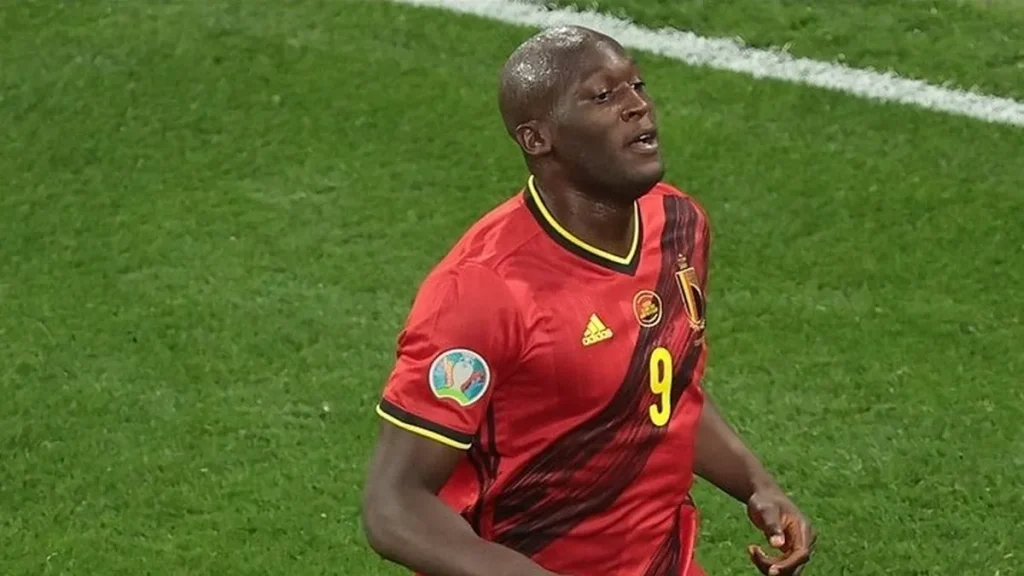
Romelu Menama Lukaku Bolingoli (b. 1993-05-13, Antwerp, Belgium) is, as of September 2026, a striker for Fenerbahçe (formerly Napoli) and the Belgium national team — listed at 1.91 m and ~94 kg, sitting at the upper edge of the elite-centre-forward distribution for both height and mass. His senior career has tracked the demand cycle of the modern target-man through Anderlecht, Chelsea, Everton, Manchester United, Inter Milan, Roma, Napoli and now Fenerbahçe, with goal output across each step that places him among the top scorers of his generation in both club and international football. The interesting case for sport science is the variable that defines his survival across that demand cycle: physical-striker target-man mechanics, the capacity to absorb sustained shielding load with back to goal, hold the ball through cumulative defensive contact, and convert the opportunities created by holding it. The underlying physiology is mass-and-leverage rather than economy-and-cue — a different operating mode for the same number-nine role, with a different substrate cost and a different career-load signature.
Table of Contents

The Physiology — what target-man mechanics actually demand
The target-man profile is the inverse of the minimal-touch finisher. Where the minimal-touch finisher minimises the number of bursts and touches required to convert, the target-man maximises the time-on-ball with back to goal under contact, creating the runways into which the rest of the side advances. The biomechanics decompose into base stability, contact-force absorption and cumulative shielding capacity — each anchored to a different physiological substrate.
Wisløff, Castagna, Helgerud, Jones and Hoff established the load-bearing relationship between maximal lower-limb strength and on-pitch performance in elite soccer: half-squat strength correlates strongly with sprint performance and vertical jump, and — for the target-man — with the capacity to produce ground reaction force against an opposing centre-back’s contact load [1]. The relevant variable for sustained shielding is absolute strength as well as relative strength: the heavy striker absorbs heavy contact, and the absolute mass that sits behind the shielding base is itself a substrate.
Bangsbo, Mohr and Krustrup’s match-demand decomposition placed shielding inside the metabolic accounting: the elite forward absorbs hundreds of contact phases per match, with each contact lasting on the order of seconds and accumulating across the 90 minutes into a substantial cumulative contact-load [2]. The target-man whose mass-and-strength substrate is matched to the contact-load profile retains possession through extended shielding episodes; the one whose substrate is undermatched leaks possession early in the contact phase and forces the rest of the side to defend more.
Stølen, Chamari, Castagna and Wisløff’s physiology-of-soccer review extended the framework to position-specific demands and noted that the centre-forward’s match is dominated by short, contact-rich bursts inside a long low-intensity baseline rather than by sustained running [3]. The target-man variant tilts that distribution further toward contact-rich bursts: more shielding episodes per match, longer episodes, and a higher fraction of total external work absorbed as eccentric contact load rather than as concentric sprinting effort.
Mohr, Krustrup and Bangsbo added the temporal dimension: high-intensity output drops across the match, and the discriminator across forwards is who maintains the late-match output, not who runs the most early [4]. The target-man whose mass-and-strength substrate is well-matched to his role can sustain the shielding pattern across 90 minutes, while a substrate-mismatched variant is forced to compromise either by leaking possession or by reducing the volume of shielding episodes.
Bradley and colleagues’ Premier League high-intensity-running analysis positioned forwards at the upper end of sprint-distance-per-match with the lowest total distance, with a running profile dominated by short, tactically cued bursts [5]. For the target-man, the bursts are typically the ball-receiving runs into space behind the centre-backs and the support runs after a hold-up release; the external high-intensity-running profile sits inside the same envelope as the minimal-touch finisher but with a different distribution of the contact-load column.
The Case — Lukaku as target-man archetype
For a 1.91 m / 94 kg striker generating extended target-man output across Premier League, Serie A and international football, the physiological signature is consistent with a mass-and-strength operating mode rather than an economy-and-cue mode. The candidate variables are absolute lower-limb maximal strength matched to bodyweight, sustained shielding capacity, and the eccentric-load tolerance that protects the support knees and hips through hundreds of contact phases per season [1, 2]. The role demand is mechanical and metabolic in roughly equal measure; the elite specialist who survives at that frame has typically optimised both the substrate layer and the eccentric-tolerance layer.
Wisløff’s strength-substrate framework supplies the underlying mechanism: maximal lower-limb strength scales with the capacity to produce and absorb ground reaction force, and the heavy striker who keeps relative-strength signature intact at his absolute mass can absorb contact loads beyond the reach of a lighter striker [1]. The mass advantage is not a free pass — it is a substrate that demands matching strength to express, and the target-man who loses the strength-to-mass ratio loses the contact-survival advantage.
Stølen’s integrated framework adds the technical layer. Sustained shielding is a learned technical pattern as well as a substrate-dependent variable, and the target-man who develops in physical leagues — Belgian senior football and Premier League first-team football — accumulates hundreds of season-level contact reps that shape the technique alongside the substrate [3]. The pattern is recognisable in match footage: a stable, slightly-flexed base, a wide arm placement, a low centre of mass biased toward the defender’s contact angle.
Bangsbo’s metabolic accounting supplies the cost-side picture. Each shielding episode is short but metabolically expensive, and the target-man absorbs more episodes per match than the minimal-touch variant; the metabolic cost of the role is correspondingly higher and the recovery demand correspondingly steeper [2]. The career-management implication is that the target-man’s match-load is dominated by eccentric contact rather than by aerobic running, and the recovery protocol that suits a long-distance runner is not the recovery protocol that suits a 94 kg shielder.
Mohr’s match-fatigue work explains the late-match signature. The target-man whose first-15-minute shielding survival is comparable to peers but whose 75–90-minute shielding survival is better is exporting the substrate-and-technique advantage into the late match — and the late match is where elite target-man play converts the holding work into goal involvement [4]. Bradley’s positional decomposition supplies the per-match volume substrate within which the signature becomes legible [5].
The under-discussed dimension is the cumulative-load cost. The target-man’s career-load is typically more eccentric and more contact-dense than the minimal-touch finisher’s, and the long-tail injury profile reflects that — hamstring loads from sudden direction changes after a shielded release, hip loads from sustained eccentric trunk control during contact, and the cumulative wear that catches up with the late-career target-man if the load-management protocol does not account for the role-specific stress.
Match-context note: Lukaku’s per-match touches in the opposition third, ball-retention rate against contact and goal involvement across his Premier League, Serie A and Belgium career sit at the upper band for centre-forwards (Match data: SofaScore), with the discriminator being the consistency of the target-man survival rate across multi-league transitions rather than any single peak performance.
Flickr: Miami U. Libraries – Digital Collections.
What This Means for the Reader
For developing strikers and the coaches working with them, the takeaway is that target-man mechanics are a real, trainable variant of the centre-forward role and demand a different training emphasis from the economy-and-cue variant. The transferable diagnostic uses three measurements: a relative-strength index alongside an absolute-strength reading (the mass-and-leverage ratio) [1], a sustained-shielding ball-retention test under standardised contact load (technique and eccentric tolerance), and a session-by-session log of late-match contact-survival rate to track whether the substrate is sharpening or dulling under fatigue [4, 5].
The training prescription targets the diagnostic finding. Athletes whose absolute strength is mid-range relative to their bodyweight benefit from continued investment in posterior-chain conditioning, eccentric strength work and contact-rehearsal small-sided games; athletes whose target-man survival drops sharply under cumulative load benefit from a recovery and load-management protocol that treats eccentric contact load as the primary cost driver rather than aerobic running [2, 3]. The most common error in amateur development is treating the target-man as an “athletic 9” without accounting for the eccentric-tolerance demand that defines the role; the elite literature treats the target-man as a substrate-specific variant.
The diagnostic question for the developing forward: when the contact phase extends past three seconds, am I still in possession with the body shape to release, or am I starting to break down? The honest answer changes the meaning of the conditioning programme.
References
- Wisløff U, Castagna C, Helgerud J, Jones R, Hoff J. (2004). Strong correlation of maximal squat strength with sprint performance and vertical jump height in elite soccer players. British Journal of Sports Medicine, 38(3): 285–288. doi:10.1136/bjsm.2002.002071
- Bangsbo J, Mohr M, Krustrup P. (2006). Physical and metabolic demands of training and match-play in the elite football player. Journal of Sports Sciences, 24(7): 665–674. doi:10.1080/02640410500482529
- Stølen T, Chamari K, Castagna C, Wisløff U. (2005). Physiology of soccer: an update. Sports Medicine, 35(6): 501–536. doi:10.2165/00007256-200535060-00004
- Mohr M, Krustrup P, Bangsbo J. (2003). Match performance of high-standard soccer players with special reference to development of fatigue. Journal of Sports Sciences, 21(7): 519–528. doi:10.1080/0264041031000071182
- Bradley PS, Sheldon W, Wooster B, Olsen P, Boanas P, Krustrup P. (2009). High-intensity running in English FA Premier League soccer matches. Journal of Sports Sciences, 27(2): 159–168. doi:10.1080/02640410802512775
Match-context data (descriptive only): SofaScore.

Hüseyin Akbulut is the founder of Sporeus and author of THRESHOLD (EŞİK), a 540-page Turkish-language book on endurance science.
- 540pp THRESHOLD Book
- MSc Sport Sciences
- Marmara University
The Athlete in One Paragraph
Romelu Menama Lukaku Bolingoli (b. 1993-05-13, Antwerp, Belgium) is, as of September 2026, a striker for Fenerbahçe (formerly Napoli) and the Belgium national team — listed at 1.91 m and ~94 kg, sitting at the upper edge of the elite-centre-forward distribution for both height and…
The Physiology — what target-man mechanics actually demand
The target-man profile is the inverse of the minimal-touch finisher. Where the minimal-touch finisher minimises the number of bursts and touches required to convert, the target-man maximises the time-on-ball with back to goal under contact, creating the runways into which the rest of the side…
The Case — Lukaku as target-man archetype
For a 1.91 m / 94 kg striker generating extended target-man output across Premier League, Serie A and international football, the physiological signature is consistent with a mass-and-strength operating mode rather than an economy-and-cue mode. The candidate variables are absolute lower-limb maximal strength matched to…
What This Means for the Reader
For developing strikers and the coaches working with them, the takeaway is that target-man mechanics are a real, trainable variant of the centre-forward role and demand a different training emphasis from the economy-and-cue variant. The transferable diagnostic uses three measurements: a relative-strength index alongside an…