Preview
Hüseyin Akbulut, MSc (2026). Ederson and the Distribution Mechanics of an Elite Modern Goalkeeper. Sporeus. Retrieved, October 23, 2026. https://sporeus.com/en/science/ederson-goalkeeper-distribution-mechanics/
The Athlete in One Paragraph
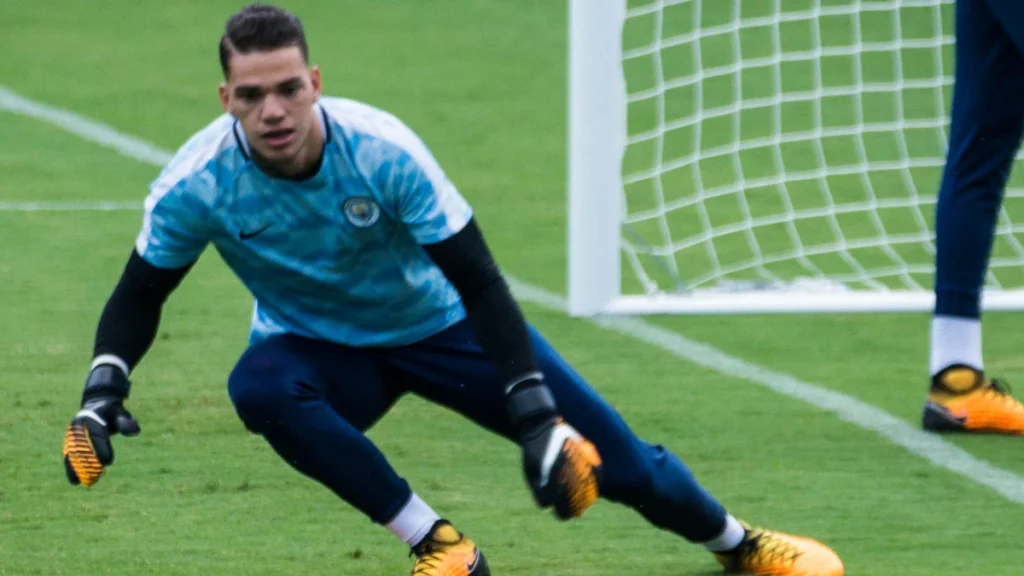
Ederson Santana de Moraes (b. 1993-08-17, Osasco, Brazil) is, as of September 2026, the goalkeeper for Fenerbahçe (formerly Manchester City) and the Brazil national team. Listed at 1.88 m and ~86 kg, he occupies a position whose definition has shifted under his feet: the modern goalkeeper is no longer the player who only stops shots but the player who initiates possession, who hits 50-metre diagonal balls onto a winger’s chest, who drops the ball over a high press into the half-space behind it. The interesting question for sport science is the kicking-biomechanics question imported from the outfield literature into the goal area: how a goalkeeper produces the foot-speed, hip-angular-velocity and ball-velocity coupling that separates a clearance from a precision pass at distance. The variable underneath that is goalkeeper distribution mechanics, and it is the trait that integrates a modern goalkeeper into a possession system rather than detaching him from it.
Table of Contents
The Physiology: what distribution mechanics actually measures
Kicking a football for distance and accuracy is a multi-segment, sequenced biomechanical event. Lees, Asai, Andersen, Nunome and Sterzing’s review of kicking biomechanics describes the canonical pattern: a run-up that loads horizontal momentum, a planted support foot that provides the rotational base, a hip-flexor-driven thigh acceleration, a knee-extension whip that transfers angular velocity to the foot, and a foot-segment impact that imparts ball velocity at release [1]. The distal segments reach peak angular velocity after the proximal segments have decelerated, the proximal-to-distal sequencing that defines all whip-like throwing and kicking actions.
Nunome, Asai, Ikegami and Sakurai’s three-dimensional kinetic analysis of side-foot and instep kicks refined the picture at the segment level. The instep kick, the technique used for long-range goalkeeper distribution, generates higher ball velocity than the side-foot kick because it allows greater knee-extension angular velocity at impact, and the energy transfer from thigh to shank is more complete when the support-foot plant is closer to the ball and the trunk is positioned to allow a full whip arc [2]. Goalkeepers distributing the ball over distance live in this technique.
Dörge, Andersen, Sørensen and Simonsen’s comparison of preferred and non-preferred legs sharpened the bilateral dimension. In their elite footballer sample, the non-preferred leg produced lower ball velocities not primarily because of muscle-strength differences but because of less efficient coordination, the segmental sequencing and timing degraded, even when the underlying force-generating capacity was comparable [3]. For a goalkeeper, this matters because possession-system distribution increasingly demands competence on both feet, a left-footed goalkeeper who cannot reliably hit 40 metres with the right is a tactical constraint on the build-up shape.
Lees and Nolan’s earlier biomechanics review framed the football kick as the most studied skill in the soccer-mechanics literature, with the canonical determinants of ball velocity established as approach-run velocity, support-foot plant geometry, hip-flexion velocity, knee-extension velocity, and foot-segment angular velocity at impact [4]. The same determinants govern goalkeeper long-distribution, with one structural difference: the goalkeeper usually has more time and more degrees of freedom in the run-up than the outfield player who is pressed in possession, which shifts the limiting variable from situational pressure to technical execution.
The match-context layer is where distribution mechanics becomes a tactical variable rather than a closed-skill biomechanics question. Stølen, Chamari, Castagna and Wisløff’s physiology-of-soccer review described the position-specific load profiles of modern football, with the goalkeeper sitting at the lowest aerobic load but the highest density of skill-execution per minute of involvement [5]. The build-up phase that the goalkeeper initiates occupies a disproportionate share of the strategic match content even when it occupies a small share of the running content [5]. The goalkeeper who distributes well does not run more; he changes what everybody else has to run.
The Case: Ederson as distribution-mechanics prototype
For a 1.88 m / 86 kg goalkeeper operating in a possession-dominant Premier League system that builds from the back, the technical demand on distribution is the highest among first-choice goalkeepers in elite European football. The case is not that he kicks the ball harder than every other goalkeeper, peak ball-velocity differences in that population are small, but that the coupling of approach-run, support-foot plant, hip-knee sequencing and foot-segment angular velocity is reproducible across both feet, at varied distances, under press conditions, with the trajectory placed onto a teammate’s chest rather than into open space [1, 2].
The bilateral dimension is what makes the case distinctive at the position. Dörge and colleagues’ finding that non-preferred-leg ball velocity loss is dominated by coordination rather than strength implies that bilateral distribution is trainable but only through deliberate technical work, repeated repetition with both feet against a real cue, not just open-field drilling [3]. A goalkeeper whose bilateral competence is in place opens the half-pitch in build-up; a goalkeeper restricted to one foot constrains the build-up shape and is more easily pressed.
The integration into a possession system is structural rather than technical. The match-demand framework, applied to the build-up phase, makes a quiet point: the goalkeeper distribution that breaks a press redistributes the running load across the opposition for the next 30–60 seconds [5]. A successful long-diagonal to a winger requires the press to reset, the opposition midfield to track back, and the opposition full-back to recover; a successful drop-pass through the lines requires three opposition players to compress space they had vacated. The mechanical event is one kick; the tactical event is a cascade.
Match-context note: Ederson’s long-pass volume and completion percentage in the Premier League and Champions League sit in the upper band for first-choice goalkeepers (Match data: SofaScore), with the discriminator being the proportion of attempts directed at progressive build-up targets rather than reset-clearances under pressure that any first-team goalkeeper would attempt.
The repeatability dimension is mechanical rather than metabolic. A goalkeeper does not fatigue across distribution events in a single match the way a midfielder does across pressing actions, each long-pass repetition costs little metabolically, but he does need to deliver the same plant-foot geometry and the same proximal-distal sequencing on a stoppage-time goal kick under crowd pressure as on a calm first-half restart [4]. The mechanical signature is constant; the situational pressure varies. The goalkeeper at the upper end of the position holds the signature when the pressure rises.
What This Means for the Reader
For a developing goalkeeper, the takeaway is that distribution is not an arm of goalkeeping; it is a parallel skill set, and at the modern game’s top level it is no longer optional. Three measurements diagnose where the limit lies: a maximum-distance instep-kick test on the preferred and non-preferred foot to estimate force-output ceiling; a precision-target test at 30, 40 and 50 metres on both feet to estimate accuracy under unloaded conditions; and a press-simulated distribution drill that adds a time-under-pressure constraint to the same target tests [1, 3].
The training prescription targets the diagnostic finding: athletes with adequate distance but poor accuracy need technical work, support-foot placement, plant-leg knee angle, follow-through, rather than more strength; athletes with strong preferred-foot but weak non-preferred-foot need bilateral repetition under representative pressure, not symmetrical strength work; athletes with both adequate but who collapse under press need a different stimulus altogether, small-sided games with real defenders, real time pressure, and a real consequence for losing possession [2, 3, 4]. The single diagnostic question for the developing goalkeeper: when my distribution fails, did I lose the ball because the technique broke down, or because the technique never adapted to the press?
References
- Lees A, Asai T, Andersen TB, Nunome H, Sterzing T. (2010). The biomechanics of kicking in soccer: a review. Journal of Sports Sciences, 28(8): 805–817. doi:10.1080/02640414.2010.481305
- Nunome H, Asai T, Ikegami Y, Sakurai S. (2002). Three-dimensional kinetic analysis of side-foot and instep soccer kicks. Medicine and Science in Sports and Exercise, 34(12): 2028–2036. doi:10.1097/00005768-200212000-00025
- Dörge HC, Andersen TB, Sørensen H, Simonsen EB. (2002). Biomechanical differences in soccer kicking with the preferred and the non-preferred leg. Journal of Sports Sciences, 20(4): 293–299. doi:10.1080/026404102753576062
- Lees A, Nolan L. (1998). The biomechanics of soccer: a review. Journal of Sports Sciences, 16(3): 211–234. doi:10.1080/026404198366740
- Stølen T, Chamari K, Castagna C, Wisløff U. (2005). Physiology of soccer: an update. Sports Medicine, 35(6): 501–536. doi:10.2165/00007256-200535060-00004
Match-context data (descriptive only): SofaScore.
Hüseyin Akbulut is the founder of Sporeus and author of THRESHOLD (EŞİK), a 540-page Turkish-language book on endurance science.
- 540pp THRESHOLD Book
- MSc Sport Sciences
- Marmara University
The Athlete in One Paragraph
Ederson Santana de Moraes (b. 1993-08-17, Osasco, Brazil) is, as of September 2026, the goalkeeper for Fenerbahçe (formerly Manchester City) and the Brazil national team. Listed at 1.88 m and ~86 kg, he occupies a position whose definition has shifted under his feet: the modern…
The Physiology: what distribution mechanics actually measures
Kicking a football for distance and accuracy is a multi-segment, sequenced biomechanical event. Lees, Asai, Andersen, Nunome and Sterzing's review of kicking biomechanics describes the canonical pattern: a run-up that loads horizontal momentum, a planted support foot that provides the rotational base, a hip-flexor-driven thigh…
The Case: Ederson as distribution-mechanics prototype
For a 1.88 m / 86 kg goalkeeper operating in a possession-dominant Premier League system that builds from the back, the technical demand on distribution is the highest among first-choice goalkeepers in elite European football. The case is not that he kicks the ball harder…
What This Means for the Reader
For a developing goalkeeper, the takeaway is that distribution is not an arm of goalkeeping; it is a parallel skill set, and at the modern game's top level it is no longer optional. Three measurements diagnose where the limit lies: a maximum-distance instep-kick test on…