

Preview
Hüseyin Akbulut, MSc (2026). Markus Rehm and the Paralympic Prosthesis Energy-Return Mechanics of an Elite Para Long Jumper. Sporeus. Retrieved, October 5, 2026. https://sporeus.com/en/science/markus-rehm-paralympic-prosthesis-energy-return-mechanics/
The Athlete in One Paragraph
Markus Rehm (b. 1988-08-22, Göppingen, Germany) is a German Para long jumper, multi-Paralympic gold medallist, and the world record holder in the T64 long jump with marks that have repeatedly extended past 8.70 m — distances that sit comfortably within the range of able-bodied Olympic finals and have made his event one of the most physically and philosophically interrogated in modern athletics. Listed at 1.85 m and approximately 81 kg, he competes with a below-knee carbon-fibre running blade on the takeoff leg following an amputation in adolescence; the intact contralateral limb is the swing leg. The biomechanical question that surrounds his career is unusually pointed: how does a passive, unilateral, carbon-fibre prosthesis compare with an intact human leg at the takeoff phase of a long jump, and where do the trainable physiological factors — runway approach speed, neuromuscular drive, jumping technique — end and the device-dependent ones begin? The variable underneath that question is paralympic prosthesis energy-return mechanics — the elastic storage-and-return profile of a running blade interacting with the takeoff impulse of long jump.
Table of Contents
The Physiology — what energy-return mechanics actually transform
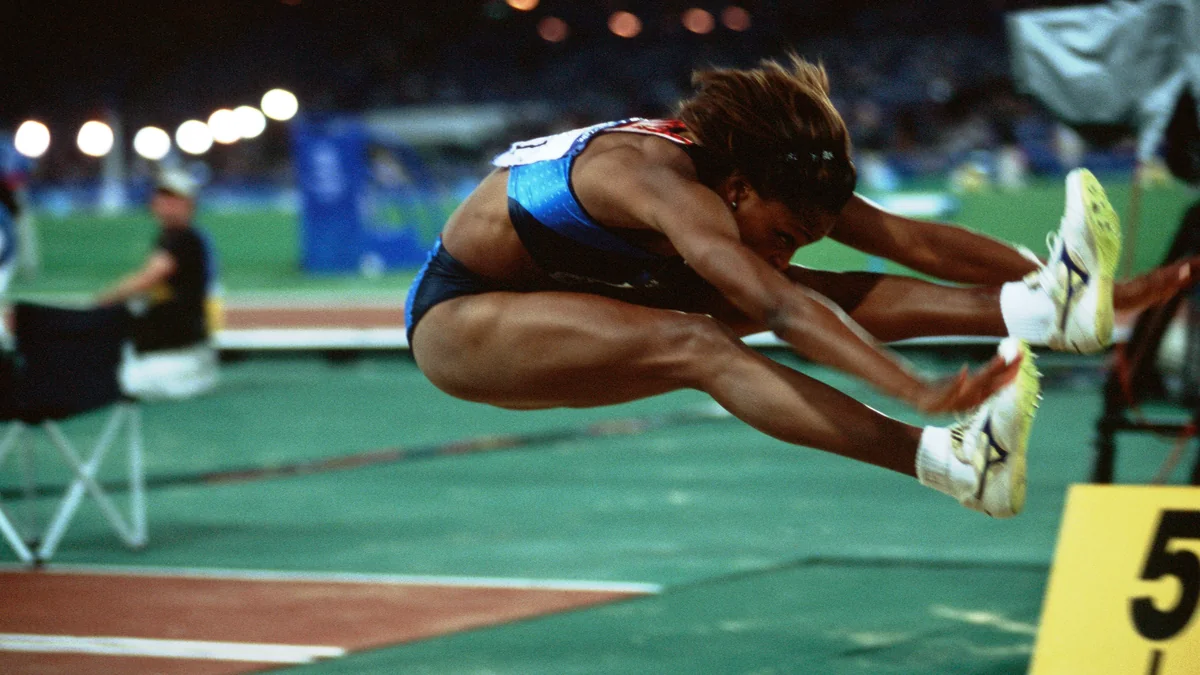
A long jump is, mechanically, a horizontal-to-vertical conversion task: the athlete arrives at the board with a high horizontal velocity, plants the takeoff leg into the runway, and converts a fraction of that horizontal kinetic energy into the vertical and forward components that produce flight distance. The takeoff leg performs three jobs in roughly 0.10–0.15 s of ground contact — it must absorb the impact of the plant, store elastic energy in the lower-limb structures, and return that stored energy through a coordinated extension that drives the centre of mass into a flight trajectory. Stølen, Chamari, Castagna and Wisløff frame the integrative point that elite athletic performance is the sum of multiple subsystems aligned with each other rather than the maximisation of any one [1]; the long-jump takeoff is one of the densest examples of that integration in athletics.
The intact-limb takeoff is governed by the stretch-shortening cycle: an eccentric load on the plant leg pre-tensions the muscle-tendon unit, stores elastic energy in the series-elastic component, and returns a significant fraction of that energy through the concentric extension that follows. Komi’s canonical SSC framework specifies that the magnitude of the return depends on the rate of the eccentric load and the timing of the concentric reversal — fast, well-timed eccentric-to-concentric transitions return more useful energy than slow, mistimed ones [2]. The intact takeoff also delivers active concentric force above and beyond the elastic return; the total vertical impulse is the sum of the elastic-return component and the active concentric component.
Markovic and Mikulic’s plyometric synthesis adds the trainability dimension: the intact lower-limb SSC adapts to plyometric training across years, and the magnitude of the adaptation tracks neuromuscular variables — rate of force development, eccentric strength, intermuscular coordination — that are measurable and modifiable [3]. Wisløff, Castagna, Helgerud, Jones and Hoff’s correlation between maximal squat strength and jump height anchors the strength reservoir [4]: the larger the maximal-force capacity of the lower limb, the larger the impulse that can be delivered into the ground in a fixed contact time, and the higher the resultant centre-of-mass velocity at takeoff.
A carbon-fibre running blade is a mechanically different element. It is a passive, anisotropic spring with a near-fixed stiffness profile and an essentially fixed energy-return ratio across its operating range; it stores and returns mechanical energy through bending of the carbon-fibre composite without an active concentric component. The blade does not generate force; it returns a fraction of what is put into it. The contralateral intact limb retains its full SSC and active concentric capacity, while the prosthetic side delivers a takeoff impulse whose character is dominated by the device’s spring-and-return rather than by a muscle-tendon SSC.
The Case — Rehm as the prosthesis-mechanics reference
For a 1.85 m, 81 kg Para long jumper jumping at distances that overlap the able-bodied elite range, the case is that the upstream physiology is fully present and the takeoff mechanics are different in kind, not merely in degree. Approach-velocity capacity — the upstream cap on horizontal kinetic energy — depends on the same neuromuscular determinants that govern any sprinter, and Rehm’s runway speed is the trainable variable that gates everything downstream of it [3, 4]. The blade does not run for the athlete; he must accelerate the system, with one intact limb and one prosthetic limb, through the same sprint mechanics that bound any 1.85 m / 81 kg athlete approaching a board.
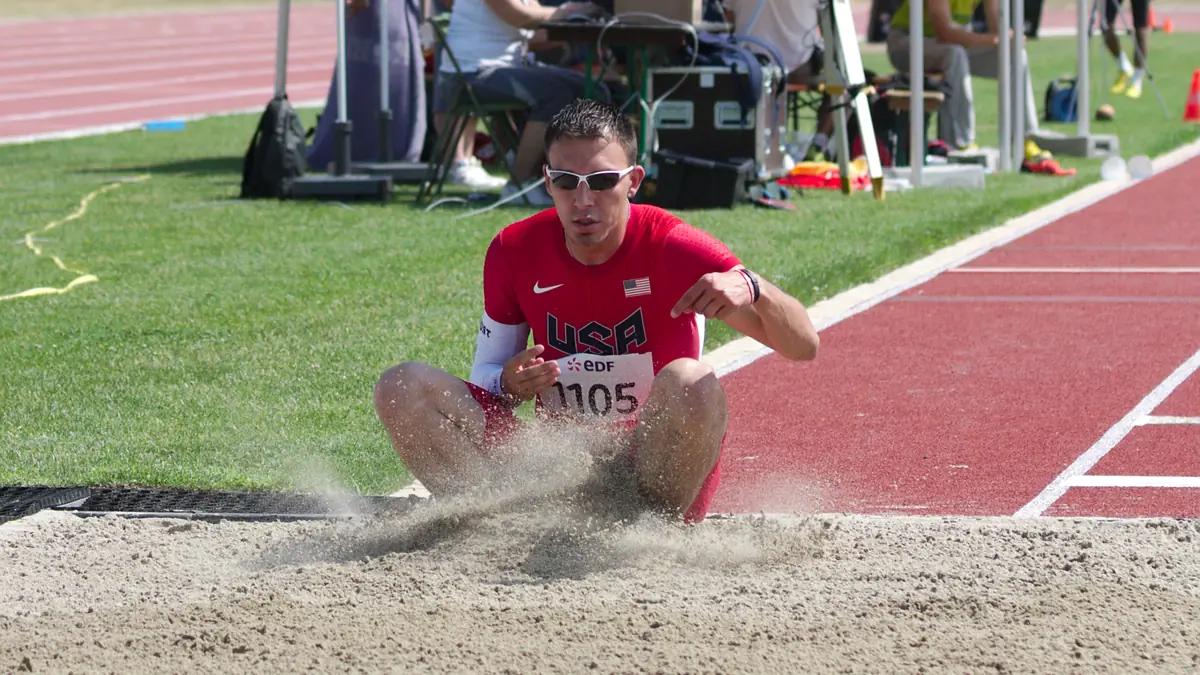
The takeoff comparison itself is where the mechanics diverge. An intact-limb takeoff sums elastic-return and active concentric force across roughly 0.10–0.15 s of contact, with the magnitude bounded by the athlete’s maximal-strength reservoir, RFD, and SSC quality [2, 3, 4]. The blade-side takeoff is dominated by the spring-and-return of the carbon-fibre composite; the energy-return ratio is fixed by the device’s geometry and material, the contact time and ground-reaction-force profile differ from the intact-limb case, and the active concentric component that an intact muscle-tendon unit would add is replaced by a passive return that depends only on what the runway approach put in. The contralateral intact limb continues to operate as a normal swing leg with its own muscle-tendon dynamics intact.
What this implies for the trainable-versus-device split is that approach speed, swing-leg dynamics, trunk and arm coordination, the ability to deliver a clean foot strike on the board, and the neuromuscular control of the asymmetric takeoff are all heavily trainable; the blade’s energy-return ratio is not. The athlete who runs faster onto the board has more energy to put into the spring and more vertical impulse on the contralateral side; the athlete whose neural control of the asymmetric plant degrades loses the timing that lets the spring return useful energy in the right direction. The integrative framing — that elite performance is the sum of subsystems aligned, not any one maximised — fits this case as precisely as it fits any able-bodied case [1, 2, 3, 4, 5].
(Performance data: World Para Athletics / IPC)
What This Means for the Reader
For a developing Para athlete or for any athlete operating with an asymmetric mechanical system, the takeaway is that the device defines a fixed return ratio while the physiology around it remains fully trainable [1, 2, 3, 4]. Approach-velocity gains, maximal-strength gains in the intact limb, plyometric conditioning of the contralateral SSC, and neuromuscular work on the asymmetric takeoff timing all move the system; the device itself does not improve with training. Three measurements diagnose the limiting variable: a sprint-mechanics profile across the approach, a maximal-strength reference for the intact lower limb relative to body mass, and a movement-quality assessment of the takeoff plant on video [3, 4, 5].
The single diagnostic question for the developing Para long jumper: when my distance plateaus, is it my approach speed, my intact-limb impulse, or my asymmetric-takeoff timing that has stopped progressing? The answer distinguishes work that the athlete can do from constraints that belong to the device.
References
- Stølen T, Chamari K, Castagna C, Wisløff U. (2005). Physiology of soccer: an update. Sports Medicine, 35(6): 501–536. doi:10.2165/00007256-200535060-00004
- Komi PV. (2000). Stretch-shortening cycle: a powerful model to study normal and fatigued muscle. Journal of Biomechanics, 33(10): 1197–1206. doi:10.1016/s0021-9290(00)00064-6
- Markovic G, Mikulic P. (2010). Neuro-musculoskeletal and performance adaptations to lower-extremity plyometric training. Sports Medicine, 40(10): 859–895. doi:10.2165/11318370-000000000-00000
- Wisløff U, Castagna C, Helgerud J, Jones R, Hoff J. (2004). Strong correlation of maximal squat strength with sprint performance and vertical jump height in elite soccer players. British Journal of Sports Medicine, 38(3): 285–288. doi:10.1136/bjsm.2002.002071
- Markovic G. (2007). Does plyometric training improve vertical jump height? A meta-analytical review. British Journal of Sports Medicine, 41(6): 349–355. doi:10.1136/bjsm.2007.035113
Performance data (descriptive only): World Para Athletics / IPC.
The Athlete in One Paragraph
Markus Rehm (b. 1988-08-22, Göppingen, Germany) is a German Para long jumper, multi-Paralympic gold medallist, and the world record holder in the T64 long jump with marks that have repeatedly extended past 8.70 m — distances that sit comfortably within the range of able-bodied Olympic…
The Physiology — what energy-return mechanics actually transform
A long jump is, mechanically, a horizontal-to-vertical conversion task: the athlete arrives at the board with a high horizontal velocity, plants the takeoff leg into the runway, and converts a fraction of that horizontal kinetic energy into the vertical and forward components that produce flight…
The Case — Rehm as the prosthesis-mechanics reference
For a 1.85 m, 81 kg Para long jumper jumping at distances that overlap the able-bodied elite range, the case is that the upstream physiology is fully present and the takeoff mechanics are different in kind, not merely in degree. Approach-velocity capacity — the upstream…
What This Means for the Reader
For a developing Para athlete or for any athlete operating with an asymmetric mechanical system, the takeaway is that the device defines a fixed return ratio while the physiology around it remains fully trainable [1, 2, 3, 4]. Approach-velocity gains, maximal-strength gains in the intact…