Preview
Hüseyin Akbulut, MSc (2026). Mikaela Shiffrin and the Eccentric Leg Strength of an Elite Alpine Ski Racer. Sporeus. Retrieved, October 21, 2026. https://sporeus.com/en/science/mikaela-shiffrin-alpine-skiing-eccentric-leg-strength/
The Athlete in One Paragraph
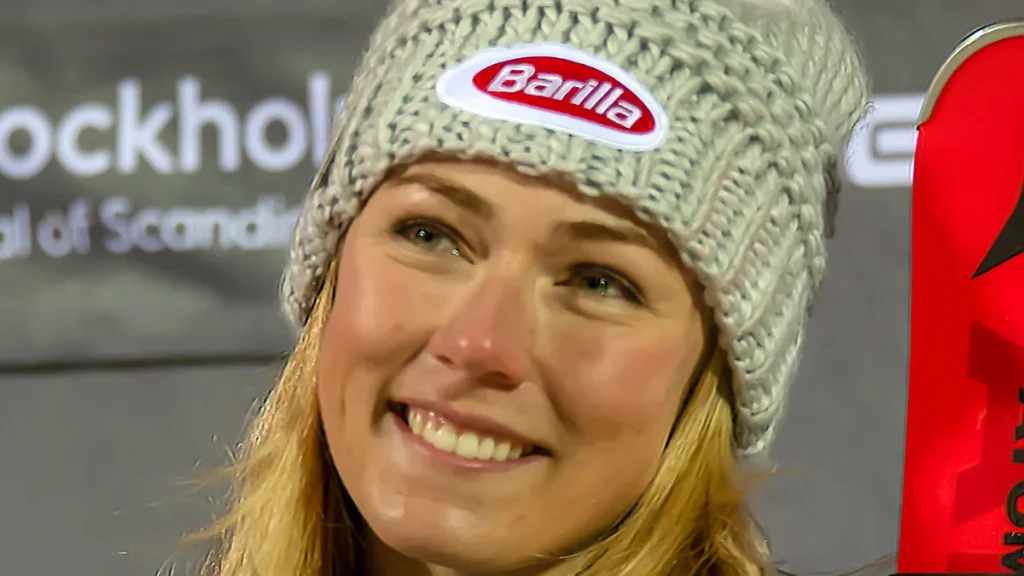
Mikaela Pauline Shiffrin (b. 13 March 1995, Vail, Colorado, United States) is an alpine ski racer for the United States Ski Team and the most-successful World Cup racer in the history of the discipline by total wins. Listed at 1.70 m and ~70 kg, she is a multi-discipline specialist whose competitive identity is built on technical events, slalom and giant slalom, alongside speed-discipline appearances; record-breaking World Cup victories sit on a profile in which the body must absorb and redirect repeated 4–5g loads through every gate of every run, often within a 50–60 second window of total race time. The interesting case for sport science is the discriminator that decides every alpine turn: eccentric leg strength, the ability of the quadriceps, hip extensors and trunk to absorb high-velocity, high-magnitude lengthening loads at every gate while continuing to produce concentric output through the next acceleration phase.
Table of Contents

The Physiology: what eccentric leg strength actually is
Skeletal muscle produces force in three modes, concentric (shortening), isometric (static) and eccentric (lengthening) and the eccentric mode is, in absolute force terms, the strongest of the three. Cormie, McGuigan and Newton’s review of maximal neuromuscular power formalised the principle that high-velocity force expression is built on a foundation of maximal strength; the muscle that cannot produce force at low velocity cannot produce force at high velocity, and the muscle that cannot absorb force eccentrically cannot redirect it concentrically [1]. For the alpine ski racer, every turn is an eccentric-concentric cycle in which the quadriceps lengthen under load to absorb the forces of the carved arc and then shorten to drive the next acceleration phase.
Wisløff and colleagues’ canonical work on maximal squat strength established the direct correlation between strength and high-velocity performance, sprint speed, vertical jump height and change-of-direction quickness all track maximal lower-limb force production [2]. The alpine equivalent is the carve: a high-quality turn at World Cup speeds (often 60–80 km/h in technical events, 100+ km/h in speed events) imposes a sustained 4–5g load on the outside leg through the apex of the turn. The skier whose maximum eccentric capacity is high can hold a tighter carve at higher speed without buckling; the skier whose capacity is lower must reduce angle or speed to stay within tolerance.
Spiteri and colleagues’ work on the mechanical determinants of change of direction extended the strength-performance link to the multi-axis case: faster directional changes require greater eccentric braking force, greater concentric propulsive force and a shorter ground-contact transition between the two [3]. The alpine analogue is the gate-to-gate transition, the sub-second window in which the racer must unweight, switch edges, reload and drive into the next turn. The eccentric capacity is the rate-limiting variable in the absorption phase; the concentric capacity is the limiter in the propulsion phase; the integration of the two is what separates the World Cup podium from the start house.
Stølen and colleagues’ soccer-physiology review supplies the aerobic-substrate scaffold that supports a 50–60 second alpine run with elevated heart-rate output, and Buchheit and Laursen’s HIIT framework supplies the recovery logic for a six-event weekend in which the racer must reproduce maximum effort across multiple runs separated by minutes rather than hours [4, 5]. The integrated profile is broader than any single training-bout can build; the calendar of competition is itself part of the periodisation.
The Case: Shiffrin as the modern alpine archetype
For a 1.70 m, 70 kg racer, the alpine arithmetic is unforgiving and clean: every kilogram of body mass increases the gravitational driver of the descent but also increases the load the lower limb must absorb at the apex of each turn, and every joule of unabsorbed energy at the apex is a joule of lost line into the next gate [1, 2]. Shiffrin’s anthropometric profile, within the technical-event band, lean, with a lower-body conditioning consistent with the World Cup archetype, sits within the physiological window the discipline rewards.
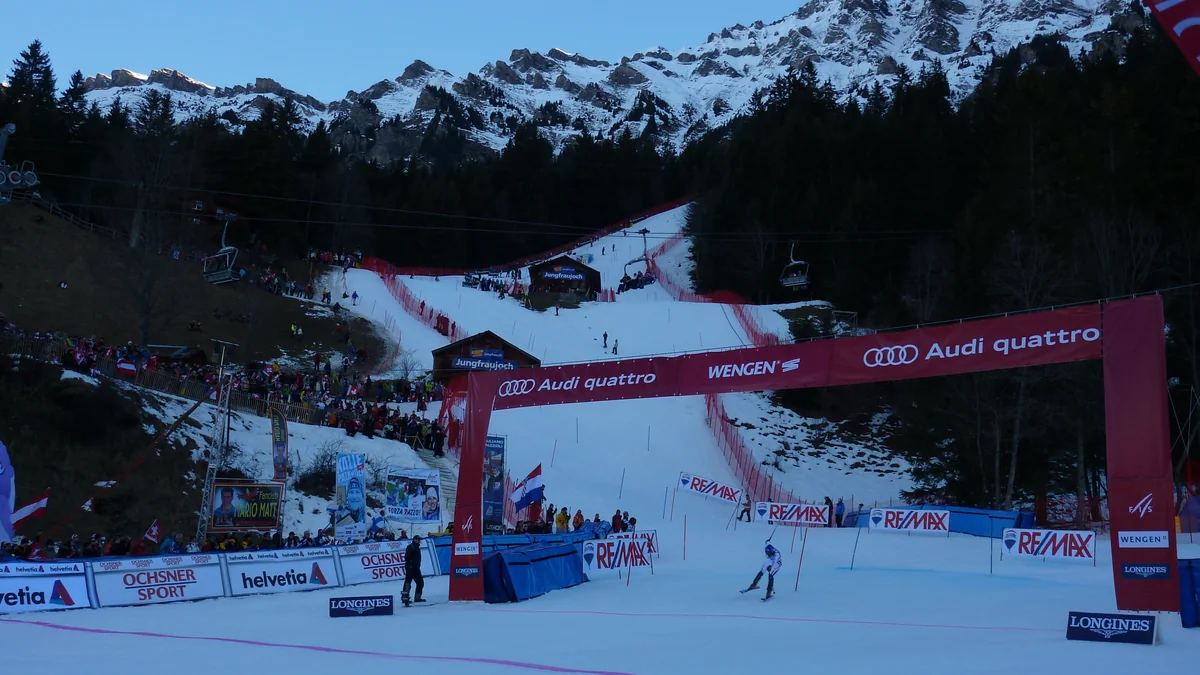
The interesting wrinkle in Shiffrin’s case is range across disciplines: technical events demand high-frequency turns at moderate speed; speed events demand fewer, longer turns at higher speed and higher absolute load. The eccentric capacity that protects the knee at slalom speeds is the same capacity that protects the knee at downhill speeds, but the loading rhythm differs, short, repeated, high-frequency in slalom; longer, rarer, higher-amplitude in downhill [1, 3]. The racer who competes across the disciplines has to develop both ends of the eccentric loading spectrum without letting either collapse, which is a periodisation problem more than a strength problem.
The recovery dimension is the unspoken constraint underneath the technique. Buchheit and Laursen’s principle, that aerobic ceiling supports faster recovery between supra-threshold efforts, applies directly to a six-event World Cup weekend in which the racer must reproduce peak eccentric output across multiple runs [5]. Shiffrin’s record-breaking longevity at the top of the World Cup standings is consistent with a racer whose eccentric capacity, aerobic ceiling and recovery infrastructure are integrated rather than developed in isolation [4, 5].
(Performance data: FIS Alpine Ski World Cup)
What This Means for the Reader
For the amateur skier, the takeaway is that eccentric leg strength is the variable that protects the knee on a long descent and the variable that determines how late in the day technique survives. The relevant test is not the squat one-rep maximum but the slow descent under load, the controlled, lengthening-phase quality of a heavy box step-down or a Nordic hamstring curl [1, 2].
The training implication is that eccentric capacity is best built deliberately, with prescribed tempo on the lengthening phase and progressive load over months rather than weeks. Cormie’s framework, that maximal power emerges from a base of maximal strength, extends to the eccentric domain: high-velocity eccentric absorption is built on a foundation of high-load slow eccentric work [1, 3]. The amateur who chases plyometrics without first building the eccentric base typically pays in patellar-tendon and hamstring strain.
The diagnostic question for the developing skier or change-of-direction athlete: when you descend a heavy load slowly under control, can you hold the lengthening phase smoothly, or does the bar collapse the last few centimetres? The smoothness, not the load, is the predictor of how the next steep turn ends.
References
- Cormie P, McGuigan MR, Newton RU. (2011). Developing maximal neuromuscular power: Part 1, biological basis of maximal power production. Sports Medicine, 41(1): 17–38. doi:10.2165/11537690-000000000-00000
- Wisløff U, Castagna C, Helgerud J, Jones R, Hoff J. (2004). Strong correlation of maximal squat strength with sprint performance and vertical jump height in elite soccer players. British Journal of Sports Medicine, 38(3): 285–288. doi:10.1136/bjsm.2002.002071
- Spiteri T, Newton RU, Binetti M, Hart NH, Sheppard JM, Nimphius S. (2015). Mechanical determinants of faster change of direction and agility performance in female basketball athletes. Journal of Strength and Conditioning Research, 29(8): 2205–2214. doi:10.1519/JSC.0000000000000876
- Stølen T, Chamari K, Castagna C, Wisløff U. (2005). Physiology of soccer: an update. Sports Medicine, 35(6): 501–536. doi:10.2165/00007256-200535060-00004
- Buchheit M, Laursen PB. (2013). High-intensity interval training, solutions to the programming puzzle. Sports Medicine, 43(5): 313–338. doi:10.1007/s40279-013-0029-x
Performance data (descriptive only): FIS Alpine Ski World Cup.
Discuss this in the forum: Trail running descents: technique and leg preparation · Eccentric training: what is it good for?

Hüseyin Akbulut is the founder of Sporeus and author of THRESHOLD (EŞİK), a 540-page Turkish-language book on endurance science.
- 540pp THRESHOLD Book
- MSc Sport Sciences
- Marmara University
The Athlete in One Paragraph
Mikaela Pauline Shiffrin (b. 13 March 1995, Vail, Colorado, United States) is an alpine ski racer for the United States Ski Team and the most-successful World Cup racer in the history of the discipline by total wins. Listed at 1.70 m and ~70 kg, she…
The Physiology: what eccentric leg strength actually is
Skeletal muscle produces force in three modes, concentric (shortening), isometric (static) and eccentric (lengthening) and the eccentric mode is, in absolute force terms, the strongest of the three. Cormie, McGuigan and Newton's review of maximal neuromuscular power formalised the principle that high-velocity force expression is…
The Case: Shiffrin as the modern alpine archetype
For a 1.70 m, 70 kg racer, the alpine arithmetic is unforgiving and clean: every kilogram of body mass increases the gravitational driver of the descent but also increases the load the lower limb must absorb at the apex of each turn, and every joule…
What This Means for the Reader
For the amateur skier, the takeaway is that eccentric leg strength is the variable that protects the knee on a long descent and the variable that determines how late in the day technique survives. The relevant test is not the squat one-rep maximum but the…