Preview
Hüseyin Akbulut, MSc (2026). Jannik Sinner and the Tall Baseliner Court Coverage Economy of an Elite Tennis Player. Sporeus. Retrieved, September 26, 2026. https://sporeus.com/en/science/jannik-sinner-tall-baseliner-court-coverage-economy/
The Athlete in One Paragraph
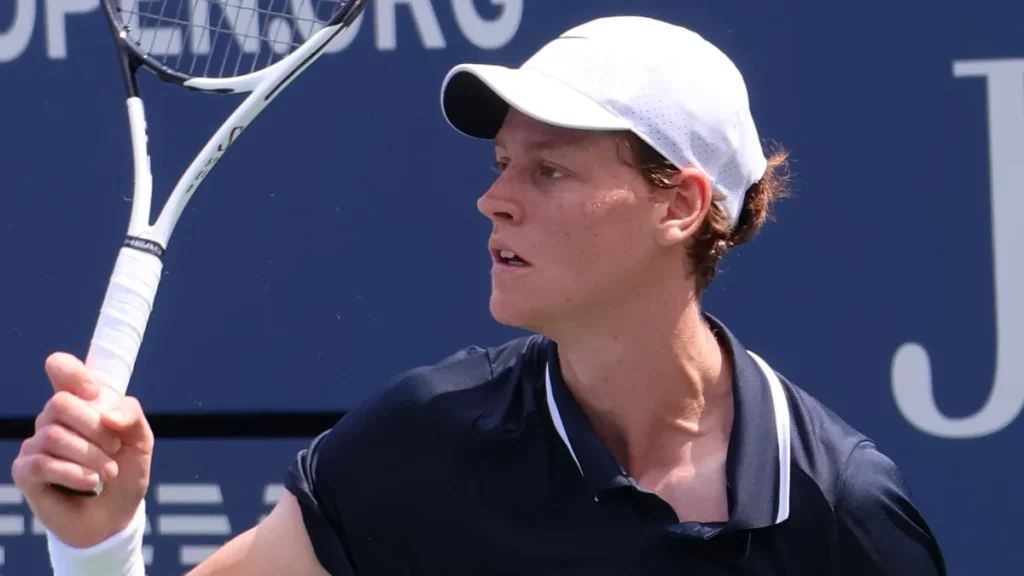
Jannik Sinner (b. 2001-08-16, San Candido, South Tyrol, Italy) is a professional tennis player on the ATP tour and a long-standing member of the Italy Davis Cup squad. Listed at 1.91 m and ~76 kg, he sits among the tallest of the modern world-number-one cohort, with a baseliner game built on flat, deep groundstrokes and an uncommon willingness to take the ball on the rise. The interesting case for sport science is not any single forehand or any single backhand drive but the geometry problem hidden inside his anthropometry: a 6’4″ body must cover a court whose dimensions were standardised when men were considerably shorter, with lateral-coverage demands that punish long levers and deceleration costs that scale with body mass. The variable underneath that story is tall-baseliner court coverage economy — how stride architecture, change-of-direction mechanics, eccentric-strength reserve, and shot-preparation efficiency interact to let a tall player move laterally as economically as a shorter one.
Table of Contents

The Physiology — what tall-baseliner court coverage economy actually involves
The intermittent high-intensity profile of professional tennis sits inside the framework Stølen, Chamari, Castagna and Wisløff describe for soccer: repeated short sprints, decelerations, lateral cuts and submaximal aerobic ticking-over between points [1]. For a tall player the demand is the same demand the shorter player faces — but the per-action cost is higher. Long levers produce greater rotational inertia about the centre of mass, so the deceleration and re-acceleration around each lateral cut costs more energy and more eccentric work per metre covered.
Sheppard, Young, Doyle, Sheppard and Newton’s foundational paper on reactive agility distinguished closed-skill change-of-direction from open-skill reactive cuts: both share the mechanical substrate of the plant-and-push, but the open-skill version adds the perceptual decision cost on top [2]. For a baseliner anticipating the opponent’s shot and committing to a wide cover, the cost is a function of how early the cue is read; for a tall player, the same late-cue read has a larger consequence because the rotational inertia of the long body is harder to redirect once it is moving the wrong way.
Young and Farrow’s review of agility components emphasised that change-of-direction performance is not a single trait but a stack: stride mechanics, eccentric capacity, perceptual reading, and decision speed [3]. Tall players who cover well do not violate this stack — they optimise it differently, trading a longer stride length for fewer ground contacts, but paying for that with higher eccentric demand at each plant.
Bangsbo, Mohr and Krustrup’s account of intermittent match-running in soccer is read here as a description of the aerobic-anaerobic substrate underneath repeated lateral coverage: when the aerobic engine is large, the per-rally recovery during the sub-maximal phases between high-intensity actions is faster, and the within-set decline in coverage is shallower [4]. For a tall player whose per-action cost is higher, the aerobic substrate is the silent margin that prevents the higher cost from compounding into late-set collapse.
Wisløff, Castagna, Helgerud, Jones and Hoff’s classic on maximal squat strength, sprint and jump correlations supplies the strength-reserve substrate [5]. The same maximal-strength platform that produces a faster sprint produces a more economical deceleration, because the eccentric capacity to absorb the braking forces of a wide cut scales with the maximal-strength platform underneath it. For a tall player the strength reserve is not a luxury — it is the load-bearing layer of the coverage economy.
The takeaway is that tall-baseliner court coverage is not a simple anthropometric handicap to be overcome; it is a different optimisation, paid for with eccentric strength, perceptual sharpness, and aerobic substrate, all of which are trainable.
The Case — Sinner as tall-baseliner coverage exemplar
For a 1.91 m / 76 kg ATP player whose lateral coverage is observably above the norm for his height bracket, the underlying profile is consistent with a coverage economy that has been engineered against, rather than around, his anthropometry [2, 3]. The publicly visible elements of his game — the deep court position that converts wide angles into smaller running distances, the shot preparation that begins early enough to commit the body before the opponent’s contact, and the recovery footwork that returns him to the centre line economically — map onto exactly the components Young and Farrow named in the agility stack, optimised for a long-lever body.
The strength-reserve layer is the under-discussed one. A 1.91 m baseliner who decelerates well on a wide cut has paid for that capacity with the kind of maximal-strength platform that Wisløff and colleagues describe — squat-strength reserve and posterior-chain eccentric capacity that allow the long lever to brake without buckling at the knee or rolling at the ankle [5]. The visible economy is the surface; the strength reserve is the substrate.
The aerobic-substrate layer matters across the set. A larger aerobic engine accelerates the sub-maximal recovery between points, which means the per-rally cost is paid down faster, which means the within-set decline is shallower [1, 4]. For a tall player whose per-action cost is higher, this margin is not a luxury — it is what prevents the higher cost from compounding into late-set fatigue.
The reactive-agility layer interacts with the perceptual-cognitive game. A tall body that has read the cue late has paid a larger cost than a shorter body that has read the cue late, because the rotational inertia is harder to redirect [2]. A tall player who covers well is therefore disproportionately reliant on early cue-reading and pattern recognition; the visible signature of an economical tall baseliner is the anticipation, not the speed.
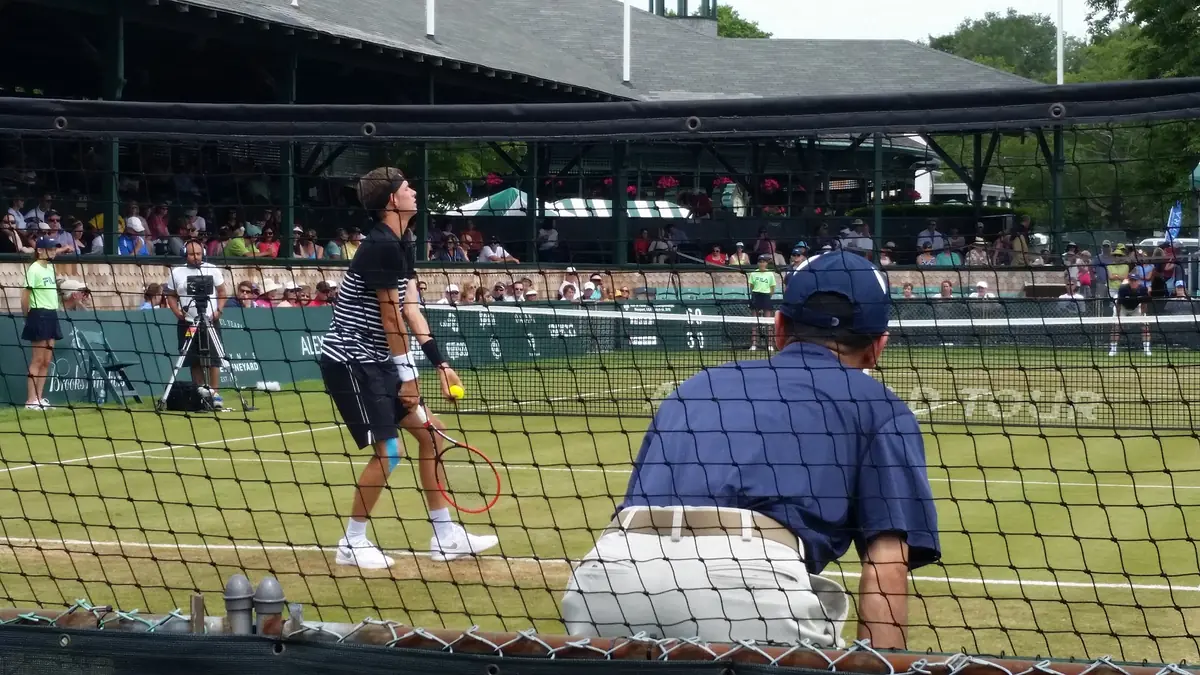
(Match data: ATP) Sinner’s per-rally and per-set coverage metrics, as well as his late-set first-serve and groundstroke retention, sit at or above ATP top-five norms, with the discriminator being his deceleration and recovery economy rather than peak top-end pace.
What This Means for the Reader
For a developing tall player or any baseliner working on coverage economy, the lesson is that height is not the constraint — eccentric capacity, perceptual reading, and aerobic substrate are the constraints, and all three are trainable [1, 2, 3, 4, 5]. The shorter player’s lower per-action cost is a starting advantage; it is not a permanent ceiling.
Practical assessment: track three indicators across the season — a change-of-direction reference test (a modified 505 with bilateral comparison), an eccentric-strength benchmark (Nordic hamstring or single-leg deceleration test), and a sub-maximal aerobic reference (five-minute steady-state heart-rate at a fixed pace). Drift in any of the three is the early signal that the coverage economy is moving the wrong way.
The diagnostic question for the tall player: am I paying for my length with the eccentric strength and aerobic substrate that lets me cover the court as cheaply as a shorter player, or am I quietly absorbing a per-action tax that the third set will collect on?
References
- Stølen T, Chamari K, Castagna C, Wisløff U. (2005). Physiology of soccer: an update. Sports Medicine, 35(6): 501–536. doi:10.2165/00007256-200535060-00004
- Sheppard JM, Young WB, Doyle TLA, Sheppard TA, Newton RU. (2006). An evaluation of a new test of reactive agility and its relationship to sprint speed and change of direction speed. Journal of Science and Medicine in Sport, 9(4): 342–349. doi:10.1016/j.jsams.2006.05.019
- Young WB, Farrow D. (2006). A review of agility: Practical applications for strength and conditioning. Strength and Conditioning Journal, 28(5): 24–29. doi:10.1519/00126548-200610000-00004
- Bangsbo J, Mohr M, Krustrup P. (2006). Physical and metabolic demands of training and match-play in the elite football player. Journal of Sports Sciences, 24(7): 665–674. doi:10.1080/02640410500482529
- Wisløff U, Castagna C, Helgerud J, Jones R, Hoff J. (2004). Strong correlation of maximal squat strength with sprint performance and vertical jump height in elite soccer players. British Journal of Sports Medicine, 38(3): 285–288. doi:10.1136/bjsm.2002.002071
Match-context data (descriptive only): ATP.
The Athlete in One Paragraph
Jannik Sinner (b. 2001-08-16, San Candido, South Tyrol, Italy) is a professional tennis player on the ATP tour and a long-standing member of the Italy Davis Cup squad. Listed at 1.91 m and ~76 kg, he sits among the tallest of the modern world-number-one cohort,…
The Physiology — what tall-baseliner court coverage economy actually involves
The intermittent high-intensity profile of professional tennis sits inside the framework Stølen, Chamari, Castagna and Wisløff describe for soccer: repeated short sprints, decelerations, lateral cuts and submaximal aerobic ticking-over between points [1]. For a tall player the demand is the same demand the shorter player…
The Case — Sinner as tall-baseliner coverage exemplar
For a 1.91 m / 76 kg ATP player whose lateral coverage is observably above the norm for his height bracket, the underlying profile is consistent with a coverage economy that has been engineered against, rather than around, his anthropometry [2, 3]. The publicly visible…
What This Means for the Reader
For a developing tall player or any baseliner working on coverage economy, the lesson is that height is not the constraint — eccentric capacity, perceptual reading, and aerobic substrate are the constraints, and all three are trainable [1, 2, 3, 4, 5]. The shorter player's…